What is the Halstead-Reitan battery? The classic fixed neuropsychological test set | Riot IQ
Aug 31, 2026·Specific IQ Tests & Formats
What is the Halstead-Reitan battery? The classic fixed neuropsychological test set
The Halstead-Reitan battery is a fixed set of eight tests built by Ward Halstead and Ralph Reitan to detect brain damage. Learn how it works and scores. (152 chars)
Dr. Russell T. WarneChief Scientist
Share
The Halstead-Reitan Neuropsychological Battery is a fixed set of eight tests that clinicians have used since the mid-twentieth century to detect brain damage and describe how it affects thinking, perception, and movement. Ward Halstead began building the tests at the University of Chicago in the 1930s and 1940s, and his student Ralph Reitan spent the following decades validating and extending them into a standardized battery. It is the best-known example of the "fixed battery" approach, in which every patient completes the same full set of tests. This article explains what the battery contains, how it is scored, why it mattered to the history of clinical neuropsychology, and why most practitioners today work differently.
Where the Halstead-Reitan battery came from
Ward Halstead opened a laboratory at the University of Chicago in the 1930s to study patients with brain injuries, and he took an unusually practical approach for his era. According to a 1994 historical review by Ralph Reitan in the Journal of Clinical Psychology, Halstead worked closely with neurological surgeons and observed brain-damaged patients in their everyday living situations to identify the real problems they experienced, rather than relying on theory alone. Over a twelve-year period from 1935 to 1947 he administered an experimental battery of tests to 50 patients who had undergone cerebral lobectomy (28 of them frontal) along with 187 other experimental and control subjects. He published the results in 1947 in the book Brain and Intelligence: A Quantitative Study of the Frontal Lobes.
Halstead's central insight was that a conventional IQ test alone could not capture the range of abilities that brain damage disrupts. Patients with serious lesions sometimes scored normally on intelligence tests while failing badly at abstraction, sensory perception, or motor tasks. He therefore built tasks that sampled a much wider range of brain functions.
Ralph Reitan (1922 to 2014) trained in Halstead's laboratory and then, in the early 1950s, established his own laboratory at Indiana University Medical Center. Reitan's contribution was relentless empirical validation. At Halstead's suggestion he made a practice of interpreting test results "blind," meaning he knew nothing about the patient beyond the scores, and then checked his conclusions against the neurological findings. Reitan reported in his 1994 review that this program of research showed the battery to be sensitive to a broad range of neurological variables, including the location, type, and status of a brain lesion. Tribute articles in Archives of Clinical Neuropsychology after his death in 2014 credit him as a pioneer who helped put clinical neuropsychology on a scientific footing. The battery is one branch of the broader field covered in our guide to what neuropsychological testing is.
The core tests in the battery
Descriptions of the adult battery, such as the entry in the Gale Encyclopedia of Mental Disorders, list eight core tests. The full administration typically takes about five to six hours, which is one reason the battery is demanding for both patients and examiners.
• Category Test: a measure of abstraction and concept formation. The examinee views a series of figures and must discover the underlying rule from feedback about right and wrong answers, a task that requires flexible reasoning rather than learned knowledge.
• Tactual Performance Test: a formboard task completed without vision. The examinee places shaped blocks into a board by touch alone, first with the dominant hand, then the non-dominant hand, then both, and afterwards draws the board from memory. It measures tactile perception, motor skill, and incidental memory.
• Seashore Rhythm Test: the examinee listens to pairs of rhythmic patterns and judges whether they are the same or different, a measure of auditory attention and nonverbal perception.
• Speech Sounds Perception Test: the examinee hears spoken nonsense syllables and matches them to written alternatives, testing sustained attention and the link between hearing and language.
• Finger Tapping Test: a simple motor speed task in which the examinee taps a key as fast as possible with each index finger. Comparing the two hands helps identify which side of the brain may be affected.
• Trail Making Test: a paper-and-pencil task of connecting numbered and lettered circles in sequence. It began life outside the battery, in a United States Army test set from 1944, and Reitan adapted it for clinical use around 1950 after finding it highly sensitive to brain damage. We describe it in detail in our article on the Trail Making Test.
• Aphasia Screening Test: a brief survey of language functions such as naming, reading, writing, and following directions, used to flag language disturbances for further workup.
• Sensory-Perceptual Examination: procedures that check whether the examinee perceives touch, sound, and visual stimuli on each side of the body, including under simultaneous stimulation.
The Halstead Impairment Index
Halstead wanted a single summary number that expressed how much of the battery fell in the brain-damaged range, and the result is the "Halstead Impairment Index." According to the Gale encyclopedia entry, the index is calculated by counting the number of tests on which the examinee scored in the impaired range and dividing by the number of tests administered. The result runs from 0.0 to 1.0. Scores of roughly 0.0 to 0.2 are considered normal, 0.3 to 0.4 suggest mild impairment, 0.5 to 0.7 suggest moderate impairment, and 0.8 to 1.0 suggest severe impairment.
The index was an early example of treating test data actuarially, meaning that fixed scoring rules, rather than clinical impressions, drive the conclusion. A single index has obvious limits, though. Two patients with the same index can have very different problems, so skilled examiners always interpreted the full pattern of scores alongside the summary number.
How the traditional battery paired with an IQ test and the MMPI
The Halstead-Reitan battery was rarely given by itself. In the traditional approach, examiners administered a Wechsler intelligence scale alongside it to establish the patient's general intellectual level, and often added the Minnesota Multiphasic Personality Inventory (MMPI) to assess emotional functioning and personality. The Gale encyclopedia entry describes these as ancillary measures that examiners may administer with the core battery. The combination made sense: the Wechsler Adult Intelligence Scale told the clinician how the patient compared with the general population on overall ability, the MMPI helped separate emotional contributions from neurological ones, and the Halstead-Reitan tests probed the specific functions that brain damage disrupts.
This package played a large historical role. Before modern brain imaging existed, a referral question was often literal: does this patient have a brain lesion, and if so, where? Reitan's validation research showed the battery could contribute usefully to those questions. In that sense the battery helped establish clinical neuropsychology as a recognized specialty with its own methods and evidence base.
Why the field moved to flexible batteries
Most neuropsychologists today do not administer the full Halstead-Reitan battery. The StatPearls clinical reference on neuropsychological assessment states that "flexible" test batteries, in which the clinician selects tests case by case around a core set, are more common, and that fixed battery approaches such as the Halstead-Reitan are now less common. Large surveys of practicing neuropsychologists point the same way. A 2005 survey of 747 North American doctorate-level neuropsychologists by Rabin, Barr, and Burton found that the most frequently used instruments were the Wechsler intelligence and memory scales, followed by the Trail Making Test and the California Verbal Learning Test, a list that reflects flexible test selection rather than the fixed battery. A ten-year follow-up survey published in 2016 found the same top five tests in the same order.
Several forces drove the shift. CT and MRI scans took over the job of locating lesions, so referral questions moved toward describing strengths, weaknesses, and everyday functioning. A five-to-six-hour fixed battery is expensive and exhausting when a shorter, targeted set can answer the actual question, and newer tests arrived with larger, more current normative samples. Individual Halstead-Reitan tests still appear in practice, with the Trail Making Test in particular remaining a popular selection within flexible batteries.
Where the RIOT IQ test fits
The Halstead-Reitan battery and an IQ test answer different questions. The battery was built to detect and characterize brain dysfunction, while an intelligence test measures general cognitive ability, so someone curious about their own thinking skills wants the latter. The RIOT IQ test, developed by RIOT IQ with psychometrician Dr. Russell T. Warne, is an online option for adults 18 and older. Its full name is the Reasoning and Intelligence Online Test, and it includes 15 subtests across six cognitive indices: verbal reasoning, fluid reasoning, spatial ability, working memory, processing speed, and reaction time. It takes about 52 minutes and reports scores on the familiar scale with a mean of 100 and a standard deviation of 15.
An online IQ test does not replace an individually administered diagnostic evaluation, and it does not screen for brain injury or neurological disease; for medical concerns, see a neuropsychologist. For a careful, research-based measure of your cognitive abilities, you can take the RIOT IQ test at riotiq.com.
FAQ
Is the Halstead-Reitan battery still used today?
Yes, but far less than it once was. Clinical references note that flexible batteries are now more common than fixed batteries like the Halstead-Reitan, though several of its component tests remain popular on their own.
How long does the Halstead-Reitan battery take?
The core battery takes about five to six hours, and the traditional workup added a Wechsler scale and often the MMPI, which could stretch testing across multiple sessions.
What is the Halstead Impairment Index?
It is a summary score computed as the proportion of battery tests on which a person scored in the impaired range, running from 0.0 to 1.0. Values around 0.5 and above have traditionally been read as indicating meaningful impairment.
Is the Halstead-Reitan battery an IQ test?
No. It measures functions related to brain integrity, such as abstraction, sensory perception, attention, and motor speed. In the traditional approach an IQ test, usually a Wechsler scale, was administered alongside it to measure general intelligence.
Who were Halstead and Reitan?
Ward Halstead was a University of Chicago researcher who developed the original tests between 1935 and 1947 and published Brain and Intelligence in 1947. Ralph Reitan, who trained in Halstead's laboratory, validated and expanded the tests into the standardized battery and became one of the founders of American clinical neuropsychology.
Can I take the Halstead-Reitan battery online?
No. It is an in-person clinical battery that requires special equipment, such as the tactual performance formboard, and a trained examiner. Online tests can measure general cognitive ability but cannot substitute for a clinical neuropsychological evaluation.
References
1. Halstead, W. C. (1947). Brain and intelligence: A quantitative study of the frontal lobes. University of Chicago Press. digitalcommons.rockefeller.edu
2. Reitan, R. M. (1994). Ward Halstead's contributions to neuropsychology and the Halstead-Reitan Neuropsychological Test Battery. Journal of Clinical Psychology, 50(1), 47-70. pubmed.ncbi.nlm.nih.gov
3. Hom, J., %26 Nici, J. (2015). Ralph M. Reitan: The pioneer of clinical neuropsychology. Archives of Clinical Neuropsychology, 30(8), 724-732. academic.oup.com
4. Gale Encyclopedia of Mental Disorders. (n.d.). Halstead-Reitan Battery. Encyclopedia.com. encyclopedia.com
5. Rabin, L. A., Barr, W. B., %26 Burton, L. A. (2005). Assessment practices of clinical neuropsychologists in the United States and Canada: A survey of INS, NAN, and APA Division 40 members. Archives of Clinical Neuropsychology, 20(1), 33-65. pubmed.ncbi.nlm.nih.gov
6. Rabin, L. A., Paolillo, E., %26 Barr, W. B. (2016). Stability in test-usage practices of clinical neuropsychologists in the United States and Canada over a 10-year period. Archives of Clinical Neuropsychology, 31(3), 206-230. pubmed.ncbi.nlm.nih.gov
7. Schaefer, L. A., Thakur, T., %26 Meager, M. R. (2023). Neuropsychological assessment. StatPearls Publishing. ncbi.nlm.nih.gov
8. Millisecond Software. (n.d.). Trail Making Test. Inquisit test library. millisecond.com
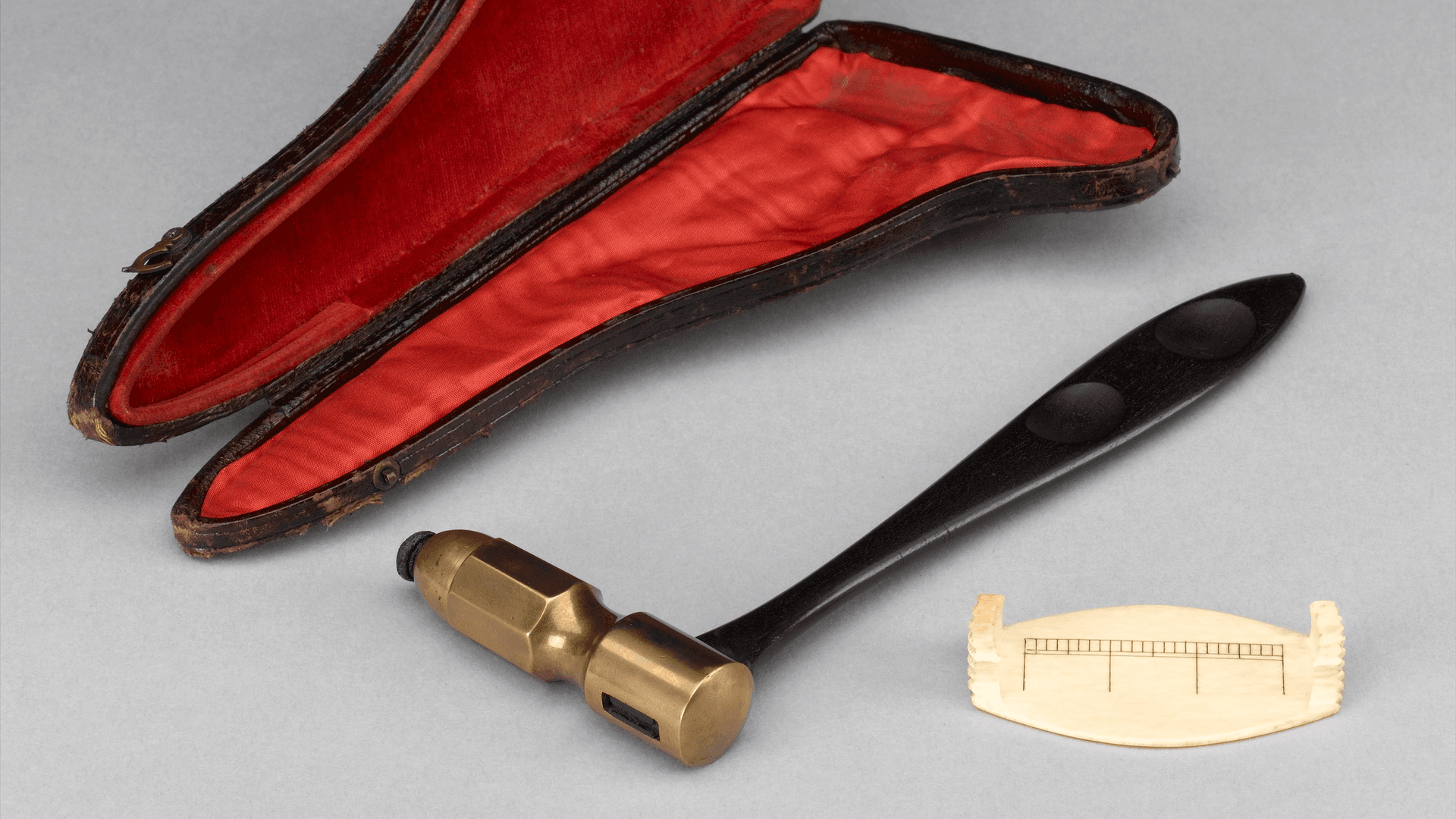
Percussor and pleximeter, cased, England, 1831-1920. Wellcome Collection, via Wikimedia Commons (CC BY 4.0)
Take our professional IQ test
Want to know your IQ? Try the first ever professional online IQ test.