What is the Stroop test? The 1935 color-word experiment, the interference effect, what it measures, and how clinicians and researchers use it today.
Dr. Russell T. WarneChief Scientist
Share
The Stroop test asks you to name the ink color of words that spell a different color name, such as the word RED printed in blue ink. The delay that conflict causes, known as the "Stroop effect," is one of the most replicated findings in psychology, first published by J. Ridley Stroop in 1935. The test measures "interference control," the ability to suppress an automatic response in favor of a deliberate one. It is a staple of attention and executive function assessment, and, despite a common misconception, it is not an IQ test. This article covers the original experiment, what the test measures, and how it is used today.
The original 1935 experiment
Stroop ran his experiments at George Peabody College and published them as "Studies of Interference in Serial Verbal Reactions" in the Journal of Experimental Psychology (volume 18, pages 643 to 662). He was building on an old observation, going back to Cattell in 1886, that people can read a color word faster than they can name a color. His innovation was to put the two in direct conflict.
The result was dramatic. Naming the ink colors of 100 words that each spelled a different color name took his subjects 47.0 seconds longer than naming 100 plain color patches, an increase of 74.3 percent. The full 1935 paper is freely available in York University's Classics in the History of Psychology archive, and the effect it reports has been reproduced in classrooms and laboratories ever since.
Why the interference happens
For a literate adult, reading is automatic. The word's meaning arrives whether you want it or not, and it arrives faster than the ink color can be named, so the two responses collide and the automatic one must be suppressed. The interference is strikingly one-sided: in Stroop's first experiment, conflicting ink colors barely slowed word reading, while conflicting words massively slowed color naming. That asymmetry, automatic process intruding on controlled process, is the heart of the effect. MacLeod's 1991 review in Psychological Bulletin, covering half a century of research, catalogs how stubbornly it resists practice and clever strategies.
What the Stroop test measures
Inhibition and interference control
In its modern form as the Stroop Color and Word Test, the instrument is used to assess the ability to inhibit "cognitive interference," which arises when processing one feature of a stimulus impedes processing another feature of the same stimulus. Suppressing the word to name the ink is a clean laboratory model of that everyday skill.
Attention, speed, and flexibility
The research literature also treats Stroop performance as an index of selective attention, processing speed, cognitive flexibility, and working memory. Unlike a simple reaction time task, which measures raw speed with no conflict to resolve, the Stroop test measures speed under interference, which is why it carries information those purer tasks do not.
Is the Stroop test an IQ test?
No. The Stroop test measures a specific executive process, and IQ tests measure broad reasoning ability across many domains. The two are related, since executive control and intelligence correlate, but they are not interchangeable, and Stroop scores play no role in IQ scoring. Stroop-type interference tasks belong to clinical and research batteries that profile attention and executive function.
How the test is administered and scored
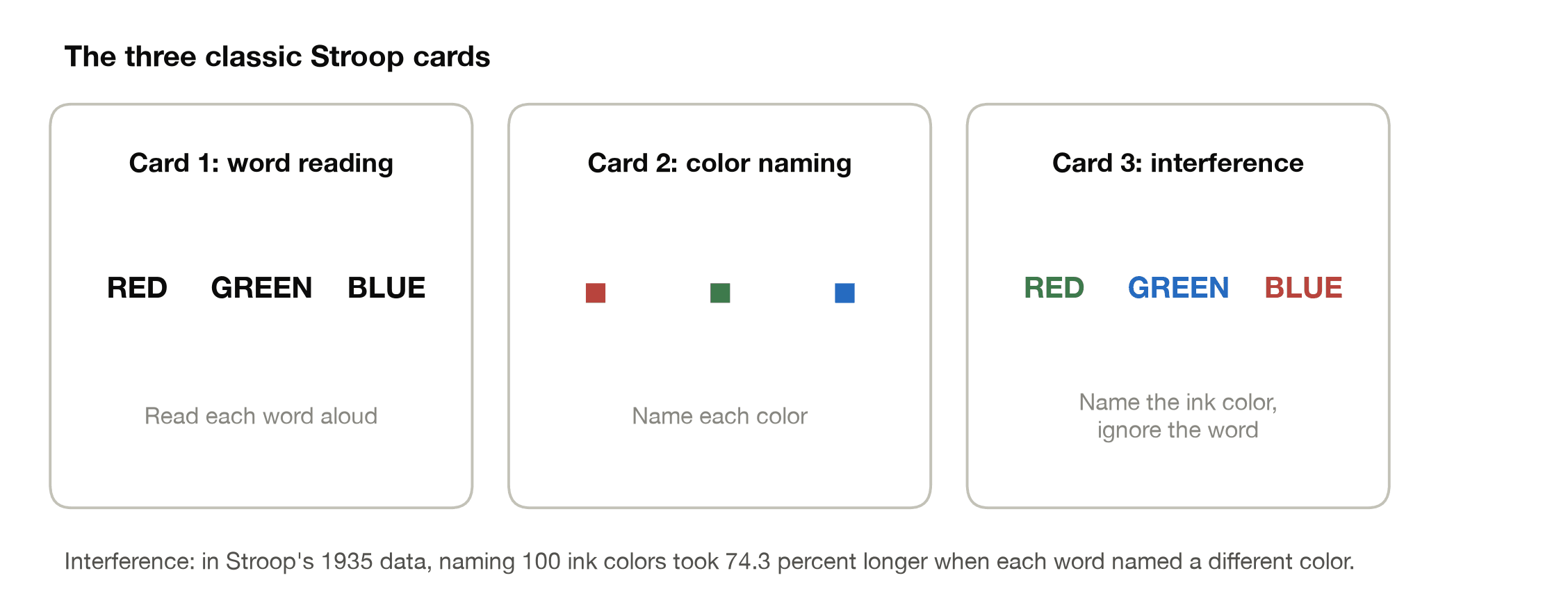
The classic format uses three cards. On the first, the person reads color words printed in black ink. On the second, they name plain color patches. On the third, the incongruent card, they name the ink colors of mismatched color words. Computerized versions present one trial at a time instead of full cards.
Scoring varies by version. Some time each card, some count correct answers within a fixed time, and some compute an "interference score" from the difference between the incongruent condition and the baseline conditions. Because administration and scoring differ across versions and languages, there is no single universal norm, and clinicians interpret results against normative data for the exact version they gave.
Clinical and research uses
The Stroop test earns its keep in neuropsychological testing, where interference control is exactly what an examiner wants to isolate. Research reviewed by Scarpina and Tagini found that patients with frontal lobe lesions and patients with Parkinson's disease show significant impairments on the incongruent condition in accuracy, though not in speed. Findings like these make the test useful for profiling attention and inhibition problems, always alongside other measures such as memory tests rather than on its own.
Modern variants
Researchers have spun the interference logic into many forms: the "emotional Stroop," which uses emotionally charged words, the counting or number Stroop, and the spatial Stroop, among others. The variants share the core conflict design while measuring different content, and their scores are only comparable within the same version, which is worth remembering whenever two Stroop results are set side by side.
Frequently asked questions
What does the Stroop test actually measure?
Primarily the ability to inhibit cognitive interference: suppressing an automatic response, reading, in order to perform a controlled one, naming the ink color. Researchers also use it as an index of selective attention, processing speed, and cognitive flexibility.
Why is the Stroop effect so hard to overcome?
Because reading is automatic for literate adults. The word's meaning is processed faster than the ink color can be named. In Stroop's original data, naming 100 incongruent ink colors took 47 seconds longer, a 74.3 percent slowdown compared with naming plain color patches.
Is the Stroop test an IQ test?
No. It is a neuropsychological measure of a specific executive process, interference control. IQ batteries sample reasoning across many domains, while Stroop-style tasks live in clinical and research batteries that assess attention and executive function.
What is a normal Stroop test score?
There is no single universal score. Versions differ in timing, item counts, and scoring method, and norms depend on the version, language, and age group, so clinicians interpret results against version-specific normative data.
What do doctors use the Stroop test for?
It is widely used in neuropsychological assessment of conditions involving frontal or executive dysfunction. Patients with frontal lobe lesions and Parkinson's disease make significantly more errors on the incongruent condition, which helps profile attention and inhibition problems alongside other measures.
The takeaway
The Stroop test is a small, elegant instrument that measures one important thing: what happens when an automatic habit collides with a deliberate goal. It tells you about interference control, and it does not tell you how well you reason. For that broader question, a full-scale instrument is the right tool. The Reasoning and Intelligence Online Test from RIOT IQ measures reasoning across multiple domains with modern norms, and you can take the free IQ test to see how broad measurement differs from a single task.
References
1. MacLeod, C. M. (1991). Half a century of research on the Stroop effect: An integrative review. Psychological Bulletin, 109(2), 163-203. doi.org/10.1037/0033-2909.109.2.163
2. Scarpina, F., & Tagini, S. (2017). The Stroop Color and Word Test. Frontiers in Psychology, 8, 557. doi.org/10.3389/fpsyg.2017.00557
3. Stroop, J. R. (1935). Studies of interference in serial verbal reactions. Journal of Experimental Psychology, 18(6), 643-662. psychclassics.yorku.ca
4. Woods, D. L., Wyma, J. M., Yund, E. W., Herron, T. J., & Reed, B. (2015). Factors influencing the latency of simple reaction time. Frontiers in Human Neuroscience, 9, 131. doi.org/10.3389/fnhum.2015.00131