What is the CTONI-2? The Comprehensive Test of Nonverbal Intelligence explained | Riot IQ
Aug 31, 2026·Specific IQ Tests & Formats
What is the CTONI-2? The Comprehensive Test of Nonverbal Intelligence explained
The CTONI-2 is PRO-ED's nonverbal intelligence test for ages 6 to 89. Learn what its six subtests measure, how scoring works, and where its limits lie.
Dr. Russell T. WarneChief Scientist
Share
The CTONI-2, short for the Comprehensive Test of Nonverbal Intelligence, Second Edition, is an individually administered intelligence test that measures general reasoning ability entirely through pictures and geometric designs. Published by PRO-ED in 2009 and authored by Donald Hammill, Nils Pearson, and J. Lee Wiederholt, it covers ages 6 years 0 months through 89 years 11 months and takes about an hour. The test taker never has to speak, read, write, or manipulate objects; every answer is given by pointing. This article explains what the CTONI-2 measures, how its six subtests and composite scores work, who it serves, how it differs from single-format nonverbal tests, and where its honest limits lie.
What the CTONI-2 measures
According to PRO-ED, the CTONI-2 is a "norm-referenced" test, meaning scores are interpreted by comparison to a representative sample of same-age peers. The publisher describes it as a measure of general intelligence for children and adults whose performance on traditional tests might be adversely affected by subtle or overt impairments involving language or motor abilities.
The test samples three reasoning operations:
• Analogical reasoning: recognizing a relationship between two things and applying that same relationship to a new pair. If a large square goes with a small square, then a large circle goes with a small circle.
• Categorical classification: deciding which items belong together because they share an underlying category, such as picking the two pictures that go together from a set.
• Sequential reasoning: working out the rule that orders a series of images and choosing what comes next.
Each of these operations is tested in two stimulus contexts. Pictorial items use pictures of familiar objects such as people, toys, and animals. Geometric items use unfamiliar sketches and abstract designs. Crossing three operations with two content types produces the test's six subtests.
One point of vocabulary is worth settling early. In a 2016 factor-analytic study in the Journal of Psychoeducational Assessment, Ryan McGill noted that so-called nonverbal tests are best understood as measures of general intelligence that use nonverbal formats. "Nonverbal intelligence" is a description of how the test asks its questions, and it should not be read as a separate kind of intelligence living in its own compartment of the mind.
The six subtests and composite scores
The six CTONI-2 subtests are Pictorial Analogies, Geometric Analogies, Pictorial Categories, Geometric Categories, Pictorial Sequences, and Geometric Sequences. McGill's account of the test structure explains that these combine into two subscale quotients, a Pictorial scale and a Geometric scale, plus a higher-order full scale composite that is thought to estimate "Spearman's g," the general factor of intelligence that emerges because performance on different cognitive tasks tends to rise and fall together.
According to the publisher PAR, the CTONI-2 yields four types of normative scores: age equivalents, percentile ranks, scaled scores for the subtests, and composite indexes. PRO-ED reports results as standard scores, percentile ranks, and age equivalents. A "percentile rank" tells you the percentage of same-age people in the norm sample who scored at or below a given score, which is often the easiest number for families to interpret.
The normative foundation is solid for a test of this type. PRO-ED reports that the CTONI-2 was normed on a large national sample of roughly 2,827 people, stratified by age, with data collected in 2007 and 2008. The publisher also reports that reliability coefficients for the composites are mostly in the .90s with a few in the high .80s, and that the test correlates with most well-known intelligence tests in the high .70s. Those correlations support the claim that the CTONI-2 is measuring the same underlying ability as full-length IQ batteries, though not perfectly interchangeably.
How the CTONI-2 is administered
Administration flexibility is the CTONI-2's signature feature. According to PAR's product description, the instructions may be delivered orally or by gestures, pantomime, and sign language, and an appendix supplies oral instructions in other languages frequently spoken in the United States. A 2012 review by Erhan Delen, Fatih Kaya, and Nicola Ritter in the Journal of Psychoeducational Assessment notes that these alternative-language instructions include Spanish, simplified Chinese, and French, and that examiners can choose oral or pantomime delivery depending on how much language they want to remove from the testing situation.
A few practical details define the testing experience:
• Pointing response only: all items appear in picture books, and the examinee simply points to the chosen answer. No verbal response, writing, or object manipulation is required.
• Untimed format: the Delen review highlights that the test is untimed, so information-processing speed does not influence scores. Examinees who work slowly but accurately are not penalized.
• About an hour: PAR states that giving all six subtests typically takes 40 to 60 minutes; PRO-ED lists the testing time as one hour.
• Ceiling rule: according to PAR, each subtest continues until the examinee gets three consecutive items wrong, which keeps testing time reasonable without artificially capping strong performers.
Who the test serves, and how it differs from matrix-only instruments
The CTONI-2 exists for people whose scores on conventional IQ tests would say more about their language or motor limitations than about their reasoning. That includes individuals who are deaf or hard of hearing, people with speech or language disorders, examinees recovering from neurological injury that affects expression, and test takers who are still learning English. For these groups, a score from a heavily verbal battery can seriously underestimate real ability, and a nonverbal measure offers a fairer look. The same logic drives instruments like the Leiter scale, which I cover in a separate article on the Leiter test, and the group-administered NNAT, which schools often use for gifted screening.
The comparison with matrix-only instruments is where the CTONI-2's design stands out. Many brief nonverbal tests rely on a single item type, usually progressive matrices in which the examinee completes a pattern grid. A single format can measure general ability efficiently, but every item exercises the same narrow task. The CTONI-2 presents its items in matrix-style arrays too, yet it deliberately varies what the examinee must do across analogies, categories, and sequences, and it varies the content between meaningful pictures and abstract geometric forms. Broader content sampling gives the full scale composite a wider evidentiary base and lets an examiner see whether an examinee handles familiar, meaningful material differently from novel, abstract material. PRO-ED notes that the second edition also expanded its study of item bias and eliminated floor effects, meaning the test can now register meaningful differences among low-scoring examinees rather than lumping them together at the bottom.
Honest limitations of nonverbal-only measurement
No nonverbal test gives a complete picture of cognitive ability, and the CTONI-2's own research base points to several boundaries worth respecting.
• The composite is the interpretable score: McGill's exploratory factor analysis found that the second-order general factor accounted for large portions of the test's variance while the Pictorial and Geometric factors accounted for small portions. His conclusion was that the CTONI-2 provides a strong measure of general intelligence and that clinical interpretation should be limited to that level. Contrasting a person's Pictorial and Geometric scores, in other words, rests on much weaker evidence than interpreting the full scale composite.
• Missing abilities: because the test is untimed and entirely visual, it tells you nothing about processing speed, verbal reasoning, or auditory working memory. Those abilities matter in school and work, so a nonverbal score should complement, and never quietly replace, a fuller evaluation when important decisions are on the line.
• Standardization caveats: the Delen review points out that 95 percent of the norm sample received oral instructions and only 5 percent received pantomime administration, and that the alternative-language instructions were not used during standardization testing. Scores obtained under those alternative conditions therefore lean on norms gathered mostly under a different procedure.
• Nonverbal does not mean culture-free: pictures of toys, animals, and everyday objects still assume cultural familiarity, and test-taking behavior itself is learned. Reducing language demands narrows cultural gaps without erasing them, a theme I take up in more depth in the article on culture fair intelligence tests.
Nonverbal reasoning beyond the clinic
The CTONI-2 is a specialist's tool: individually administered, an hour long, and built for situations where language would contaminate the measurement. Most adults who are simply curious about their own reasoning ability need something different, a full-battery measure that includes nonverbal reasoning alongside the abilities a nonverbal-only test leaves out.
That is the niche the RIOT IQ test occupies. The Reasoning and Intelligence Online Test, developed by RIOT IQ with psychometrician Dr. Russell T. Warne, is an online test for adults 18 and older with 15 subtests spanning six cognitive indices: verbal reasoning, fluid reasoning, spatial ability, working memory, processing speed, and reaction time. Several of its subtests measure reasoning with figures and spatial material in the same spirit as the CTONI-2's geometric items, while the verbal and speed indices cover ground that nonverbal-only instruments cannot. It takes about 52 minutes and reports scores on the familiar mean-100, standard-deviation-15 scale. Like any online measure, it does not replace an individually administered diagnostic evaluation such as the CTONI-2 when eligibility or clinical questions are at stake. If you want a rigorous, convenient measure of your own cognitive abilities, you can take the RIOT IQ test online.
FAQ
What does CTONI-2 stand for?
CTONI-2 stands for the Comprehensive Test of Nonverbal Intelligence, Second Edition. It is published by PRO-ED and carries a 2009 copyright.
What ages does the CTONI-2 cover?
According to PRO-ED, the CTONI-2 is normed for ages 6 years 0 months through 89 years 11 months, so it can be used across childhood, adulthood, and later adulthood.
How long does the CTONI-2 take?
PAR reports that all six subtests typically take 40 to 60 minutes, and PRO-ED lists the testing time as about one hour. The test itself is untimed, so individual sessions vary.
Does the CTONI-2 require speaking or reading?
No. Instructions can be given orally or through gestures, pantomime, or sign language, and the examinee responds to every item by pointing. No reading, writing, or spoken answers are needed.
What scores does the CTONI-2 provide?
It yields subtest scaled scores, composite indexes for the Pictorial and Geometric scales plus a full scale composite, percentile ranks, and age equivalents.
Is the CTONI-2 just a matrix reasoning test?
Its items appear in matrix-style arrays, but it samples three different reasoning operations (analogies, categories, sequences) across both meaningful pictures and abstract geometric designs, which is broader content coverage than a single-format matrix test.
References
1. Hammill, D. D., Pearson, N. A., & Wiederholt, J. L. (2009). CTONI-2: Comprehensive Test of Nonverbal Intelligence, Second Edition. PRO-ED. proedinc.com
2. PAR, Inc. (n.d.). CTONI-2: Comprehensive Test of Nonverbal Intelligence, Second Edition. parinc.com
3. Pearson Assessments. (n.d.). Comprehensive Test of Nonverbal Intelligence, Second Edition. pearsonassessments.com
4. McGill, R. J. (2016). Investigating the factor structure of the Comprehensive Test of Nonverbal Intelligence, Second Edition (CTONI-2) using exploratory factor analysis. Journal of Psychoeducational Assessment, 34(4), 339-350. doi.org
5. Delen, E., Kaya, F., & Ritter, N. L. (2012). Test review: Hammill, D. D., Pearson, N. A., & Wiederholt, J. L. (2009). Comprehensive Test of Nonverbal Intelligence, Second Edition (CTONI-2). Journal of Psychoeducational Assessment, 30(2), 209-213. eric.ed.gov
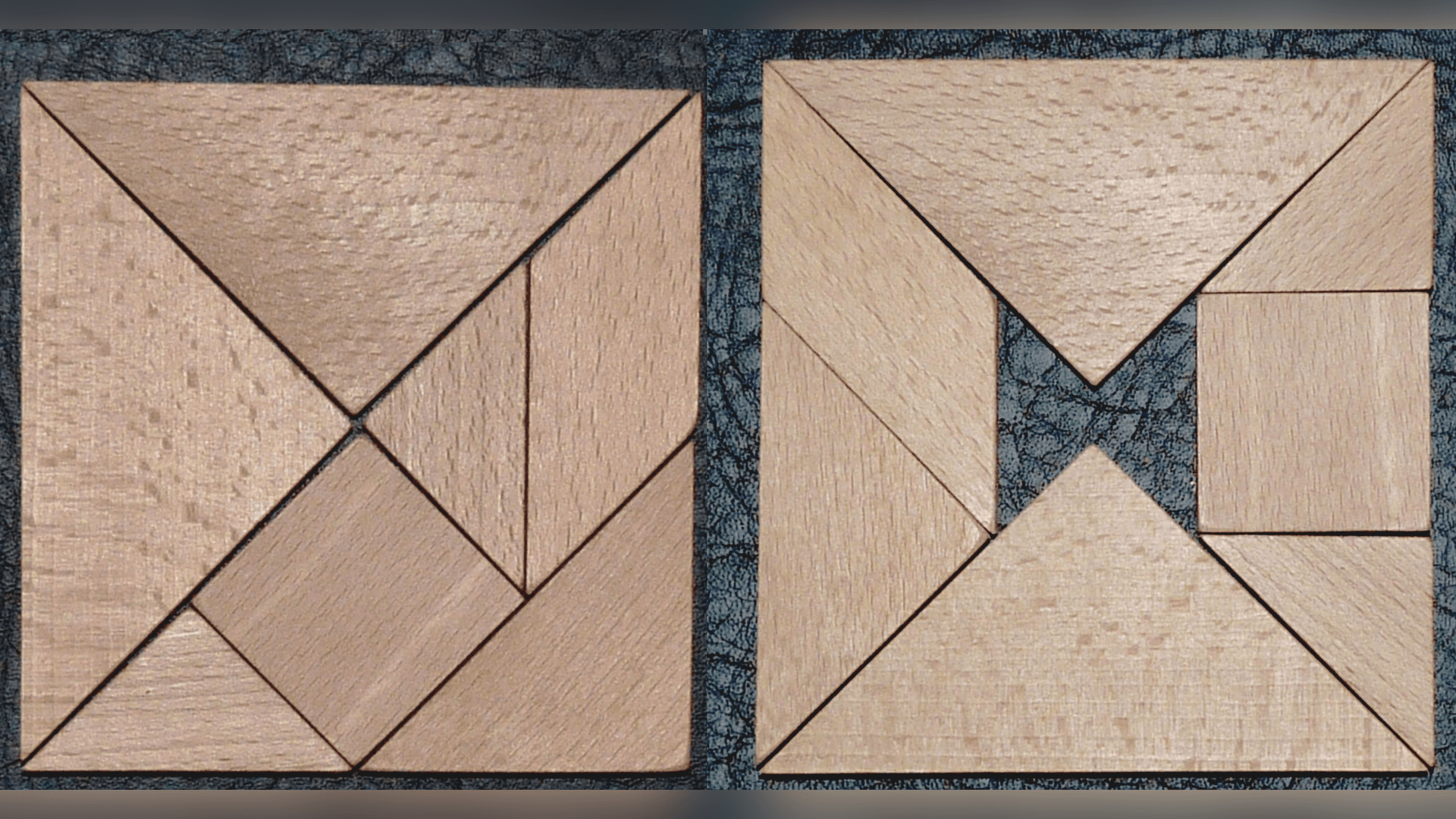
Hero photo: wooden tangram pieces arranged into two different square figures on a dark table. Photo by Siren-Com via Wikimedia Commons, CC BY-SA 3.0 (https://creativecommons.org/licenses/by-sa/3.0), cropped with blurred extension.
Take our professional IQ test
Want to know your IQ? Try the first ever professional online IQ test.