The Trail Making Test times you connecting numbered and lettered circles. Part A measures processing speed, Part B set-shifting. See normal times by age.
Dr. Russell T. WarneChief Scientist
Share
The Trail Making Test (TMT) is a timed pencil-and-paper neuropsychological test in two parts. In Part A you draw lines connecting 25 numbered circles in order as fast as you can; in Part B you alternate between numbers and letters (1, A, 2, B, 3, C, and so on). Your score on each part is simply the time it takes. Part A measures visual search and speed of processing, while Part B adds mental flexibility and executive control. The whole test takes about 5 to 10 minutes, and it is one of the most widely administered neuropsychological tasks in the world. It is a timed impairment measure, not an IQ test.
Part A vs. Part B
Part A is a fairly pure speed task: find 1, draw a line to 2, then 3, and keep scanning the page until 25. Part B keeps the same format but requires "set-shifting," switching back and forth between two sequences you hold in mind, the numbers and the alphabet. That switching leans on working memory and executive function in a way Part A does not.
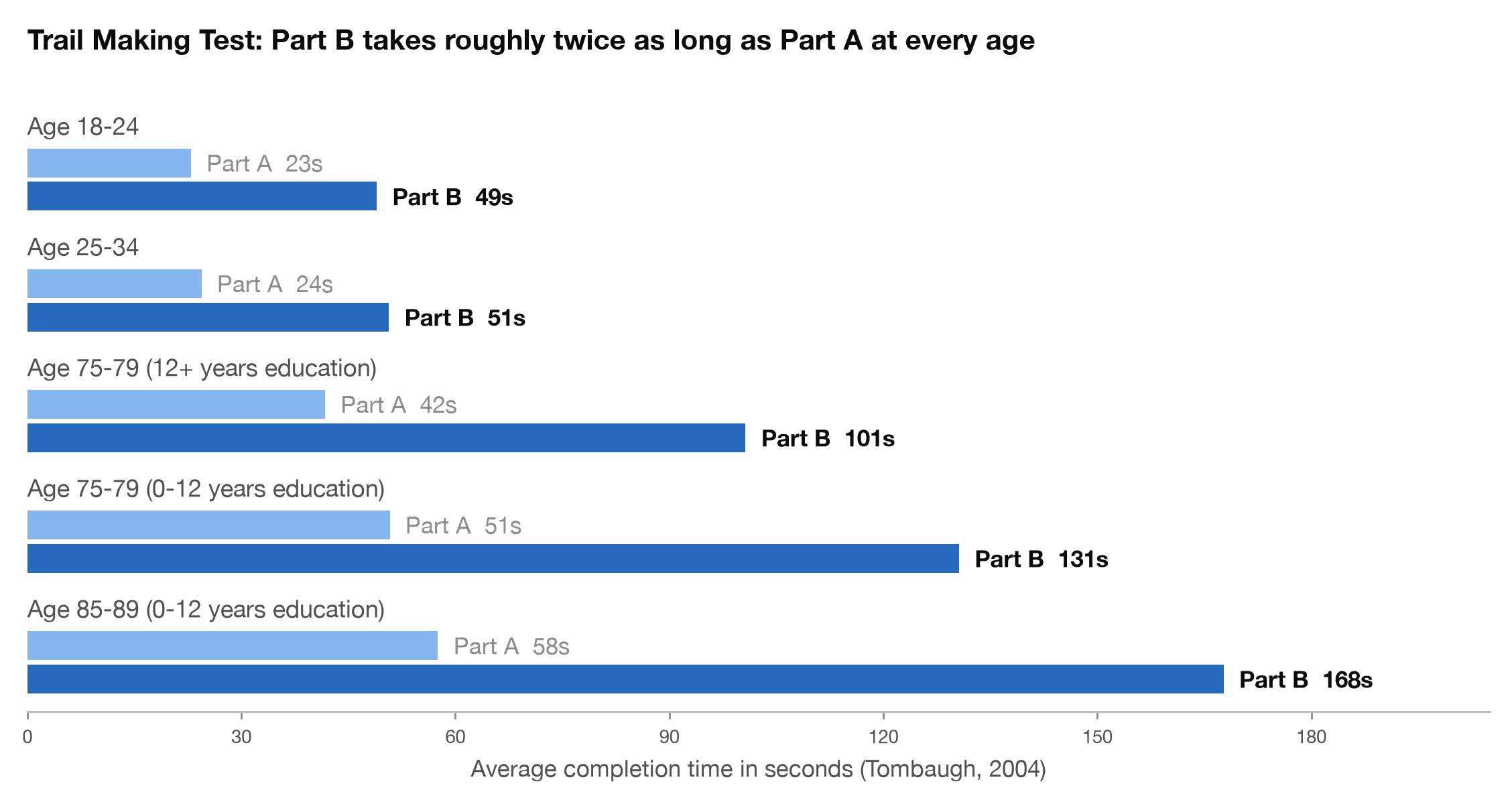
This is why clinicians look at the two times together. Because Part A captures the drawing and scanning speed on its own, a Part B time far out of line with Part A points at executive and working memory problems specifically, rather than at slow motor speed. In healthy adults, Part B typically takes about twice as long as Part A.
A test born in the Army
The TMT was originally part of the U.S. Army Individual Test Battery of 1944, built to assess soldiers during the Second World War. It was later incorporated into the Halstead-Reitan neuropsychological battery, and from there it spread into nearly every corner of clinical neuropsychology. Its endurance owes a lot to its practicality: it is quick, cheap, and sensitive to a wide range of brain conditions.
What counts as a normal time?
The standard reference norms come from Tom Tombaugh's 2004 study of 911 community-dwelling adults aged 18 to 89, stratified into 11 age groups and two education levels. Healthy adults aged 18 to 24 averaged about 23 seconds on Part A and 49 seconds on Part B. Times lengthen steadily with age: at 75 to 79 with 12 or fewer years of education, the averages were about 51 seconds for Part A and 131 seconds for Part B.
Age matters far more than anything else in these norms: it accounted for 34 percent of the variance in Part A times and 38 percent in Part B, while education accounted for only 3 to 6 percent and gender for less than 1 percent.
Early users of the test proposed absolute cutoff scores for identifying brain impairment, and that practice was abandoned once research showed that age, education, and intelligence all affect TMT performance. Today a time is always judged against norms for the person's own demographic group.
What slow times can mean
The TMT provides information on visual search, scanning, processing speed, mental flexibility, and executive function, and slowed times show up in many neurological and psychiatric conditions. Clinicians rarely interpret it alone. It usually sits inside a full battery of neuropsychological testing, alongside bedside screens such as the Mini-Mental State Exam, and the pattern across tests matters more than any single number. Tombaugh's normative sample was itself screened with the MMSE to exclude people with probable impairment.
Is the Trail Making Test an IQ test?
No. The TMT produces a time in seconds, judged against demographic norms, and it has no IQ-style standardized score. Speed on the test does relate to intelligence, and processing speed is one of the abilities a full IQ test samples, which is exactly why researchers found that intelligence affects TMT times. But a single timed task is a narrow slice of cognition, useful for flagging impairment, and it cannot summarize a person's general ability.
Trail-making times flag impairment. To see where your processing speed and reasoning fall on a normed scale, you can take the RIOT IQ test, the Reasoning and Intelligence Online Test, which reports standardized scores with a mean of 100 and a standard deviation of 15.
Frequently asked questions
What does the Trail Making Test measure?
Part A, connecting 25 numbered circles in order, measures visual search, scanning, and speed of processing. Part B, alternating numbers and letters, adds mental flexibility and executive control, since you must hold two sequences in mind and switch between them. Your score is the time each part takes.
What is a normal time for the Trail Making Test?
In Tombaugh's norms from 911 healthy adults, people aged 18 to 24 averaged about 23 seconds on Part A and 49 seconds on Part B, and times lengthen steadily with age. Scores are always judged against age norms rather than a single cutoff.
What does Part B tell you that Part A does not?
Part B requires switching between the number sequence and the alphabet. Because Part A already captures drawing and scanning speed, a Part B time far out of line with Part A points specifically at executive function and working memory rather than slow motor speed.
Where did the Trail Making Test come from?
It began as part of the U.S. Army Individual Test Battery in 1944 and was later incorporated into the Halstead-Reitan neuropsychological battery. It has since become one of the most widely administered neuropsychological tests in the world.
Is the Trail Making Test an IQ test?
No. It is a timed neuropsychological task with no normed IQ score. Speed on the TMT relates to intelligence, which is one reason fixed cutoffs were abandoned in favor of demographic norms, but an IQ test samples many abilities and reports a standardized score.
References
1. Tombaugh, T. N. (2004). Trail Making Test A and B: Normative data stratified by age and education. Archives of Clinical Neuropsychology, 19(2), 203-214. pubmed.ncbi.nlm.nih.gov
2. Bowie, C. R., & Harvey, P. D. (2006). Administration and interpretation of the Trail Making Test. Nature Protocols, 1(5), 2277-2281. doi.org
3. Army Individual Test Battery. (1944). Manual of directions and scoring. Washington, DC: War Department, Adjutant General's Office.
4. Folstein, M. F., Folstein, S. E., & McHugh, P. R. (1975). "Mini-mental state": A practical method for grading the cognitive state of patients for the clinician. Journal of Psychiatric Research, 12(3), 189-198. doi.org