How do memory tests work? From the Wechsler Memory Scale and RAVLT to digit span and 3-minute dementia screens, here is how memory is actually measured.
Dr. Russell T. WarneChief Scientist
Share
Memory is not measured with one test. Clinicians and researchers use a toolkit: quick screens such as three-word recall, "span" tasks such as repeating digit sequences, and full normed batteries such as the Wechsler Memory Scale and the Rey Auditory Verbal Learning Test. Each targets a different memory system, from holding a phone number in mind for ten seconds to retrieving a word list half an hour later. None of them is an IQ test by itself, though memory, especially working memory, is one of the abilities a full IQ test measures.
The memory systems tests target
Short-term storage vs. working memory
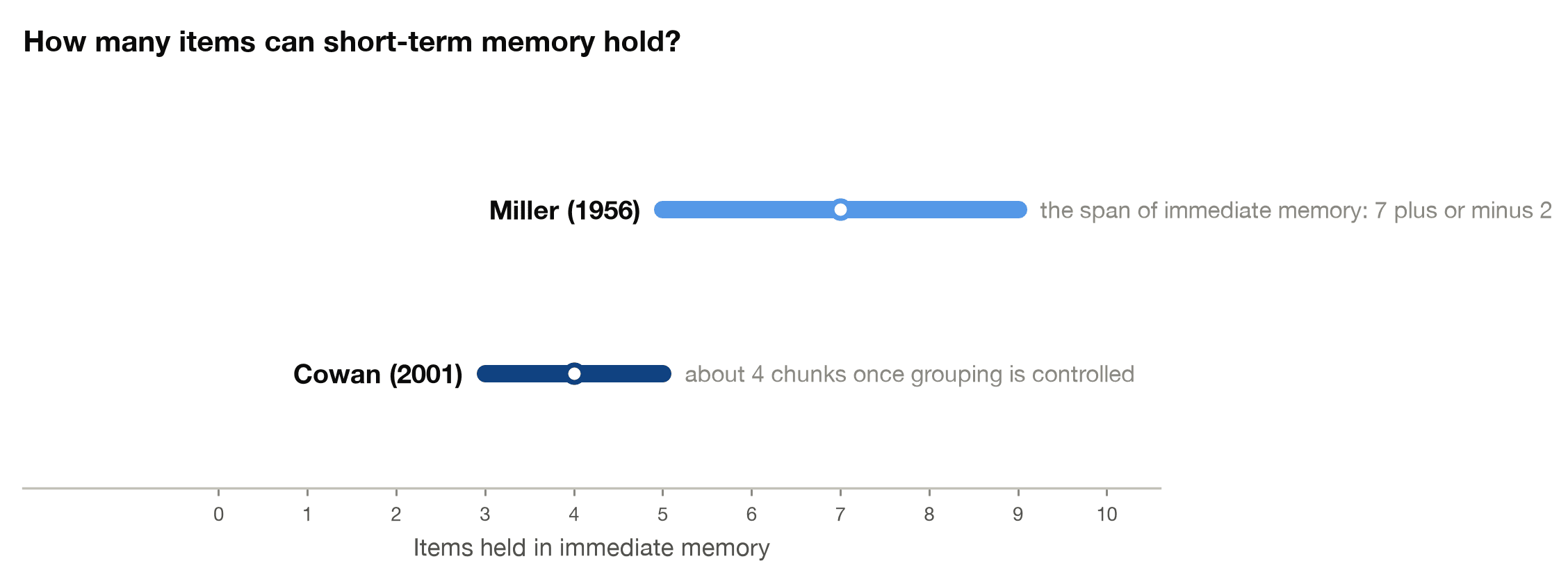
"Short-term memory" is the brief holding of information, such as repeating a list you just heard. "Working memory" is holding plus manipulation: keeping the list in mind while reordering it. George Miller's famous 1956 paper put the span of immediate memory at about seven items, plus or minus two. Nelson Cowan's 2001 reanalysis argued the true limit is smaller, three to five "chunks" with an average of about four, once rehearsal and grouping strategies are controlled. For why this capacity matters well beyond memorizing lists, see our article on what working memory is.
Learning, delayed recall, and recognition
"Episodic" memory, the record of experienced events, is tested by teaching new material and then probing it in several ways: immediate recall, recall after a delay, and "recognition," picking the studied items out of a longer list. The gap between those scores is diagnostic. A person who learns slowly but retains what they learned has a different problem from a person who learns normally and then loses it.
Clinical memory batteries
The flagship clinical instrument is the Wechsler Memory Scale, Fourth Edition (WMS-IV, published 2009). It covers ages 16 to 90 and contains seven subtests divided into auditory memory, visual memory, visual working memory, immediate memory, and delayed memory domains. It is a restricted instrument, available only to qualified professionals, and it is normed, so a score means something relative to other adults of the same age.
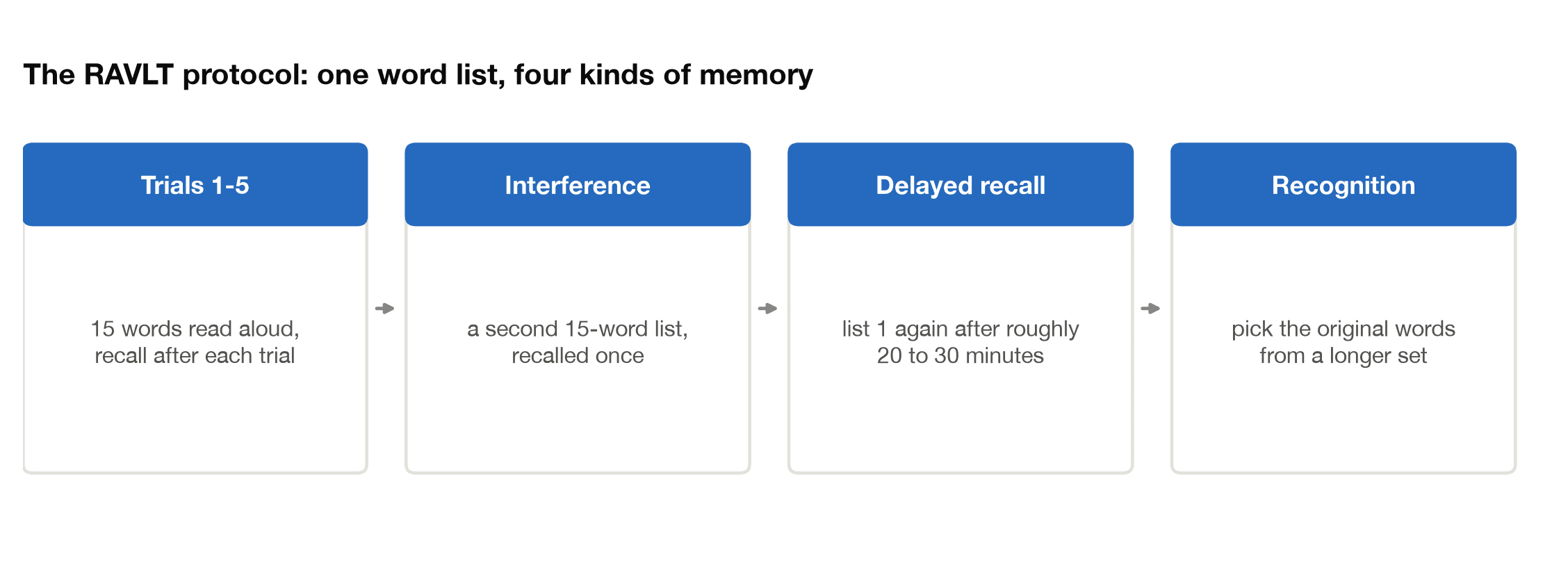
For verbal learning specifically, the standard is the Rey Auditory Verbal Learning Test (RAVLT). The examiner reads 15 nouns aloud over five consecutive trials, with free recall after each; then comes an interference list of 15 different words, recall of the original list, another recall after a delay of roughly 20 to 30 minutes, and a recognition test. Alternative equivalent forms exist to limit practice effects on retesting.
Quick memory screens
At the other end of the toolkit are screens used in primary care to catch possible impairment. The Mini-Cog combines three-word recall with clock drawing in about three minutes; the MoCA is a 10-minute, 30-point screen whose domains include short-term memory recall. The National Institute on Aging's framing applies to all of them: results "alone are insufficient to diagnose dementia," but they are an important first step. When a screen is positive, a neuropsychologist follows up with the normed batteries above. Our article on measuring cognitive aging covers how memory and processing speed tasks track age-related change.
Working memory tasks and IQ
The classic working memory task is "digit span": you hear a sequence of digits and repeat it back, first forward, then in reverse. Forward span mostly measures short-term storage; backward span forces you to hold and manipulate the sequence at once. Digit span is a core subtest of the Wechsler scales, including the WAIS, and laboratory variants such as the n-back extend the same idea. Working memory earns its place inside IQ tests because it correlates substantially with general intelligence: the ability to hold and transform information is close to the core of reasoning itself.
Memory tests vs. IQ tests
The relationship runs in one direction. A full IQ test includes memory measurement among several abilities, alongside reasoning, knowledge, spatial ability, and speed. A memory test alone is not an IQ test: a dementia screen has no norms across the ability range, and an online "memory challenge" game has no norms at all. Be equally cautious about the reverse claim, that practicing memory games raises intelligence; the evidence for that kind of transfer is weak, as we cover in our article on brain training apps and IQ.
Frequently asked questions
What is the most common memory test?
In clinics, the Wechsler Memory Scale (WMS-IV) is the flagship battery, with seven subtests across five memory domains. For verbal learning, the Rey Auditory Verbal Learning Test is a standard. For quick screening, doctors often use the three-minute Mini-Cog.
How do doctors test your memory?
Screens first, batteries second. A primary care visit may include a brief screen like the Mini-Cog or the MoCA. If it is positive, a neuropsychologist administers normed instruments such as the WMS-IV and RAVLT that separate immediate recall, delayed recall, recognition, and working memory.
What is a digit span test?
You hear a sequence of digits and repeat it back, forward and then in reverse. Forward span measures short-term storage; backward span requires holding and manipulating the sequence, which is working memory. Versions of digit span appear in Wechsler intelligence and memory scales.
How many items can short-term memory hold?
Miller's 1956 paper put the span of immediate memory at about seven plus or minus two items. Cowan's 2001 reanalysis argued the real limit is three to five chunks, averaging about four, once rehearsal and grouping strategies are controlled.
Are online memory tests accurate?
Most are unnormed games, and a fun score is not a clinical measurement. Real memory instruments are standardized, have alternative forms to prevent practice effects, and are restricted to qualified professionals. If memory loss is the concern, see a clinician.
Is memory the same as IQ?
No, though they are related. Working memory correlates substantially with general intelligence, which is why Wechsler IQ scales include a working memory index. Full IQ tests measure reasoning, knowledge, spatial ability, and speed alongside memory.
Testing your own cognition
If your concern is memory loss, the right door is a clinician's, and the tools above are what waits behind it. If your question is about cognitive ability, the Reasoning and Intelligence Online Test includes normed working memory measurement among the abilities it reports, on the same mean-100 scale the clinical instruments use. You can take the free RIOT IQ test online.
References
1. Miller, G. A. (1956). The magical number seven, plus or minus two: Some limits on our capacity for processing information. Psychological Review, 63(2), 81-97. psychclassics.yorku.ca
2. Cowan, N. (2001). The magical number 4 in short-term memory: A reconsideration of mental storage capacity. Behavioral and Brain Sciences, 24(1), 87-114. pubmed.ncbi.nlm.nih.gov
4. Bean, J. (2011). Rey Auditory Verbal Learning Test, Rey AVLT. In Encyclopedia of Clinical Neuropsychology. Springer. link.springer.com
5. Borson, S., Scanlan, J., Brush, M., Vitaliano, P., & Dokmak, A. (2000). The Mini-Cog: A cognitive "vital signs" measure for dementia screening in multi-lingual elderly. International Journal of Geriatric Psychiatry, 15(11), 1021-1027. pubmed.ncbi.nlm.nih.gov
6. Nasreddine, Z. S., Phillips, N. A., Bedirian, V., Charbonneau, S., Whitehead, V., Collin, I., Cummings, J. L., & Chertkow, H. (2005). The Montreal Cognitive Assessment, MoCA: A brief screening tool for mild cognitive impairment. Journal of the American Geriatrics Society, 53(4), 695-699. pubmed.ncbi.nlm.nih.gov
7. Schaefer, L. A., Thakur, T., & Meager, M. R. (2024). Neuropsychological assessment. In StatPearls. StatPearls Publishing. ncbi.nlm.nih.gov
8. National Institute on Aging. (n.d.). Assessing cognitive impairment in older patients.nia.nih.gov
Take our professional IQ test
Want to know your IQ? Try the first ever professional online IQ test.