🇺🇸The official website of Riot IQ
Log in
  • Home
  • About

Measure your
intelligence online.

Google

Assessments

  • All IQ Tests
  • Basic IQ Test
  • Full IQ Test
  • Custom IQ Test
  • Free IQ Test

Our Socials

  • X
  • YouTube
  • Facebook
  • LinkedIn

Other IQ Tests

  • WAIS-V
  • SB-5
  • Raven's 2
  • RIAS-2
  • CogAT 9
  • WISC-V

Community

  • Join Subreddit
  • Join Discord

Other Pages

  • Test Manual
  • Administer IQ Tests
  • About Us
  • Articles
  • Data
  • FAQ

Research

  • What do polygenic scores really predict?
  • Working speed and ability on the RIOT

Intelligence Journals & Organizations

  • Human Intelligence Research & Education (HIRE) Foundation
  • International Society for Intelligence Research (ISIR)
  • Intelligence & Cognitive Abilities Journal (ICA)
  • Intelligence Journal
  • Mensa Foundation

Contact

  • Email
  • Support

News & Press

  • International Society for Intelligence Research
  • American Thinker
  • Mensa Foundation (1/2)
  • Mensa Northern New Jersey
  • The University of Western Australia
  • Prolific
  • Quillette
  • Brainz

Our Articles

  • Gmatclub (1/2)
  • ApolloTechnical
  • LessWrong
  • Psychreg
  • Study in Switzerland
  • SuccessConsciousness
  • Creative Organizational Design (1/2)
  • ABNewsWire
  • Vanderbilt University

Our Articles

  • The Globe and Mail
  • Barchart
  • Journal
  • Mensa Foundation (2/2)
  • Psychologs
  • Creative Organizational Design (2/2)
  • AZBigMedia
  • Thoughts on Life and Love
  • Anxiety and Depression Association of America

Our Articles

  • Before It's News
  • Siglo XXI
  • TechBullion
  • Medium
  • Gmatclub (2/2)
  • MSN
  • National Review
  • Minding the Campus
  • Launching Next

Our Articles

  • Comparing Cronbach’s Alpha and McDonald’s Omega Reliability
  • Breaking the Intelligence & IQ Taboo
  • What is the Flynn Effect?
  • A Comprehensive History of IQ Tests
  • The 15 Subtests of the RIOT

Our Articles

  • How to Take an IQ Test
  • How to Calculate IQ
  • What is the RIOT IQ Test?
  • The Pro-Human Aspects of Intelligence Research
  • What is an IQ Test? A Beginner's Guide.

Our Articles

  • 5 Best IQ Tests in 2025
  • Cognitive Profiles on the RIOT IQ Test Results
  • 6 Cognitive Abilities of the RIOT
  • Are There Any Professional and Real Online IQ Tests?

Our Articles

  • Resources to Learn About IQ and Intelligence
  • Studying IQ Matters
  • The Search for Albert Einstein's IQ
  • Do Non-g Gains from the Flynn Effect Matter?

Riot IQ © 2026

  • Terms of Service
  • Privacy Policy
  • BAA Agreement
  • Test Administrator Terms
  • Terms of Service
  • •Privacy Policy
  • •BAA Agreement
  • •Test Administrator Terms

Table of Contents

  • What the TONI-4 measures
  • A test with no words in it
  • Who the TONI-4 serves
  • How TONI-4 scoring works
  • Strengths and limitations
  • Where an online test fits for adults
  • Frequently asked questions
  • What ages does the TONI-4 test cover?
  • How long does the TONI-4 take?
  • Is the TONI-4 a real IQ test?
  • Can I take the TONI-4 online or by myself?
  • What is the difference between the TONI-4 and a matrix reasoning test?
  • Who publishes the TONI-4?
  • References
Aug 31, 2026·Specific IQ Tests & Formats

What Is the TONI-4 Test? The Language-Free Intelligence Test Explained

The TONI-4 test is a language-free measure of nonverbal intelligence for ages 6 to 89. Learn what it measures, how scoring works, and its main limits. (150 chars)

Dr. Russell T. WarneChief Scientist
Share
What Is the TONI-4 Test? The Language-Free Intelligence Test Explained
The TONI-4 test (Test of Nonverbal Intelligence, Fourth Edition) is a language-free intelligence test published by PRO-ED in 2010 for people aged 6 years 0 months through 89 years 11 months. The examinee never reads, writes, speaks, or listens during the test. An examiner presents abstract picture puzzles, and the test taker answers by pointing, nodding, or another simple gesture. The whole session takes about 15 to 20 minutes. This article explains what the TONI-4 measures, who it was built for, how its scores work, where it falls short, and how it compares with a full-length online option for adults.

[VIDEO EMBED: https://www.youtube.com/embed/xpBDZIiI1EQ — "Are IQ Tests Culturally Biased? w/ Dr. Russell T. Warne"]

The TONI-4 exists because language sits at the center of most intelligence tests, and that creates a problem for anyone whose language skills do not reflect their reasoning ability. In the video above, Dr. Russell T. Warne discusses how test makers think about cultural and linguistic loading, which is the exact design question the TONI-4 tries to answer.

---


What the TONI-4 measures

The TONI-4 is a measure of "nonverbal intelligence," meaning reasoning ability assessed without words. In practice, it targets abstract problem solving with figural material. Its authors and independent reviewers describe it as an estimate of "fluid intelligence," the ability to solve novel problems that do not depend on stored knowledge.

Each item presents a set of abstract figures with one figure missing, and the test taker must identify which response option completes the pattern. The publisher lists eight visual characteristics from which items are built: shape, position, direction, rotation, contiguity, shading, size, and movement. If that format sounds familiar, it should. It is the same general logic used in any abstract reasoning test, where the question is whether you can extract a rule from figures and apply it.

A single construct deserves emphasis here: the TONI-4 produces one overall score. It does not break performance into verbal, spatial, memory, or processing-speed components the way comprehensive batteries do. It is a focused instrument, and its narrowness is deliberate.

---


A test with no words in it

The defining feature of the TONI-4 is its response format. The publisher describes the test as completely nonverbal and largely motor-free: the test taker "points, nods, or blinks to indicate the chosen response." No reading, writing, speaking, or listening is required at any point. Even the instructions can be delivered with minimal language, and printed administration instructions are available in English, Spanish, French, German, Chinese, Vietnamese, Korean, and Tagalog, according to Pearson's product listing.

This puts the TONI-4 in the family of tests often called culture-fair intelligence tests. Removing language reduces the cultural loading of a test, though it is worth keeping expectations realistic. No test is perfectly culture-free, and abstract figures still assume some familiarity with two-dimensional pictorial conventions. The honest claim is that the TONI-4 reduces language demands about as far as a test can, which matters enormously for the people it was designed to serve.

Administration is individual, one examiner and one examinee, using a picture book of stimulus plates. Testing stops after three consecutive incorrect answers, a standard "discontinue rule" that keeps the session short and prevents frustration.

---


Who the TONI-4 serves

The TONI-4 was built for people whom conventional tests assess poorly. According to the publisher, its language-free format suits individuals with communication disorders, learning disabilities, intellectual disability, autism, stroke, head injury, neuropsychological impairment, or disease, as well as people who are not proficient in English.

• Speech and language impairments: a child with a severe expressive language disorder may reason perfectly well but fail verbal test items for reasons unrelated to intelligence. The TONI-4 removes that barrier.

• Deaf and hard-of-hearing examinees: because no listening is required, the test can be administered without an interpreter mediating the core task.

• Motor impairments: since a point, nod, or even an eye blink counts as a response, people with cerebral palsy, stroke effects, or similar conditions can complete it.

• English language learners: examinees still developing English can be assessed without the test confusing limited English with limited reasoning.

• Progress monitoring and research: the two equivalent forms (A and B), each with 60 items arranged from easy to difficult, allow retesting without simply repeating the same questions.

One caution belongs alongside this list. The TONI-4 is a restricted professional instrument sold to qualified examiners; it is administered by a trained person in a controlled setting, and it is a screening-level estimate rather than a full diagnostic evaluation.

---


How TONI-4 scoring works

The TONI-4 is "norm-referenced," meaning your performance is compared against a representative sample of people rather than against a fixed pass mark. The publisher reports that the fourth edition was standardized on 2,272 people aged 6 through 89 across 33 states, with the sample stratified by age, gender, race, ethnicity, geographic region, community size, home language, and socioeconomic status.

Raw performance converts to an "index score," an age-based standard score with a mean of 100 and a standard deviation of 15, the same metric used by mainstream IQ tests. Results also come with "percentile ranks," which state the percentage of same-age peers scoring at or below a given score, and "stanines," a coarser nine-band scale used mainly in schools. A TONI-4 index of 100 is exactly average; about two-thirds of people score between 85 and 115.

As with any test score, a TONI-4 index is an estimate with measurement error around it, and a short nonverbal screener carries more error than a long multi-domain battery. Treat the score as a range, and treat labels as descriptions of scores rather than of people.

---


Strengths and limitations

The TONI-4 has earned a durable place in assessment practice, and an independent review in the Journal of Psychoeducational Assessment called it user-friendly, efficient to administer, and "a good alternative to other intelligence tests" for hard-to-test populations. Its main strengths are speed (15 to 20 minutes), a genuinely language-free format, alternate forms for retesting, and norms spanning most of the lifespan.

Its limitations follow directly from the same design choices.

• One score, one ability domain: the TONI-4 samples only figural reasoning. Intelligence is broader than that, and two people with the same TONI-4 index can differ widely in verbal ability, memory, or processing speed.

• Screening-level precision: research on clinical samples finds respectable but imperfect stability. In a study of patients with schizophrenia by Chen and colleagues, the "test-retest reliability" (the consistency of scores across two sessions) produced an intraclass correlation of 0.73, with a trivial practice effect between sessions. That is good for a brief instrument and below what full batteries achieve.

• Convergence with other measures is moderate: the same study reported a correlation of 0.61 between the TONI-4 and a broader cognitive screen, which supports the test's validity while confirming that it is not interchangeable with comprehensive testing.

• Not self-administered: you cannot take the TONI-4 on your own. It requires a qualified examiner, a testing kit, and a face-to-face session, which makes it impractical for a curious adult who simply wants a rigorous estimate of their own ability.

---


Where an online test fits for adults

If you need an assessment because language, hearing, or motor barriers make standard testing unfair, the TONI-4 through a qualified professional is a sensible route. If you are a typical adult who wants a credible measure of your own cognitive ability, a well-normed online test is the more practical path, and the general guidance in our article on the IQ test for adults applies: what matters is a real norm sample, documented reliability, and transparent reporting, whatever the format.

The RIOT IQ test (the Reasoning and Intelligence Online Test), developed by RIOT IQ with psychometrician Dr. Russell T. Warne, takes the opposite structural approach from the TONI-4: instead of one brief nonverbal score, it measures multiple cognitive abilities across a full battery of subtests, online, with norms built for adult self-assessment. The two tools answer different questions. The TONI-4 asks how well a hard-to-test person can reason when language is stripped away. A full-battery test asks how a person's abilities profile across domains. You can take the RIOT IQ test at riotiq.com if the second question is the one you want answered.

---


Frequently asked questions

What ages does the TONI-4 test cover?

The TONI-4 is normed for ages 6 years 0 months through 89 years 11 months, so it spans children, adults, and older adults on a single instrument.

How long does the TONI-4 take?

About 15 to 20 minutes. Testing also stops early once the examinee misses three consecutive items.

Is the TONI-4 a real IQ test?

It is a legitimate, professionally published measure of nonverbal intelligence with an index score on the familiar IQ metric (mean 100, standard deviation 15). It samples a narrower slice of ability than full IQ batteries, so professionals treat it as a focused or screening measure.

Can I take the TONI-4 online or by myself?

No. The TONI-4 is individually administered by a qualified examiner using a physical test kit. Adults who want a self-administered option should look for an online test with published norms and reliability data.

What is the difference between the TONI-4 and a matrix reasoning test?

They are close cousins. Both use abstract figural patterns with a missing element. The TONI-4 is a complete standardized instrument with its own norms and equivalent forms, while matrix reasoning is a task type that appears inside many different tests.

Who publishes the TONI-4?

PRO-ED, based in Austin, Texas, published the fourth edition in 2010. The authors are Linda Brown, Rita J. Sherbenou, and Susan K. Johnsen.

---


References

1. Chen, K.-C., et al. (2021). Test–retest reliability and convergent validity of the Test of Nonverbal Intelligence-Fourth Edition in patients with schizophrenia. BMC Psychiatry, 21, Article 39. pmc.ncbi.nlm.nih.gov

2. Pearson Assessments. (n.d.). Test of Nonverbal Intelligence, Fourth Edition (TONI-4) [Product page]. pearsonassessments.com

3. Ritter, N., Kilinc, E., Navruz, B., & Bae, Y. (2011). Test review: L. Brown, R. J. Sherbenou, & S. K. Johnsen, Test of Nonverbal Intelligence-4 (TONI-4). Austin, TX: PRO-ED, 2010. Journal of Psychoeducational Assessment, 29(5), 484–488. eric.ed.gov

4. WPS Publish. (n.d.). (TONI-4) Test of Nonverbal Intelligence, Fourth Edition [Product page]. wpspublish.com

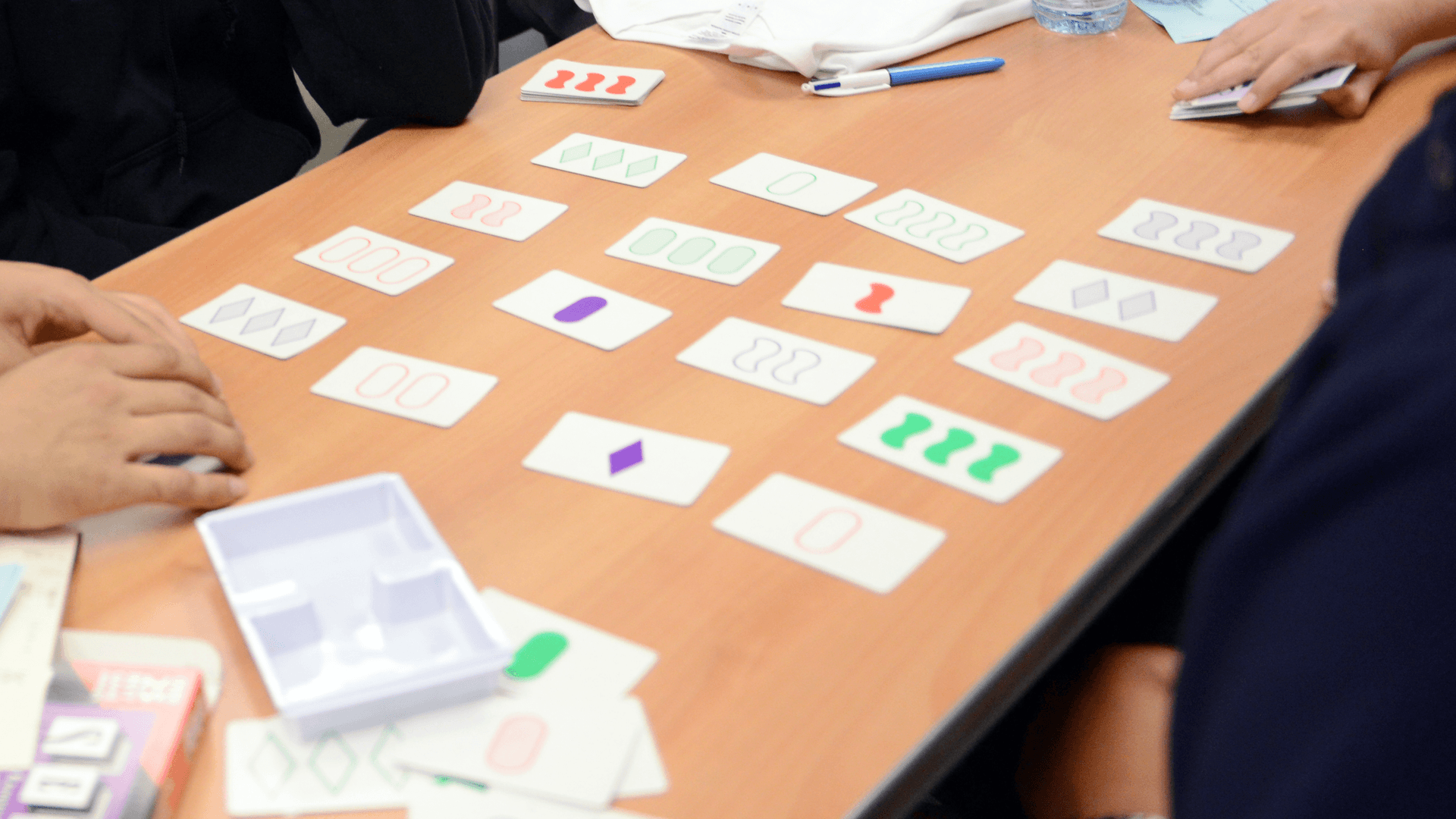
Hero photo: abstract pattern cards spread across a table during a math contest, with players' hands at the edges. Photo by University of the Fraser Valley, CC BY 2.0, via Wikimedia Commons.

Take our professional IQ test

Want to know your IQ? Try the first ever professional online IQ test.

Try our IQ test
Author
Dr. Russell T. WarneChief Scientist

Contact

Table of Contents

  • What the TONI-4 measures
  • A test with no words in it
  • Who the TONI-4 serves
  • How TONI-4 scoring works
  • Strengths and limitations
  • Where an online test fits for adults
  • Frequently asked questions
  • What ages does the TONI-4 test cover?
  • How long does the TONI-4 take?
  • Is the TONI-4 a real IQ test?
  • Can I take the TONI-4 online or by myself?
  • What is the difference between the TONI-4 and a matrix reasoning test?
  • Who publishes the TONI-4?
  • References
Article Categories
All ArticlesUnderstanding IQ ScoresTaking an IQ TestRIOT-Specific InformationGeneral IQ & IntelligenceAdvanced Topics & ResearchIQ Scores & InterpretationMensa & High-IQ SocietiesOnline IQ Tests IQ Test Basics & FundamentalsAverage IQ & DemographicsFamous People & IQHistory & Origins Of IQ TestingAccuracy, Reliability & CriticismSpecial Population & Related ConditionsImproving IQ / PreparationSpecific IQ Tests & FormatsIQ Testing for HR & RecruitmentSkills Assessment
Related Articles
What is the Halstead-Reitan battery? The classic fixed neuropsychological test setWhat is the Conners test? The Conners 4 ADHD rating scales explainedWhat is the BASC-3? A guide to Pearson's behavior rating systemWhat is the GORT-5? The Gray Oral Reading Tests explainedWhat is the KTEA-3? The Kaufman Test of Educational Achievement explainedWhat is the GFTA-3? The Goldman-Fristoe articulation test explainedWhat is the CELF-5? Pearson's language fundamentals test explainedWhat is the Beery VMI? The visual-motor integration test explainedWhat Is the Rey-Osterrieth Complex Figure Test?What is the Wisconsin Card Sorting Test?What is the Wechsler Memory Scale? A guide to the WMS-IVWhat is the D-KEFS? The Delis-Kaplan Executive Function System explainedWhat is the NEPSY-II? A guide to the child neuropsychological assessmentWhat is the Boston Naming Test?What is the RBANS? Pearson's brief neuropsychological battery explainedWhat is the ABAS-3? The adaptive behavior assessment explainedWhat is the Bracken School Readiness Assessment?What is the Denver II? The Denver Developmental Screening Test explainedWhat Is the CCAT Test? Format, Scoring, and How It Compares to an IQ TestWhat is the MMSE test? The classic 30-point cognitive screening examWhat is the Vineland-3? The adaptive behavior assessment explainedWhat Is the TACHS Test? The Catholic High School Admissions Exam ExplainedWhat is the SHSAT test? New York City's specialized high school exam explainedWhat is the RIAS-2? The Reynolds Intellectual Assessment Scales explainedWhat is the PSAT test? Format, scores, and National Merit explainedWhat Is the Nelson-Denny Reading Test?What Is the ERB Test? The CTP ExplainedWhat is the DAT test? The Dental Admission Test explainedWhat is the CTONI-2? The Comprehensive Test of Nonverbal Intelligence explainedWhat is the Stanford 10 test? A guide to the SAT10 achievement batteryWhat are the Mullen Scales of Early Learning?What is the AFCT test? The in-service ASVAB retest explainedWhat is the WRAT-5? Pearson's brief achievement test explainedWhat is the Wechsler Nonverbal Scale of Ability (WNV)?What is the Slosson Intelligence Test?What is the NAPT test? The Navy Advanced Programs Test explainedWhat is the HSPT test? Sections, scoring, and how schools use itWhat is the CLT exam? Sections, scoring, and who accepts itWhat is the Bayley-4? How the infant and toddler development scales workWhat Is the TONI-4 Test? The Language-Free Intelligence Test ExplainedWhat Is the TerraNova Test? A Guide to the Achievement BatteryWhat Is the KABC-II? A Guide to the Kaufman Assessment Battery for ChildrenWhat Is the Universal Nonverbal Intelligence Test (UNIT2)?What Is the DAS-II Test? The Differential Ability Scales ExplainedWhat Is the ASTB Test? The Navy's Aviation Selection Battery ExplainedWhat Is the SIFT Test? The Army's Flight Aptitude Test ExplainedWhat Is the DLAB Test? The Military's Language Aptitude Battery ExplainedWhat Is an AFQT Score? The Military's Enlistment Score ExplainedWhat Is the CAS2 Test? The Cognitive Assessment System and PASS TheoryWhat Is the WIAT Test? The Wechsler Individual Achievement Test ExplainedWhat Is the WASI Test? The Wechsler Abbreviated Scale of IntelligenceWhat Is the SCAT Test? Johns Hopkins CTY's Qualifying Test ExplainedWhat Is the SSAT Test? The Secondary School Admission Test ExplainedWhat Is the ISEE Test? The Independent School Entrance Exam ExplainedMCAT to IQ: What MCAT Scores Really Say About IntelligenceGMAT to IQ: What GMAT Scores Really Say About IntelligenceWhat Is the Leiter Test? The Nonverbal IQ Scale ExplainedWhat Is the RIAS Test? The Reynolds Intellectual Assessment Scales ExplainedWhat Is a GT Score? The Army's General Technical Score ExplainedWhat Is the AFOQT? The Air Force Officer Qualifying Test ExplainedWhat Is the Iowa Test? The ITBS and Iowa Assessments ExplainedWhat Is the Star Test? Renaissance Star Assessments ExplainedWhat Is the MAP Test? NWEA MAP Growth ExplainedWhat Is the Vervoe Assessment?What Is the Harver Assessment?What Is the Plum Assessment? The Discovery Survey ExplainedWhat Is the Saville Swift Test?What Is the Mettl Test? Mercer | Mettl Assessments ExplainedWhat Is TestGorilla? The Skills Testing Platform ExplainedWhat Is the Matrigma Test?What Is the Thomas GIA Test?What Is the HireVue Assessment?What Is the CASPer Test?What Is the UCAT? The University Clinical Aptitude Test ExplainedWhat Is the Beta-III Test? Beta-4 and the Nonverbal IQ LineWhat Is the Cognitive Reflection Test?What Is the McQuaig Mental Agility Test?What Is the Talent Q Elements Test?What Is the Kenexa Assessment?IQ Test Questions: What Real Tests Actually AskWhat Is the TABE Test?What Is the ACCUPLACER Test?What Is the HESI A2 Exam?What Is the ATI TEAS Test?What Is the Pymetrics Test?What Is the cut-e Test?What Is the Caliper Assessment?What Is a Deductive Reasoning Test?What Is an Inductive Reasoning Test?What Is a Quantitative Reasoning Test?What Is the Civil Service Exam?What Is the Cubiks Logiks Test?What Is the Wiesen Test of Mechanical Aptitude?What Is the Bennett Mechanical Comprehension Test?What Is the Ramsay Mechanical Aptitude Test?What Is a Clerical Aptitude Test?LSAT to IQ: What LSAT Scores Really Say About IntelligenceGRE to IQ: What GRE Scores Really Say About IntelligenceWhat Is a Situational Judgement Test?What Is the Korn Ferry Assessment?What Is the Hogan Assessment?What Is the Firefighter Aptitude Test?What Is the Police Written Exam?What Is a Mechanical Aptitude Test?What Is a Numerical Reasoning Test?What Is an Abstract Reasoning Test?What Is the Watson Glaser Test? The Law-Firm Screen ExplainedWhat Is the SHL Test? The Verify G+ ExplainedWhat Is the Predictive Index Cognitive Assessment?What Is the Peabody Picture Vocabulary Test? The PPVT-5 ExplainedWhat Is the WPPSI Test? The Wechsler IQ Test for Young ChildrenWhat Is the KBIT Test? The Kaufman Brief Intelligence Test ExplainedWhat Is the OLSAT Test? The Otis-Lennon School Ability Test ExplainedWhat Is the NNAT Test? The Naglieri Nonverbal Ability Test ExplainedWhat Is the Average Wonderlic Score? Overall, by Job, and by NFL PositionWhat Is the Wonderlic Test? Scoring, NFL History, and How It Relates to IQWhat Is the Digit Span Test?What Is the Trail Making Test?What Is the Clock Drawing Test?What Is the Mini-Mental State Exam (MMSE)?What Is the Stroop Test?What Do Vocabulary Tests Measure?What Is a Reaction Time Test?What Is the Woodcock-Johnson Test?What Is the WISC Test?What Is the CogAT Test?Memory Tests: How Memory Is Actually MeasuredWhat Is Neuropsychological Testing?What Is the Mini-Cog Test?What Is the SAGE Test?What Is the MoCA Test?What Is a Pattern Recognition Test?How to Solve 3x3 Visual Matrix Reasoning Puzzles Step by StepWhat Are IQ Tests and How Do They Work?A Guide to the Different Types of IQ Tests AvailableWhat Are Professional IQ Tests and How Do They Work?5 Types of IQ Tests ExplainedWhat Is a Matrix Reasoning Test? What the Pattern Puzzles MeasureTop 10 Online IQ Tests: A Comprehensive ComparisonRIOT IQ vs. Wonderlic Test Prep: Professional Assessment or Test Coaching?RIOT IQ vs. Wonderlic Test Practice: Which Cognitive Assessment Serves Your Needs?RIOT IQ vs. Assessment Day: Which CCAT Approach Delivers Real Value?RIOT IQ vs. Prepopedia: Which CCAT Solution Fits Your Needs?RIOT IQ vs. Job Test Prep: Which CCAT Preparation Approach Makes Sense?RIOT IQ vs. 12 Min Prep: Which CCAT Preparation Option Works Best?How Is the Stanford-Binet Intelligence Scale Used?How Does the Stanford-Binet IQ Test Work?What Is the WAIS IQ Test?Which IQ Test Should I Take?Military IQ and the ASVABIQ Tests for KidsThe Stanford–Binet Intelligence TestIs the SAT an IQ Test?What Are Reliable IQ Tests?The Wechsler IQ Tests
Take our IQ tests

Basic IQ Test

5 subtests + 5 cognitive abilities

Take the IQ test

Features

  • ~13 Minutes
  • IQ score
  • Cognitive abilities breakdown
  • ±5.6 IQ margin of error

5/15 Subtests

Learn more
Vocabulary
Matrix Reasoning
SToVeS
Visual Reversal
Symbol Search
Most comprehensive

Full IQ Test

15 subtests + all cognitive abilities

Take the IQ test

Features

  • ~52 Minutes
  • IQ score
  • Cognitive abilities breakdown
  • ±3.7 IQ margin of error

15/15 Subtests

Learn more
Vocabulary, Information, Analogies
Matrix Reasoning, Visual Puzzles, Figure Weights
Object Rotation, SToVeS, Spatial Orientation
Computation Span, Exposure Memory, Visual Reversal
Symbol Search, Abstract Matching
Simple Reaction Time, Choice Reaction Time
Compare all tests