The MoCA test is a 30-point, 10-minute screening tool for mild cognitive impairment, not an IQ test. See how scoring works, the 26-point cutoff, and more.
Dr. Russell T. WarneChief Scientist
Share
The MoCA test, short for Montreal Cognitive Assessment, is a 30-point screening tool that takes about 10 minutes and is designed to detect "mild cognitive impairment," the subtle decline in memory and thinking that can precede dementia. It was published by Ziad Nasreddine and colleagues in 2005, and a score of 26 or above is considered normal. Two things are worth stating plainly at the outset: a low MoCA score is a signal for further evaluation rather than a diagnosis, and the MoCA is a screening tool, not an IQ test.
What the MoCA measures
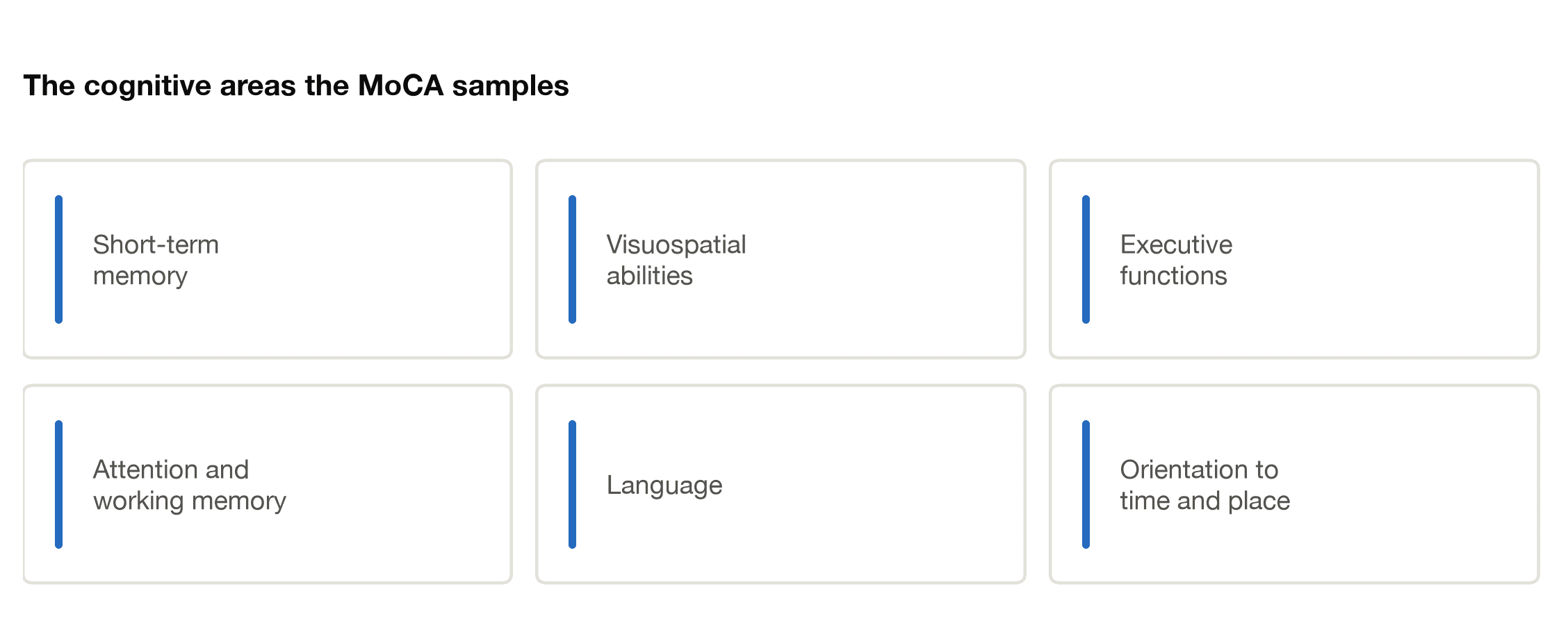
The MoCA samples several cognitive areas with a few items each. According to the official test publisher, those areas are short-term memory, visuospatial abilities, executive functions, attention and working memory, language, and orientation to time and place. Sampling is the right word: each domain gets only a handful of questions, which is enough to flag a possible problem but far too little to measure any single ability in depth.
Scoring, the 26-point cutoff, and the education correction
The maximum score is 30, and the official scoring guidance treats 26 and above as normal cognitive performance. Because schooling affects performance on several items, one point is added to the total for anyone with 12 or fewer years of education, though the corrected total still cannot exceed 30. Scores below 26 suggest possible impairment and warrant a fuller medical evaluation.
How accurate is the MoCA?
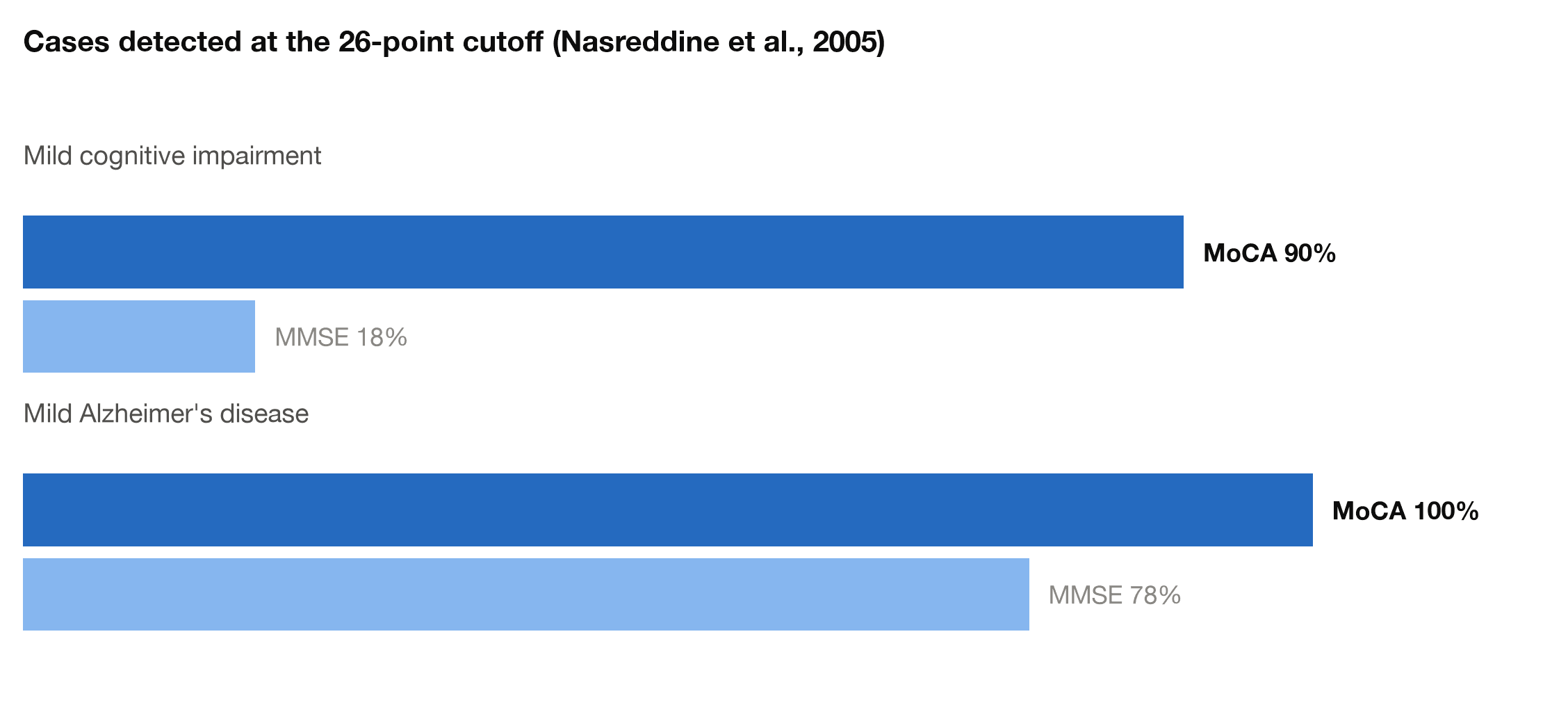
The 2005 validation study compared the MoCA against the Mini-Mental State Examination (MMSE), the older screen it was built to improve on. Using the 26-point cutoff, the MoCA detected 90 percent of mild cognitive impairment cases; the MMSE detected 18 percent. In the mild Alzheimer's group the MoCA detected 100 percent of cases versus 78 percent for the MMSE. "Specificity," the rate at which a test correctly clears healthy people, was excellent for both instruments: 100 percent for the MMSE and 87 percent for the MoCA.
The main reason for the difference is item difficulty. The MoCA includes harder recall and executive-function items that the MMSE lacks, so it catches subtler decline. The tradeoff is a somewhat higher false-positive rate, which is one more reason a positive screen leads to further testing rather than a diagnosis.
A screening tool, not an IQ test
The MoCA has a ceiling of 30 points, and most cognitively healthy adults score near it. That is by design. A screen for impairment needs items that nearly everyone with intact cognition can pass; it does not need, and does not have, the graded difficulty that separates average from superior ability. A perfect 30 out of 30 says nothing about whether someone's IQ is 100 or 140. Ranking ability across the normal range is the job of a full IQ test, which reports standardized scores on a scale with a mean of 100 and a standard deviation of 15.
The limits run in the other direction too. The National Institute on Aging notes that results of brief screens "alone are insufficient to diagnose dementia," even though they are an important first step. A low score can reflect poor sleep, medication effects, depression, or simple unfamiliarity with testing. The usual next step after a positive screen is a medical workup and, often, comprehensive neuropsychological testing. For what research says about prior ability and later decline, see our article on IQ and dementia.
Who administers the MoCA and when
The publisher lists nurses, primary care and specialty physicians, occupational therapists, speech-language pathologists, psychologists, and researchers among its users. The test exists in paper and app formats, with adaptations for hearing or visual impairment, low education, and administration by telephone or videoconference. Under the current official policy, certification is optional for clinicians who use only the total score for screening, and mandatory for professionals who interpret individual tasks or domain sub-scores.
MoCA vs. other cognitive screens
• MMSE: The older 30-point standard. Far less sensitive to mild impairment (18 percent versus 90 percent in the 2005 study), largely because its items are easier.
• Mini-Cog: A three-minute screen combining three-word recall with clock drawing, scored out of 5. Faster than the MoCA and robust to education and language differences; see our guide to the Mini-Cog test.
• SAGE: A self-administered, pen-and-paper exam from Ohio State that people complete at home and bring to their physician; see our guide to the SAGE test.
Frequently asked questions
What is a normal MoCA score?
The MoCA is scored out of 30, and the official guidance treats 26 and above as normal. One point is added for people with 12 or fewer years of education, and the total still cannot exceed 30. Scores below 26 suggest possible impairment and warrant a full evaluation, not a diagnosis.
Is the MoCA test an IQ test?
No. The MoCA is a 10-minute screen for detecting possible cognitive impairment, mostly in older adults. It has a 30-point ceiling and cannot distinguish average from superior ability, which is exactly what a full IQ test with normed scores is designed to do.
What does the MoCA test check?
It samples short-term memory, visuospatial abilities, executive functions, attention and working memory, language, and orientation to time and place. Each domain gets only a few items, enough to flag problems but too few to measure any domain in depth.
Why is the MoCA used instead of the MMSE?
In the 2005 validation study, the 26-point cutoff detected 90 percent of mild cognitive impairment cases versus 18 percent for the MMSE, and 100 percent of mild Alzheimer's cases versus 78 percent. The MoCA includes harder executive and recall items that the MMSE lacks.
What happens if you score low on the MoCA?
A low score is a signal, not a verdict. The National Institute on Aging notes that screening results alone are insufficient to diagnose dementia. The usual next step is a medical workup and often a referral for comprehensive neuropsychological testing.
Measuring ability rather than impairment
The MoCA answers one question well: is there a sign of impairment that deserves a closer look? It cannot tell you where you stand on the ability scale, because it was never normed to do so. If that is the question you care about, a properly normed assessment such as the Reasoning and Intelligence Online Test measures the full range of adult ability with standardized scores. You can take the free RIOT IQ test online.
References
1. Nasreddine, Z. S., Phillips, N. A., Bedirian, V., Charbonneau, S., Whitehead, V., Collin, I., Cummings, J. L., & Chertkow, H. (2005). The Montreal Cognitive Assessment, MoCA: A brief screening tool for mild cognitive impairment. Journal of the American Geriatrics Society, 53(4), 695-699. pubmed.ncbi.nlm.nih.gov
3. MoCA Cognition. (n.d.). The Montreal Cognitive Assessment.mocacognition.com
4. National Institute on Aging. (n.d.). Assessing cognitive impairment in older patients.nia.nih.gov
5. Borson, S., Scanlan, J., Brush, M., Vitaliano, P., & Dokmak, A. (2000). The Mini-Cog: A cognitive "vital signs" measure for dementia screening in multi-lingual elderly. International Journal of Geriatric Psychiatry, 15(11), 1021-1027. pubmed.ncbi.nlm.nih.gov
Take our professional IQ test
Want to know your IQ? Try the first ever professional online IQ test.