The Token Test measures spoken language comprehension by asking listeners to follow commands about colored tokens, revealing subtle aphasia after stroke. (153 chars)
Dr. Russell T. WarneChief Scientist
Share
The Token Test is a brief clinical assessment of "receptive language," the ability to understand what other people say. An examiner places a set of plastic tokens that differ in color, shape, and size on a table, then gives spoken commands that grow steadily longer and grammatically more complicated, from "Touch the yellow square" to instructions like "Drop the yellow circle on the red square." Because the commands contain no wasted words and no helpful context, even mild comprehension problems show up quickly. Neurologists Ennio De Renzi and Luigi Vignolo introduced the test in 1962, and it remains one of the most widely used tools for detecting subtle "aphasia," a language disorder usually caused by stroke or brain injury. This article covers where the Token Test came from, how it works, what it detects, why its deceptively simple commands are hard, the main versions in use today, and how it relates to broader cognitive testing.
Origins of the Token Test
The Token Test was published in 1962 by Ennio De Renzi and Luigi Vignolo, two neurologists working at the University of Milan. Their paper in the journal Brain carried a title that summarized the goal precisely: a sensitive test to detect receptive disturbances in aphasics.
Their central insight was about redundancy. Everyday conversation is full of repeated information, gestures, facial expressions, and situational cues, so a patient with a mild comprehension deficit can follow along by catching a few key words and filling in the rest. De Renzi and Vignolo stripped all of that away. According to the test's current European publisher, the initial version contained 61 commands built from deliberately non-redundant wording, so that a listener had to decode the meaning of every single word to respond correctly. There was nothing in the room, and nothing in the sentence, to guess from.
The design proved remarkably durable. Researchers writing in the journal Behavioral Sciences note that the Token Test has since been translated into more than 40 languages and adopted in clinical practice around the world.
How the Token Test works
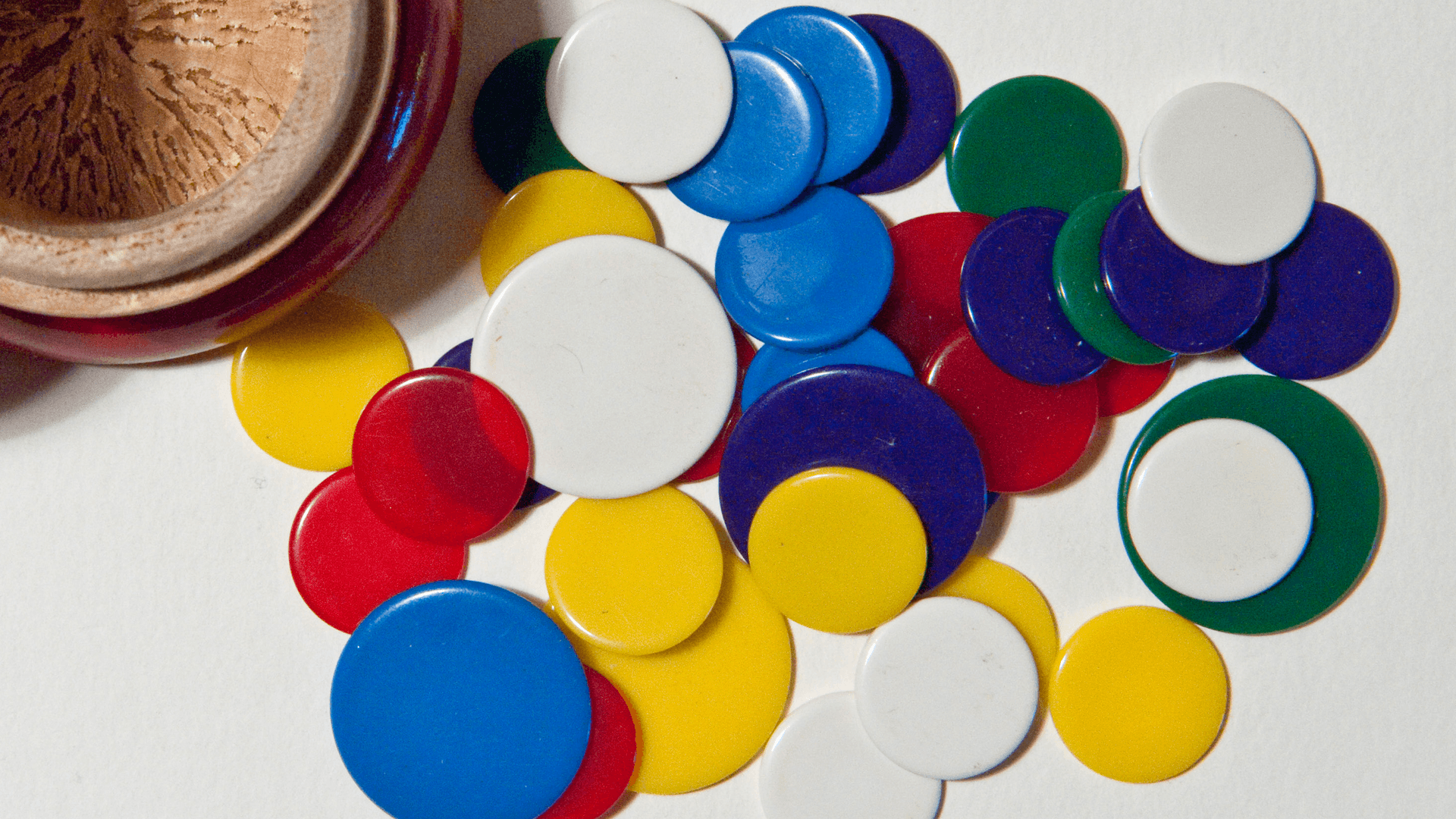
The materials are simple by design. The classic test uses 20 flat tokens that vary along three dimensions: two shapes (circles and rectangles in the original; many later versions use squares), two sizes (large and small), and five colors (originally red, blue, green, yellow, and white; some later editions replaced blue with black because patients found the two hard to tell apart).
The commands are organized into five parts of increasing difficulty. In the early parts, the grammar stays elementary and difficulty rises only because each command packs in more features to track:
• Part-by-part buildup: early items name one or two attributes ("Touch the yellow square"), then add size ("Touch the small yellow square"), then require two targets ("Touch the yellow square and the blue circle").
• The syntactic final part: the last section introduces grammatical particles and complex sentence structures, such as "Drop the yellow circle on the red square." Here the listener must understand prepositions, word order, and conditional phrasing, and act on them exactly.
The examinee never needs to speak. All responses are gestures: touching, picking up, or moving tokens. That matters clinically, because it lets an examiner assess comprehension separately from the speech-production problems that often dominate the picture in aphasia.
What the Token Test detects
The Token Test screens for receptive language deficits, and its reputation rests on sensitivity to problems that ordinary conversation hides. The test's publisher describes its core use case as identifying receptive language disorders in patients "who did not show comprehension disorders in a normal communicative interaction." Clinicians sometimes call these hidden problems "latent" aphasia: the patient chats appropriately, follows routine requests, and seems fine, yet fails once contextual crutches are removed.
The clinical context is common. According to the National Institute on Deafness and Other Communication Disorders, aphasia results from damage, usually from a stroke or traumatic brain injury, to the brain areas responsible for language, and roughly one-third of stroke survivors experience it. The same agency cites a National Aphasia Association estimate that about 2 million people in the United States are living with aphasia.
Because the Token Test isolates comprehension, clinicians rarely use it alone. It is typically paired with expressive measures such as the Boston Naming Test, which asks patients to name pictured objects, so that the evaluation covers both understanding and production of language.
Why such simple commands become so hard
A striking feature of the Token Test is that healthy adults find it almost trivially easy, while the final sections defeat many patients. Two ingredients drive the difficulty.
The first is load on "working memory," the mental workspace that holds information briefly while you use it. As commands lengthen, the listener must hold more attributes in mind at once: shape, color, size, and sometimes two targets plus an action. The second is syntax. In the final part, meaning depends on grammatical structure rather than vocabulary, so a listener who catches every word but loses the relationships between them still fails.
Research confirms that the test taps more than language alone. A 2022 study in Behavioral Sciences examined 37 stroke patients with right-hemisphere lesions and no aphasia at all, and found that about 57% still made Token Test errors. Errors on the hardest sections correlated with digit span scores, a standard index of verbal short-term and working memory, and with executive-function performance. The authors concluded that Token Test errors may not reflect an exclusively linguistic problem, so examiners should weigh other cognitive factors when interpreting a low score. That caution cuts both ways: the same properties that make the test sensitive also mean a poor score is a signal to investigate, never a diagnosis by itself. Comprehension of this kind is narrower than verbal reasoning, which involves drawing inferences and manipulating ideas expressed in words, but the two clearly share machinery.
Versions and scoring
Several forms of the Token Test are in active use, and scoring is deliberately modest: most versions simply credit each command performed correctly, then compare the total against norms.
• The original long form: just over 60 commands in five parts. It is thorough but time-consuming, which motivated shorter alternatives.
• The 36-item short form: published by De Renzi and Faglioni in 1978 in the journal Cortex with normative data from 215 healthy adults. Years of schooling, though not age, affected performance, so scores are adjusted for education. The authors set the cutoff at 29 adjusted points, a threshold that classified only 5% of healthy adults as impaired while catching 93% of the 200 aphasic patients they tested.
• The Token Test for Children, Second Edition (TTFC-2): published by PRO-ED in 2007 by Ronnie McGhee, David Ehrler, and Frank DiSimoni for ages 3 years 0 months through 12 years 11 months. According to the publisher, it presents 46 commands in four parts of increasing difficulty, takes 10 to 15 minutes, and was normed on 1,310 children across 22 states. It yields standard scores, percentile ranks, and age equivalents as a screening measure of receptive language.
• Computerized adaptations: research platforms now offer digital versions of the De Renzi and Vignolo procedure that present commands by audio and record responses automatically.
The Token Test and cognitive testing today
The Token Test occupies a specific niche: it is a focused clinical screen, usually embedded in a larger battery rather than given on its own. In a full neuropsychological evaluation, it sits alongside measures of memory, attention, and problem-solving to build a profile of strengths and deficits after brain injury or illness. It is a test of language comprehension after neurological damage, and it was never designed to measure intelligence in healthy people.
For readers interested in measuring their own cognitive abilities rather than screening for aphasia, a normed IQ test is the appropriate instrument. The RIOT IQ test, the Reasoning and Intelligence Online Test, was developed by RIOT IQ with psychometrician Dr. Russell T. Warne for adults 18 and older. It includes 15 subtests across six cognitive indices (verbal reasoning, fluid reasoning, spatial ability, working memory, processing speed, and reaction time), takes about 52 minutes, and reports scores on the familiar mean-100, standard-deviation-15 scale. Two of those indices, verbal reasoning and working memory, tap the same capacities that make the later Token Test items challenging. Like any online measure, it does not replace an individually administered diagnostic evaluation. It does provide a rigorous, convenient picture of general cognitive ability. You can take it at riotiq.com.
Frequently asked questions
What does the Token Test measure?
It measures receptive language, the ability to understand spoken commands. Because its hardest items are long and grammatically complex, performance also reflects verbal working memory and attention.
Who invented the Token Test?
Neurologists Ennio De Renzi and Luigi Vignolo of the University of Milan published it in the journal Brain in 1962 as a sensitive test for receptive disturbances in aphasia.
How long does the Token Test take?
The 36-item short form takes only a few minutes, and the children's version (TTFC-2) takes about 10 to 15 minutes according to its publisher. The original long form takes somewhat longer.
Is the Token Test an IQ test?
No. It is a clinical screen for language comprehension deficits after brain injury or stroke. Healthy adults score near the ceiling, so it cannot distinguish levels of general intelligence.
What is a passing score on the Token Test?
On the widely used 36-item short form, De Renzi and Faglioni set an education-adjusted cutoff of 29: scores below that level fall outside the range achieved by 95% of healthy adults and suggest a comprehension deficit worth investigating.
Can children take the Token Test?
Yes. The Token Test for Children, Second Edition (TTFC-2) is normed for ages 3:0 through 12:11 and is used to screen for receptive language problems in that age range.
References
1. De Renzi, E., & Vignolo, L. A. (1962). The Token Test: A sensitive test to detect receptive disturbances in aphasics. Brain, 85(4), 665–678. doi.org
2. De Renzi, E., & Faglioni, P. (1978). Normative data and screening power of a shortened version of the Token Test. Cortex, 14(1), 41–49. doi.org
3. Basagni, B., Pancani, S., Pellicciari, L., et al. (2022). Extra-linguistic cognitive functions involved in the Token Test: Results from a cohort of non-aphasic stroke patients with right hemisphere lesion. Behavioral Sciences, 12(12), 494. pmc.ncbi.nlm.nih.gov
4. PRO-ED. (2007). Token Test for Children–Second Edition (TTFC-2).. proedinc.com
5. National Institute on Deafness and Other Communication Disorders. Aphasia.. nidcd.nih.gov
6. Token Test (European publisher). Information about the Token Test.. tokentest.eu
7. Millisecond Software. Token Test (computerized adaptation of De Renzi %26 Vignolo, 1962).. millisecond.com
Hero photo: colorful plastic counters in red, blue, yellow, green, and white spilling from a small red pot across a plain white table. Photo by Hannes Grobe, CC BY 3.0 (https://creativecommons.org/licenses/by/3.0), via Wikimedia Commons, cropped.
Take our professional IQ test
Want to know your IQ? Try the first ever professional online IQ test.