What Is the TerraNova Test? A Guide to the Achievement Battery
The TerraNova test is a standardized achievement battery covering reading, language, math, science, and social studies in grades 2-12. See how it works.
Dr. Russell T. WarneChief Scientist
Share
The TerraNova test is a series of standardized "achievement tests," assessments that measure what a student has already learned in school, published by Data Recognition Corporation (DRC). Depending on the edition and format, it covers reading, language, mathematics, science, and social studies for students in grades 2 through 12. TerraNova is common in Catholic and other private schools and in homeschool settings, where it often serves as the annual standardized test. It is frequently confused with an IQ test, and the two measure different things. This article explains what the TerraNova covers, who takes it, how achievement tests differ from intelligence tests, and why a student's scores on the two kinds of tests can disagree.
---
What the TerraNova test measures
TerraNova is a "norm-referenced" test, meaning a student's performance is reported relative to a national sample of students in the same grade rather than against a fixed passing score. Results typically appear as "percentiles," the percentage of same-grade students nationwide whose scores fall at or below the student's score.
The core battery covers five subject areas:
• Reading: comprehension of passages at the student's grade level.
• Language: usage and conventions of written English.
• Mathematics: grade-level concepts and problem solving.
• Science: grade-appropriate science content.
• Social studies: grade-appropriate social studies content.
Schools can add optional "Plus" sections that break out word analysis, vocabulary, language mechanics, spelling, and math computation in finer detail.
Several editions remain in circulation. The TerraNova, Second Edition (also labeled the CAT 6) is still widely administered on paper. TerraNova 3 followed, including an online Complete Battery for grades 3 through 8. The newest edition, TerraNova Next, is available in both online and paper formats and reports norm-referenced data at national and local levels alongside criterion-referenced performance levels. TerraNova was originally developed by CTB/McGraw-Hill; DRC acquired the CTB assessment business from McGraw-Hill Education in 2015 and has published the test since.
---
Who takes the TerraNova?
Most public school students never see the TerraNova because states run their own accountability tests. The TerraNova's stronghold is the private and religious school sector, a niche it shares with the Iowa test, another nationally normed paper achievement battery. Catholic diocesan school systems are prominent users; in the Archdiocese of Philadelphia, for example, students in grades 2 through 7 take the TerraNova each year, and other dioceses use the test as well. Because it is a nationally normed achievement test, it also serves homeschool families who want (or are required by their state to obtain) an annual standardized measure of progress.
Homeschool families can administer the test through approved distributors. Seton Testing Services, one of the largest, rents paper test booklets to homeschools, private schools, and public schools for a 14-day window. The test is timed, and total testing time runs from about 1.5 to 5.5 hours depending on grade level and format.
Parents sometimes assume these annual school tests reveal a child's intelligence. In most cases they do not attempt to; schools generally test achievement rather than IQ, a distinction covered in more detail in do schools test for IQ.
---
How an achievement test differs from an IQ test
An achievement test measures learned academic content that is tied to a curriculum: whether a fifth grader can do fifth-grade math, read fifth-grade passages, and recall fifth-grade science. An intelligence test instead measures reasoning ability with material that depends as little as possible on specific schooling, such as pattern recognition, spatial visualization, and working memory tasks. Intelligence researchers, including Dr. Russell T. Warne, treat the two as related but distinct constructs: schooling quality changes achievement scores directly, while reasoning ability is broader than any curriculum.
The TerraNova ecosystem itself respects this distinction. DRC pairs the TerraNova with a separate companion test called InView, an ability measure that an Archdiocese of Philadelphia testing official described simply: "we compare ability with achievement." Schools use that pairing because the two scores answer different questions. A group-administered school ability test such as the CogAT plays a similar role alongside achievement batteries in public districts.
A useful rule of thumb: if the test asks what you were taught, it is an achievement test. If it asks you to reason through unfamiliar problems, it is closer to an intelligence test.
---
Why TerraNova scores and IQ scores can disagree
Achievement and intelligence are strongly correlated, which is why the confusion between the two persists. A meta-analysis of 240 samples with 105,185 participants found a population correlation of about .54 between intelligence test scores and school grades. When measurement error is stripped out at the level of underlying traits, the link is stronger still: in a study of roughly 70,000 English children, general intelligence measured at age 11 correlated .81 with national exam achievement at age 16.
A correlation of .54, or even .81, still leaves substantial room for the two scores to part ways in an individual student. Common reasons include:
• Curriculum exposure: an achievement test can only credit content a student has been taught. A bright student in a weak program, or one who moved between curricula, may post modest TerraNova scores despite strong reasoning ability.
• Effort and study habits: conscientious students can outscore their measured ability on achievement tests through steady work; the reverse pattern appears in able students who disengage.
• Test conditions and error: every score carries "measurement error," random variation from attention, health, and the particular items on the form. Two tests taken months apart will rarely match exactly.
• Different score scales and norms: a percentile on a grade-based achievement norm is a different quantity from an IQ score on an age-based norm, so the numbers are not interchangeable even when both are high.
Schools sometimes use an "ability-achievement comparison" formally, flagging students whose achievement runs well below measured ability for follow-up. Large gaps in either direction are also one signal used in gifted identification, where an achievement battery alone can miss a strong reasoner who has not yet been taught the content.
---
Where an online reasoning test fits
The TerraNova answers a curricular question: is this student learning grade-level material? It was never designed to estimate reasoning ability, and a TerraNova percentile should not be read as an IQ score. Anyone who wants a measure of reasoning ability needs an instrument built for that purpose and normed for it.
The RIOT IQ test (the Reasoning and Intelligence Online Test, from RIOT IQ) is one such instrument. It measures six cognitive abilities (verbal reasoning, fluid reasoning, spatial ability, working memory, processing speed, and reaction time), reports scores on the familiar IQ scale with a mean of 100 and a standard deviation of 15, and was built with intelligence researcher Dr. Russell T. Warne. For a student or adult who already has achievement data from a test like the TerraNova, a normed reasoning score adds the other half of the ability-achievement picture. You can take the test at riotiq.com.
As with any single test score, treat the result as an estimate with a confidence interval rather than a fixed label. That caution applies equally to a TerraNova percentile and to an IQ score.
---
Frequently asked questions
Is the TerraNova an IQ test?
No. The TerraNova is a norm-referenced achievement test that measures learned school content. Its publisher offers a separate ability test, InView, for measuring the skills that support academic success.
What grades take the TerraNova test?
Editions cover grades 2 through 12, depending on format. The paper TerraNova 2/CAT 6 spans grades 2 to 12, the TerraNova 3 online Complete Battery covers grades 3 to 8, and the Archdiocese of Philadelphia, a representative Catholic school user, tests grades 2 through 7 annually.
Who publishes the TerraNova?
Data Recognition Corporation (DRC), which acquired the test in 2015 from McGraw-Hill Education's CTB assessment business. CTB/McGraw-Hill developed the original TerraNova.
Can homeschoolers administer the TerraNova?
Yes. Distributors such as Seton Testing Services rent the test to homeschools as well as private and public schools, with a 14-day rental window for the paper booklets.
Is the TerraNova timed?
Yes. Total testing time runs from roughly 1.5 to 5.5 hours depending on grade level and format.
---
References
1\. Data Recognition Corporation. (n.d.). TerraNova Next. terranovanext.com. https://www.terranovanext.com/
3\. Data Recognition Corporation. (2015, June 30). Data Recognition Corporation (DRC) announces agreement to acquire key assets of the CTB assessment business of McGraw-Hill Education [Press release]. PR Newswire. https://www.prnewswire.com/news-releases/data-recognition-corporation-drc-announces-agreement-to-acquire-key-assets-of-the-ctb-assessment-business-of-mcgraw-hill-education-300106912.html
5\. CatholicPhilly.com. (2023, July). Catholic school students show consistent performance on TerraNova tests. https://catholicphilly.com/2023/07/news/local-news/catholic-school-students-show-consistent-performance-on-terranova-tests/
6\. Deary, I. J., Strand, S., Smith, P., & Fernandes, C. (2007). Intelligence and educational achievement. Intelligence, 35(1), 13–21. https://doi.org/10.1016/j.intell.2006.02.001
7\. Roth, B., Becker, N., Romeyke, S., Schäfer, S., Domnick, F., & Spinath, F. M. (2015). Intelligence and school grades: A meta-analysis. Intelligence, 53, 118–137. https://doi.org/10.1016/j.intell.2015.09.002
8\. Warne, R. T. (2020). In the know: Debunking 35 myths about human intelligence. Cambridge University Press. https://searchworks.stanford.edu/view/13735699
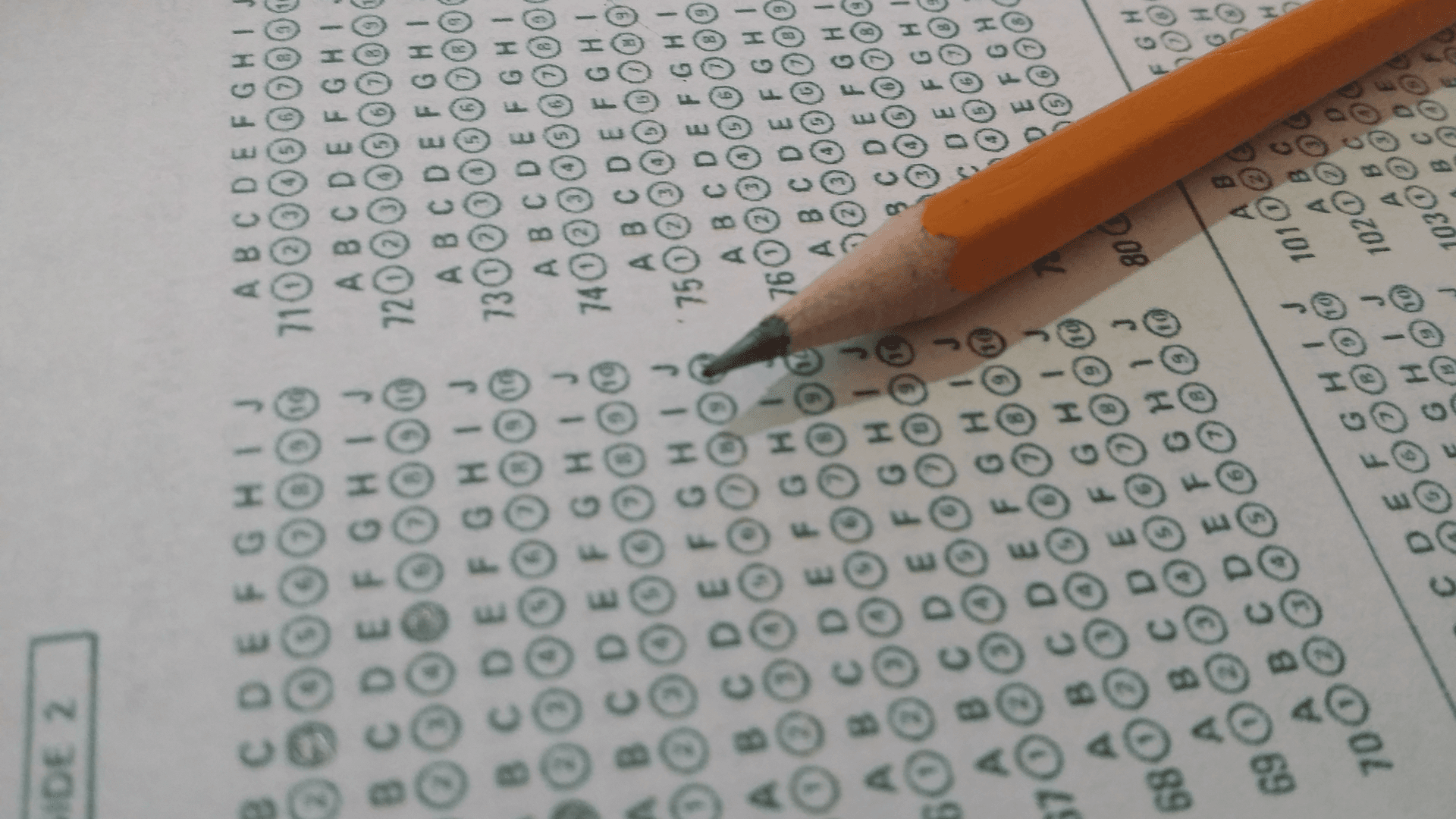
Hero photo: a pencil resting on a multiple-choice bubble answer sheet. Photo by lecroitg, CC0 1.0, via Wikimedia Commons.
Take our professional IQ test
Want to know your IQ? Try the first ever professional online IQ test.