What Is the AFOQT? The Air Force Officer Qualifying Test Explained
The AFOQT is the Air Force's officer aptitude test: 12 subtests, percentile scoring, and pilot composites. See what it measures and how it relates to IQ.
Dr. Russell T. WarneChief Scientist
Share
The AFOQT, or Air Force Officer Qualifying Test, is the standardized aptitude test the U.S. Air Force and Space Force use to select candidates for officer commissioning programs and for rated career fields such as pilot. The current version, Form T, has been in use since August 2014. It packs 12 subtests into a session lasting just under five hours, and it reports results as percentile scores from 1 to 99 against other applicants. Minimums are set by Air Force regulation: the 15th percentile on the Verbal composite and 10th on the Quantitative composite for commissioning, and the 25th percentile on the relevant composite for pilot and other rated jobs.
What is on the AFOQT
Form T contains 12 subtests. Five cover classic academic aptitude: Verbal Analogies, Arithmetic Reasoning, Word Knowledge, Math Knowledge, and Reading Comprehension. Four cover aviation and technical material: Instrument Comprehension, Table Reading, Block Counting, and Aviation Information. Physical Science covers school science. The remaining two are different in kind: a 50-item Situational Judgment Test scored against the consensus of high-performing Air Force officers, and a 240-item Self-Description Inventory, a personality measure that feeds no aptitude composite. Total time in the room runs about 4 hours and 47 minutes, with roughly 3 hours and 37 minutes of actual testing.
The seven composite scores
• Pilot: Math Knowledge, Table Reading, Instrument Comprehension, and Aviation Information.
• CSO: The Combat Systems Officer composite: Word Knowledge, Math Knowledge, Table Reading, and Block Counting.
• ABM: The Air Battle Manager composite blends six subtests, from Verbal Analogies through Aviation Information.
• Academic Aptitude, Verbal, and Quantitative: The general-ability composites, built from the five academic subtests.
• Situational Judgment: Reported as its own composite from the Situational Judgment Test.
The Pilot composite also feeds the Pilot Candidate Selection Method (PCSM) score, together with the Test of Basic Aviation Skills and logged flying hours.
How AFOQT scoring works
Every composite is a percentile from 1 to 99 showing where you stand relative to other AFOQT examinees, not the percentage of questions you answered correctly. Three administrations are allowed in a lifetime (the third requires a waiver), with at least 90 days between attempts. Two rules are unusually test-taker-friendly: scores never expire, and the Air Force superscores, meaning your best composite from any attempt becomes your score of record. There is no penalty for guessing.
Minimums are floors, not targets. Selection boards treat scores competitively, and successful applicants typically score far above the regulatory minimums. The Air Force also revalidates the test on a fixed cycle, recalibrating composites at least every five years.
Is the AFOQT an IQ test?
Structurally, it is close. Factor analyses of the AFOQT consistently find a large general cognitive ability factor underneath the subtests: Carretta and Ree mapped a hierarchical structure with "g" at the apex in 1996, and a 2023 analysis of Form T data found a general ability factor plus four specific abilities. That makes the AFOQT a heavily g-loaded instrument, like every serious aptitude test.
But an AFOQT percentile is not an IQ. The norm group is the Air Force applicant pool, a smaller and more selected group than the general population, so the 50th percentile on the AFOQT does not mean average intelligence in the everyday sense. The rated composites also mix learned aviation knowledge with reasoning, which a pure intelligence test would exclude. The military's enlisted-side equivalent works the same way, as we cover in our guide to military IQ and the ASVAB. If you want your reasoning measured against the general population on a true IQ scale, that is what the RIOT IQ test is built for.
Frequently asked questions
What AFOQT score do I need?
By regulation: Verbal 15 and Quantitative 10 for line officer commissioning, and 25 on the Pilot, CSO, or ABM composite for those career fields. Competitive selection usually demands much more.
How many times can you take the AFOQT?
Three times in a lifetime, with the third attempt requiring a waiver, and at least 90 days between attempts. Your best composite scores across attempts are superscored.
Do AFOQT scores expire?
No. Under current Air Force policy, valid AFOQT scores have no expiration date.
Is the AFOQT harder than the ASVAB?
It targets a different population. The AFOQT is normed on officer applicants, who are on average a more selected group, and it adds aviation-specific content the ASVAB does not have.
Can you study for the AFOQT?
Yes, especially the knowledge-heavy subtests such as Aviation Information and Physical Science. Note that official policy restricts group study for anyone who has already tested.
References
1. Carretta, T. R., & Ree, M. J. (1996). Factor structure of the Air Force Officer Qualifying Test: Analysis and comparison. Military Psychology, 8(1), 29-42. doi.org/10.1207/s15327876mp0801_3
2. ALMamari, K. (2023). Factor structure and criterion-related validity of the Air Force Officer Qualifying Test Form T for pilot applicants. Assessment, 30(2), 508-532. doi.org/10.1177/10731911211058691
3. Ree, M. J., & Earles, J. A. (1992). Intelligence is the best predictor of job performance. Current Directions in Psychological Science, 1(3), 86-89. doi.org/10.1111/1467-8721.ep10768746
4. Department of the Air Force. (2025). Personnel assessment program (DAFMAN 36-2664). e-publishing.af.mil
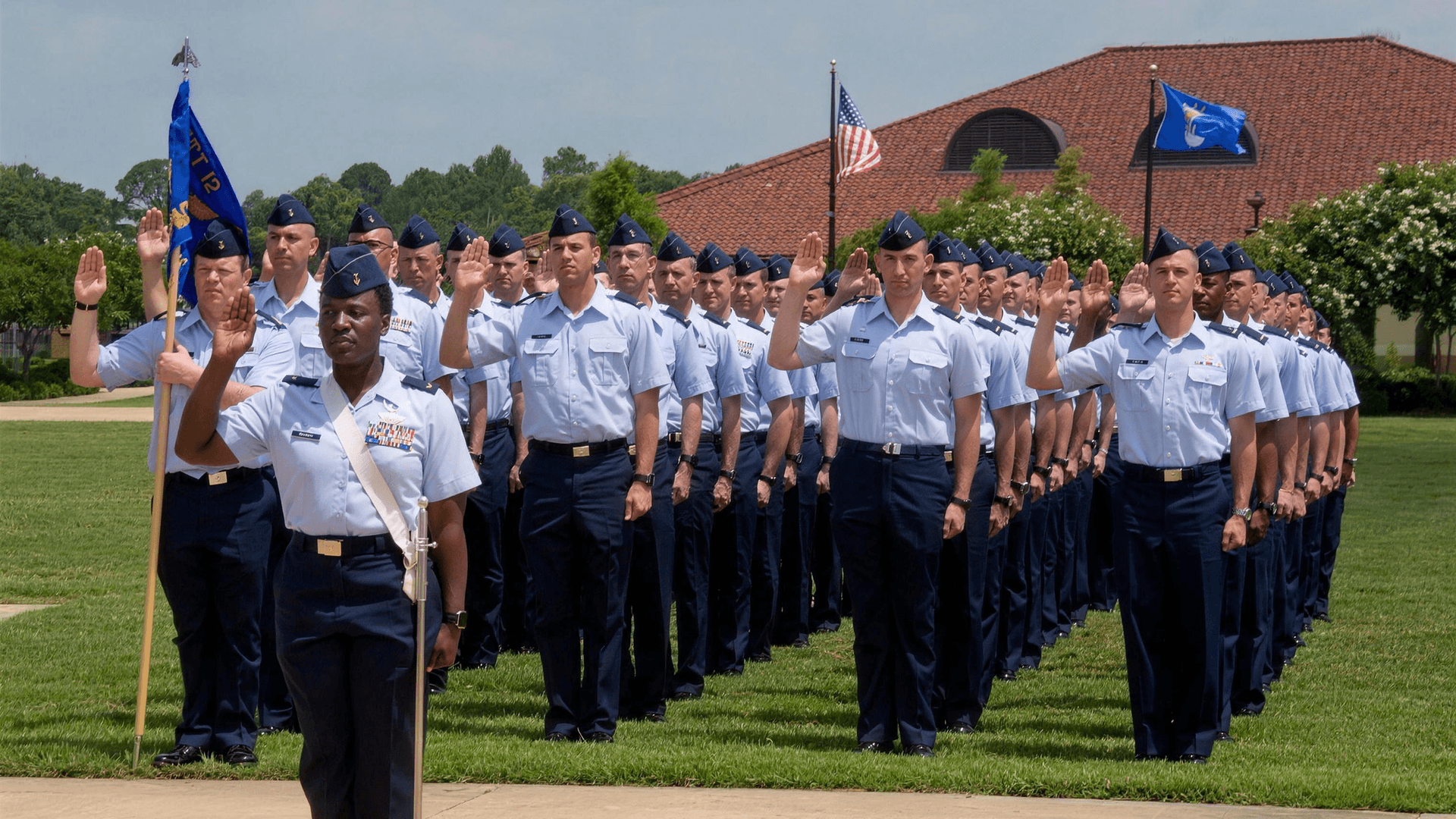
Hero photo: Officer Training School cadets take the oath of office at Maxwell Air Force Base, Alabama, June 2016. U.S. Air Force photo by Melanie Rodgers Cox, public domain.
Take our professional IQ test
Want to know your IQ? Try the first ever professional online IQ test.