Aug 16, 2026·Specific IQ Tests & FormatsWhat Is the Peabody Picture Vocabulary Test? The PPVT-5 Explained
The Peabody Picture Vocabulary Test (PPVT-5) measures receptive vocabulary for ages 2:6 to 90+. See how it is scored and why it is not a full IQ test.
Dr. Russell T. WarneChief Scientist
The Peabody Picture Vocabulary Test, now in its fifth edition as the PPVT-5, is a brief, individually administered measure of "receptive vocabulary," the words a person understands when heard. The format is simple: the examiner says a word, and the test taker points to the one of four pictures that matches it. The test covers ages 2 years 6 months through 90 and older, takes 10 to 15 minutes, and yields a single standard score with a mean of 100 and a standard deviation of 15. PPVT scores correlate substantially with IQ, and the test is still not an IQ test; this article explains both halves of that sentence.
How the test works
Each item shows four pictures. The examiner reads a stimulus word aloud, and the examinee answers by pointing or speaking, so the test demands no reading, writing, or problem solving of any kind. Starting points depend on age, and testing stops after 6 consecutive incorrect responses, so nobody sits through every item. That design is what makes the PPVT usable with toddlers, elderly adults, and people with motor or speech difficulties who cannot manage a conventional test.
Results come back as age-based standard scores (mean 100, SD 15) plus percentiles, stanines, normal curve equivalents, age equivalents, and Growth Scale Values for tracking change over time. The PPVT-5 can be given on paper or digitally, and Pearson lists it at qualification level B, which covers speech-language pathologists, school psychologists, special educators, and researchers.
What the PPVT measures
Receptive vocabulary is a classic marker of "crystallized" ability, the accumulated knowledge side of intelligence, and vocabulary is one of the best single indicators of verbal ability that psychology has. Words are learned over a lifetime of listening, reading, and reasoning about meaning, so a large receptive vocabulary reflects a long history of successful learning. That is why a 10-minute picture test can serve as a quick estimate of verbal ability. We cover the underlying science in our articles on
what vocabulary tests measure and
crystallized intelligence.
What the PPVT does not measure
The PPVT-5 deliberately provides no composite scores, because it measures only receptive vocabulary. It says nothing about fluid reasoning, working memory, processing speed, spatial ability, or even expressive language. Research comparing the PPVT with Wechsler scales makes the practical point: the two are correlated but should not be used interchangeably for individuals (Bell et al., 2001). A person's PPVT score is a vocabulary measurement, and treating it as an IQ would stretch one narrow ability, however well it tracks "g" overall, into a claim about many. A full battery such as the
WISC-V samples the broader set of abilities that an IQ score summarizes.
Who uses the PPVT and when
Speech-language pathologists use the PPVT to assess language development and delays; schools use it in evaluations where a child's understanding of spoken words is at issue; researchers use it as a fast verbal-ability estimate. It is co-normed with the Expressive Vocabulary Test, Third Edition (EVT-3), meaning both tests were standardized on the same sample, so an examiner can compare a person's receptive and expressive vocabulary directly and spot gaps between understanding and production. The PPVT-5 norms rest on a national standardization sample of 2,720 individuals from age 2:6 upward.
A short history
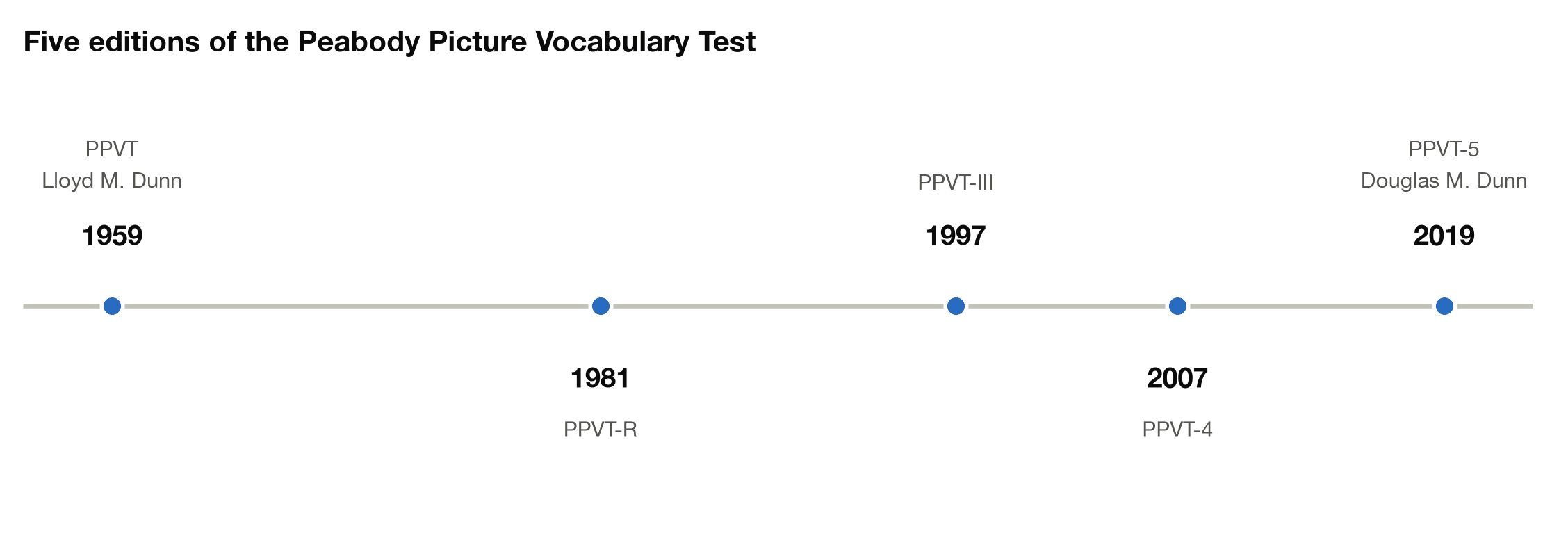
Lloyd M. Dunn published the original PPVT in 1959, one of a series of assessment tools he and his wife Leota developed at Peabody College, now part of Vanderbilt University. Revisions followed in 1981 (PPVT-R), 1997 (PPVT-III), and 2007 (PPVT-4), and the current PPVT-5, authored by Douglas M. Dunn and published in 2018 with a 2019 citation date, continues the family line. Few psychological instruments have stayed in continuous use, under the same name and format, for more than sixty-five years.
The PPVT answers one question well: how large is your receptive vocabulary? To measure the fuller range of abilities behind an IQ score, reasoning, memory, speed, and knowledge together, a full-length instrument is the right tool. The Reasoning and Intelligence Online Test from RIOT IQ is a validated, normed assessment, and the
free IQ test is the easiest place to start.
Frequently asked questions
What does the Peabody Picture Vocabulary Test measure?
It measures receptive vocabulary: how many spoken Standard American English words a person understands. The examiner says a word, and the examinee picks which of four pictures matches it. It yields one standard score with a mean of 100 and an SD of 15, and no IQ.
Is the Peabody test an IQ test?
No. PPVT scores correlate with IQ because vocabulary is strongly tied to general and crystallized ability, but the PPVT-5 samples a single narrow skill and provides no composite scores. Research comparing the PPVT with Wechsler scales concludes the two should not be used interchangeably.
What ages is the PPVT-5 for?
Ages 2 years 6 months through 90 and older, with age-based norms across the lifespan.
How long does the PPVT-5 take?
About 10 to 15 minutes. Start points depend on age, and testing stops after 6 consecutive errors, so nobody sits through every item.
Who administers the PPVT?
Professionals at Pearson qualification level B, typically speech-language pathologists, school psychologists, special educators, and researchers. The examinee needs no reading, speaking, or writing, which is why it works for very young children and people with motor or speech difficulties.
What is the difference between the PPVT-5 and the EVT-3?
The PPVT-5 tests receptive vocabulary, the words you understand, while the EVT-3 tests expressive vocabulary, the words you can produce. They are co-normed on the same sample, so scores can be compared directly to spot receptive-expressive gaps.
References
1. Pearson. (2019).
Peabody Picture Vocabulary Test, Fifth Edition (PPVT-5) [Product page]. pearsonassessments.com2. SpLD Assessment Standards Committee. (2025, November).
PPVT-5 assessor guidance. SASC.
sasc.org.uk3. Bousard, I., & Brysbaert, M. (2021).
The Dutch Auditory & Image Vocabulary Test (DAIVT): A new Dutch receptive vocabulary test for students. Psychologica Belgica, 61(1).
doi.org/10.5334/pb.5524. Bell, N. L., Lassiter, K. S., Matthews, T. D., & Hutchinson, M. B. (2001).
Comparison of the Peabody Picture Vocabulary Test-Third Edition and Wechsler Adult Intelligence Scale-Third Edition with university students. Journal of Clinical Psychology, 57(3), 417-422.
doi.org/10.1002/jclp.10245. Vanderbilt Kennedy Center. (n.d.).
Lloyd Dunn and the Peabody Picture Vocabulary Test. Vanderbilt University Medical Center.
vkc.vumc.org6. Texas Statewide Leadership for Autism Training. (n.d.).
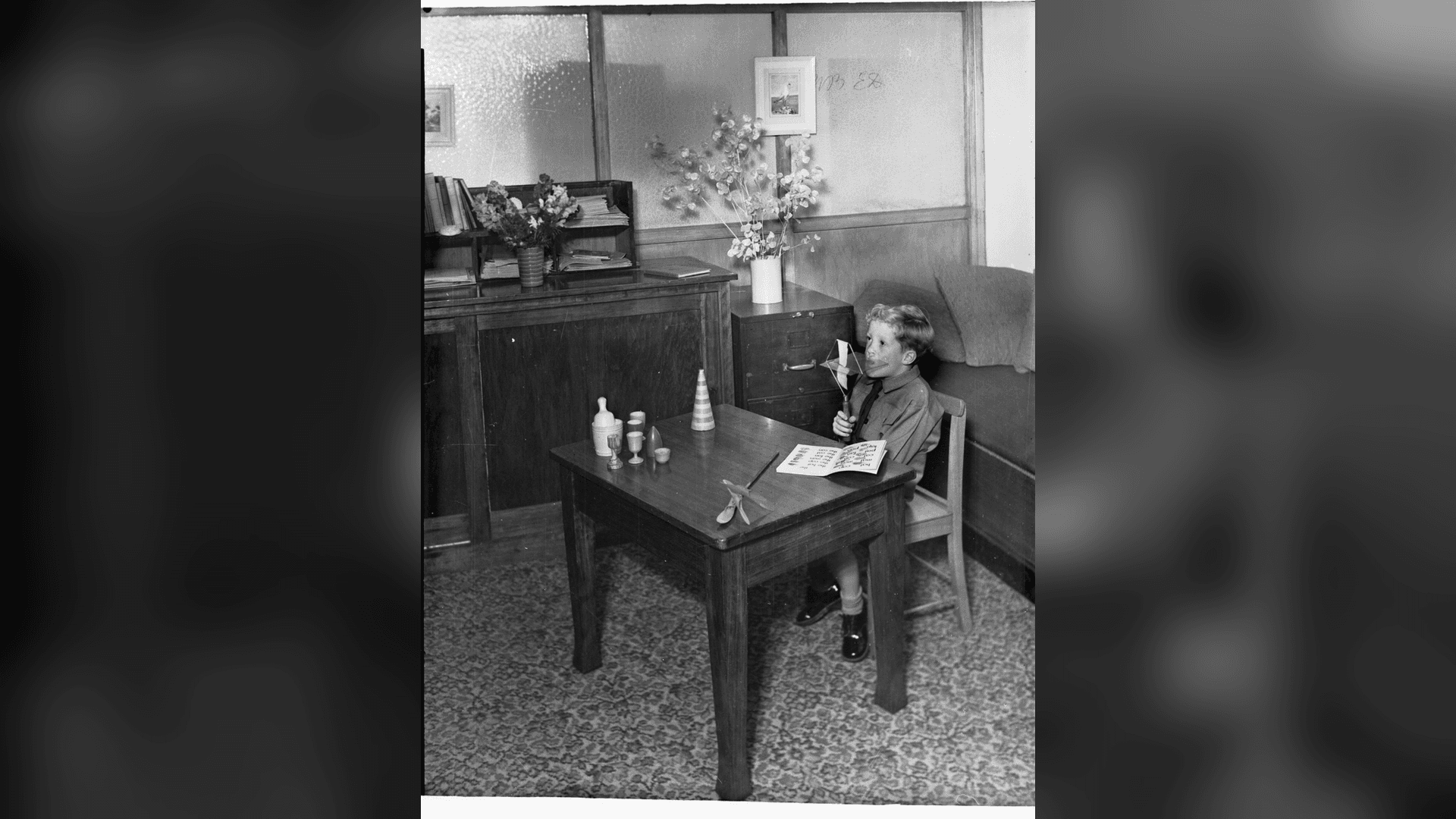
Peabody Picture Vocabulary Test, Fifth Edition [Evaluation summary]. txautism.netHero image: a young student works with picture materials in a speech therapy clinic, circa 1945. State Government Photographer, History Trust of South Australia, CC0, via Wikimedia Commons. Take our professional IQ test
Want to know your IQ? Try the first ever professional online IQ test.
AuthorDr. Russell T. WarneChief Scientist