What is the Children's Memory Scale? The CMS explained
The Children's Memory Scale (CMS) is a clinician-administered memory and learning test for ages 5 to 16. Learn its subtests, index scores, and link to IQ.
Dr. Russell T. WarneChief Scientist
Share
The Children's Memory Scale (CMS) is an individually administered test of learning and memory for children aged 5 through 16, written by neuropsychologist Morris Cohen and published in 1997 by The Psychological Corporation, now part of Pearson. It is given one-on-one by a psychologist or other examiner qualified at the publisher's "C level," the tier reserved for professionals with graduate training in psychological assessment. The CMS is not an IQ test. It measures how well a child takes in, holds, and retrieves verbal and visual information, along with the attention and "working memory" (the ability to hold information in mind while using it) that support learning. Its scores are designed to be set beside an IQ score so an examiner can see whether a child's memory is in line with general ability or falls short of it. This article covers what the CMS measures, its subtests and eight index scores, how it links to the Wechsler intelligence scales, and what it cannot tell you.
What the Children's Memory Scale measures
According to Pearson, the CMS "fills the need for a comprehensive learning and memory test for children ages five to 16," and it measures learning across several memory dimensions: attention and working memory, verbal and visual memory, short- and long-delay memory, recall and recognition, and learning characteristics. The current distributor, Multi-Health Systems (MHS), describes it as a test that "enables you to compare memory and learning to ability, attention, and achievement."
Pearson's technical report on the CMS organizes the battery into three domains.
• Auditory/verbal memory: remembering material a child hears, such as short stories and pairs of words.
• Visual/nonverbal memory: remembering material a child sees, such as the positions of dots on a grid or a set of faces.
• Attention/concentration: holding and manipulating short sequences of numbers or ordered information, the working-memory foundation that every other memory task relies on.
Within the two memory domains, each subtest is given twice. The "immediate" portion asks the child to reproduce material right after it is presented. The "delayed" portion returns to the same material after about 30 minutes to see how much has survived the interval. Cohen's own summary of the test, published in the Encyclopedia of Clinical Neuropsychology, notes that each subtest in the verbal and visual domains provides measures of both immediate and delayed recall. Several delayed tasks also include a "recognition" trial, where the child picks out previously presented items from a set of choices. The difference matters clinically: a child who cannot retell a story but recognizes its details when prompted has a retrieval problem rather than a storage problem.
The subtests and how the session runs
Pearson's technical report lists nine subtests, arranged so that each domain has two core subtests and one supplemental subtest.
• Auditory/verbal domain: Stories and Word Pairs are the core subtests; Word Lists is supplemental. All three have immediate and delayed portions.
• Visual/nonverbal domain: Dot Locations and Faces are the core subtests; Family Pictures is supplemental. Again, each has immediate and delayed portions.
• Attention/concentration domain: Numbers and Sequences are the core subtests; Picture Locations is supplemental. The report notes that Numbers is an alternate form of the Digit Span task on the Wechsler children's scale.
The publisher reports an unusual timing structure. The six core subtests take about 20 minutes, followed by a built-in 30-minute break, and then the delayed memory tasks take another 10 to 15 minutes. Pearson notes that examiners can administer other verbal or nonverbal measures during the break, which is why the CMS is often slotted into a longer evaluation alongside an intelligence or achievement test. Two record forms exist, one for ages 5 to 8 and one for ages 9 to 16.
The publisher's norms come from a national sample of 1,000 children described as normally functioning, a modest sample by modern standards and one collected in the mid-1990s.
The eight index scores
The CMS reports "scaled scores" for individual subtests and eight index scores that combine subtests. Pearson's technical report lists the indexes as Verbal Immediate, Verbal Delayed, Visual Immediate, Visual Delayed, Attention/Concentration, Learning, Delayed Recognition, and General Memory. Six come from subtests within a single domain. The Learning index draws on both the verbal and visual domains, and the General Memory Index, according to the report, combines the immediate and delayed memory indexes from both domains.
Index scores use the familiar "standard score" scale with a mean of 100 and a "standard deviation," a measure of how spread out scores are, of 15. Pearson chose that scale so CMS indexes can be compared directly with Wechsler composite scores.
Reliability is uneven across the indexes. Pearson's technical report gives an average reliability of .91 for General Memory, .86 for Verbal Immediate, .84 for Verbal Delayed, and .87 for Attention/Concentration, but only .76 for both Visual Immediate and Visual Delayed. The visual indexes therefore carry a wider margin of error, and a moderate dip on one of them deserves more caution than the same dip on a verbal index.
How the CMS relates to an IQ test
The CMS was built to sit beside the Wechsler intelligence scales rather than replace them. When Pearson standardized the WISC-IV in 2003, it collected linking data on the CMS by giving both tests to 126 children aged 6 to 16, on average about 12 days apart. According to the technical report, the WISC-IV Full Scale IQ correlated .61 with the CMS General Memory Index, .63 with Verbal Delayed, and .72 with Attention/Concentration, but only .34 with Visual Immediate and .31 with Visual Delayed. The highest single relationship, .74, was between the WISC-IV Working Memory Index and the CMS Attention/Concentration Index, which the report attributes partly to overlapping task formats.
Pearson's authors summarize the pattern this way: the results "support that memory functioning is a distinct cognitive process that is related to the intellect but not the same as intellectual functioning." A meta-analysis by Ackerman, Beier, and Boyle in Psychological Bulletin reached a similar conclusion for working memory and general intelligence, which is why a memory battery can add information an IQ test does not already contain.
The practical tool that comes out of the linking study is the "ability-memory discrepancy analysis." The examiner uses the child's Full Scale IQ (or, in some cases, the General Ability Index or a factor index) to predict the memory score that would be expected, then checks whether the observed CMS score falls meaningfully below that prediction. A large, unusual gap is a signal worth investigating; a small gap is noise. Pearson's report recommends this predicted-actual method over a simple difference because it accounts for the correlation between the two tests. Readers comparing options may want to see how the WRAML-3 and the TOMAL-2 approach the same problem, and how the adult-oriented Wechsler Memory Scale handles memory and IQ comparison at older ages.
Who uses the CMS, and its limitations
Pearson positions the CMS as a tool for learning disability and attention evaluations and as a "process skills screening instrument" for children with diagnosed conditions such as traumatic brain injury, ADHD, epilepsy, cancer, brain tumors, or strokes. In practice it is used by clinical psychologists, school psychologists, and pediatric neuropsychologists who need to document memory as a specific process rather than infer it from an IQ profile, and the results feed intervention planning.
Three limitations deserve plain statement.
• Age of the norms: the standardization sample was collected for a 1997 publication. Norms drift over decades, and a child tested today is being compared with peers from a generation ago.
• Distribution and platform changes: Pearson's product page states that CMS kits, manuals, and forms are now sold through Multi-Health Systems, and that digital administration on Pearson's Q-interactive platform ended after 2022. The test remains available, but it is hand-scored.
• Retest noise: an analysis by Brooks, Holdnack, and Iverson in Archives of Clinical Neuropsychology used the CMS retest sample of 125 healthy children, tested about two months apart, and found that having at least one index or subtest score change by a statistically reliable amount was common, while change on three or more scores was rare. A single score that moves between evaluations should therefore not be over-interpreted.
The CMS produces scores, not diagnoses. What a memory profile means is a judgment for the qualified clinician who administered it, informed by history, observation, and other measures.
Memory scores, IQ scores, and where an online test fits
The CMS and an IQ test answer different questions. An IQ test estimates general reasoning ability; the CMS estimates how efficiently a child stores and retrieves new material. The two are related enough that the comparison is informative and different enough that neither can stand in for the other. For adults who want a rigorous estimate of the reasoning side of that picture, the RIOT IQ test, the Reasoning and Intelligence Online Test, was developed by RIOT IQ with psychometrician Dr. Russell T. Warne for people 18 and older. It includes 15 subtests across six cognitive indices (verbal reasoning, fluid reasoning, spatial ability, working memory, processing speed, and reaction time), takes about 52 minutes, and reports scores on the same mean-100, standard-deviation-15 scale as the CMS indexes. It is a measure of ability rather than a clinical memory battery, and it does not replace an individually administered diagnostic evaluation like the one the CMS is part of.
Frequently asked questions
What ages is the Children's Memory Scale for?
Pearson lists the CMS age range as 5 through 16 years, with separate record forms for ages 5 to 8 and ages 9 to 16.
Is the Children's Memory Scale an IQ test?
No. It measures learning and memory, and its index scores are designed to be compared with an IQ score so an examiner can judge whether memory is in line with general ability. Pearson's own linking data show moderate correlations between CMS indexes and WISC-IV IQ, consistent with related but distinct abilities.
How long does the CMS take?
The publisher reports about 20 minutes for the six core subtests, a 30-minute break during which other tests can be given, and then 10 to 15 minutes of delayed memory tasks.
What are the eight CMS index scores?
Verbal Immediate, Verbal Delayed, Visual Immediate, Visual Delayed, Attention/Concentration, Learning, Delayed Recognition, and General Memory. Each is reported on a scale with a mean of 100 and a standard deviation of 15.
Who can administer the Children's Memory Scale?
It is a qualification level C instrument, restricted to professionals with graduate training in psychological assessment, such as clinical psychologists, school psychologists, and neuropsychologists.
Is there a newer edition of the CMS?
No. As of 2026 the 1997 edition is the only one; the publisher's product page and the MHS storefront both list the original Cohen (1997) test. Clinicians who want newer norms often turn to the WRAML-3, published in 2021.
3. Drozdick, L. W., Holdnack, J., Rolfhus, E., & Weiss, L. (2005). WISC-IV and Children's Memory Scale (WISC-IV Technical Report No. 5). Harcourt Assessment. pearsonassessments.com
4. Cohen, M. J. (2011). Children's Memory Scale. In J. S. Kreutzer, J. DeLuca, & B. Caplan (Eds.), Encyclopedia of Clinical Neuropsychology. Springer. link.springer.com
5. Brooks, B. L., Holdnack, J. A., & Iverson, G. L. (2017). Reliable change on memory tests is common in healthy children and adolescents. Archives of Clinical Neuropsychology, 32(8), 1001–1009. pmc.ncbi.nlm.nih.gov
6. Ackerman, P. L., Beier, M. E., & Boyle, M. O. (2005). Working memory and intelligence: The same or different constructs? Psychological Bulletin, 131(1), 30–60. pubmed.ncbi.nlm.nih.gov
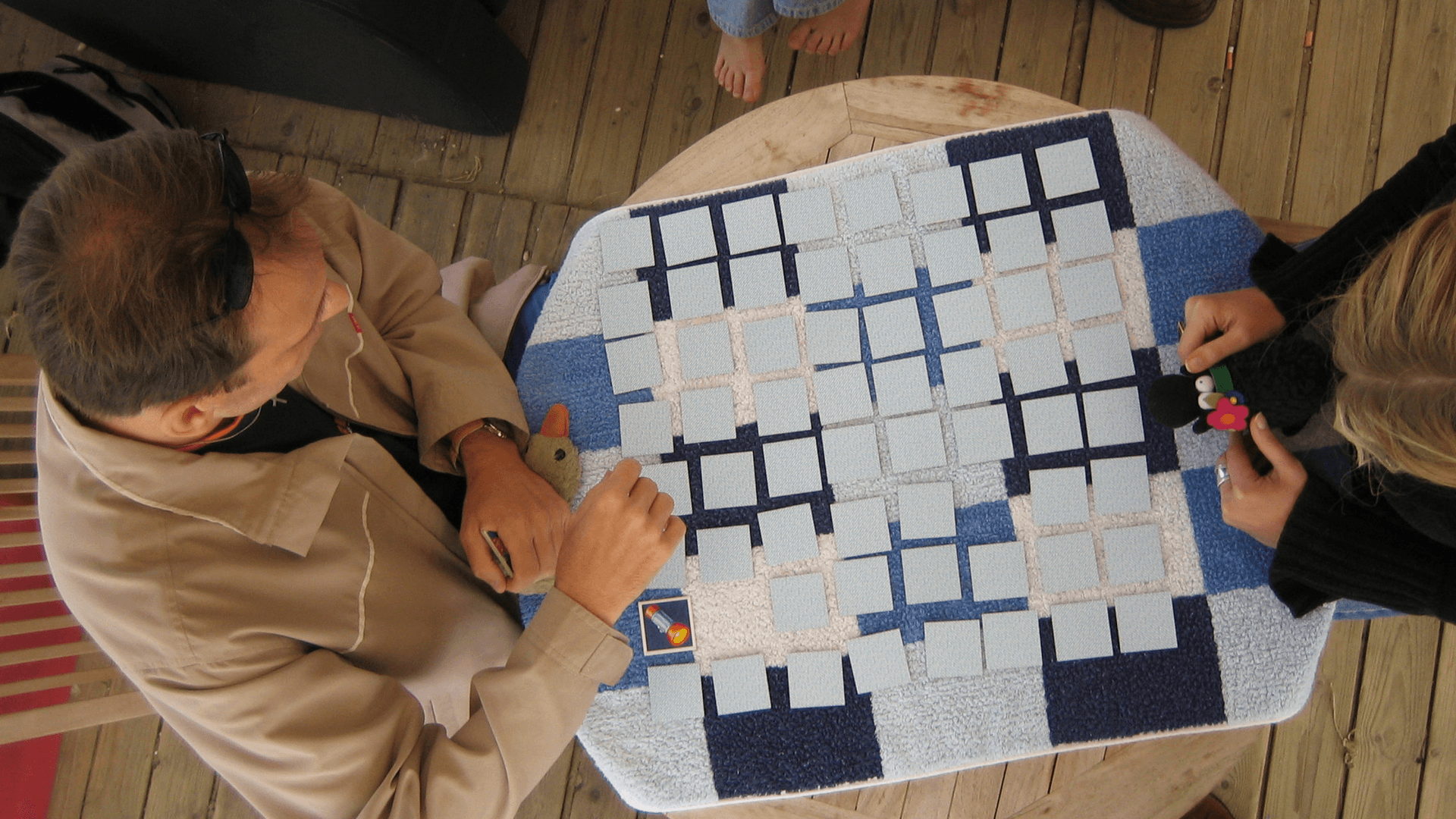
Hero photo: An adult and a child playing a memory matching game. Photo by Tilanus, via Wikimedia Commons, CC BY-SA 3.0 (cropped).
Take our professional IQ test
Want to know your IQ? Try the first ever professional online IQ test.