What is the Woodcock Johnson test? Learn how the WJ V measures cognitive abilities, achievement, and oral language, and how evaluators use its scores.
Dr. Russell T. WarneChief Scientist
Share
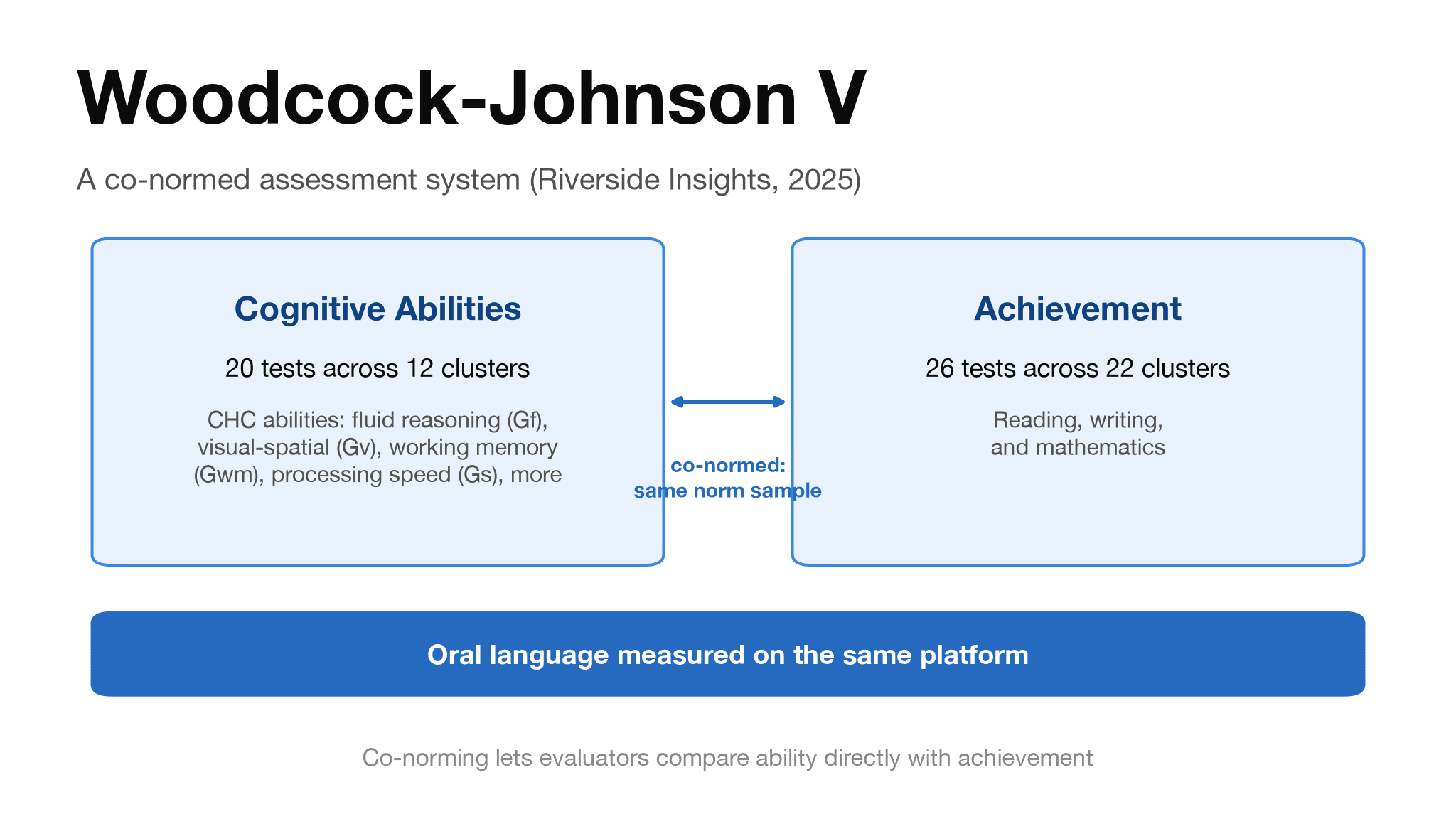
The Woodcock-Johnson is an individually administered test battery from Riverside Insights that measures cognitive abilities, academic achievement, and oral language. The current edition, the Woodcock-Johnson V (WJ V), is a fully digital system released in February 2025; the prior edition, the WJ IV (2014), covered ages 2 to 90. Schools and psychologists rely on it for learning disability evaluations, gifted assessments, and clinical testing, because its "co-normed" design lets an evaluator compare a person's ability directly with their achievement. This article explains what it measures and how it is used.
The three domains the Woodcock-Johnson measures
• Cognitive abilities: The cognitive battery functions as an individually administered intelligence test, reporting a general ability score plus specific abilities such as fluid reasoning, working memory, and processing speed. The WJ V includes 20 cognitive tests across 12 clusters.
• Academic achievement: Reading, writing, and mathematics skills. The WJ V includes 26 achievement tests across 22 clusters.
• Oral language: Listening and spoken-language skills, measured on the same platform. In the WJ IV, oral language was a separate co-normed battery alongside the cognitive and achievement batteries.
Co-norming is the system's defining feature: all the batteries were normed on the same sample of people. That means a student's cognitive score and reading score can be compared directly, without the statistical noise that comes from comparing scores built on different reference groups.
The theory behind it: Cattell-Horn-Carroll
The Woodcock-Johnson's cognitive tests are explicitly built on "Cattell-Horn-Carroll" (CHC) theory, a hierarchical model of intelligence with general cognitive ability, g, at the top and broad abilities beneath it, such as fluid reasoning (Gf), visual-spatial processing (Gv), working memory (Gwm), and processing speed (Gs). The WJ IV was marketed as covering the widest range of cognitive abilities of any standardized battery, measuring seven broad CHC abilities. The structure matters for interpretation: the general ability score carries the most predictive weight, while the broad-ability cluster scores describe the profile beneath it.
WJ V vs. WJ IV: what changed
Riverside announced the WJ V on February 3, 2025, and the redesign is substantial. The new edition is digital-native: there is no physical kit, and examiners administer it with a laptop and an examinee tablet. It was normed from 2022 to 2024 on a sample of more than 5,000 people aligned to 2020 U.S. Census demographics. It also adds a 15-test Virtual Test Library and a dedicated Nonverbal battery covering four CHC domains, announced for November 2026. The WJ IV, published in 2014, used printed easels organized into three independent co-normed batteries and covered ages 2 to 90. Riverside positions the WJ V for K-12 and adult examinees.
How it is used in learning disability evaluations
The co-normed design is exactly what a "specific learning disability" (SLD) evaluation needs. Because the cognitive and achievement batteries share one norm group, an evaluator can see whether a child's reading, writing, or math achievement is unexpectedly low relative to their measured cognitive ability. Federal IDEA regulations permit schools to identify an SLD partly through a pattern of strengths and weaknesses in performance relative to intellectual development, which is precisely the comparison the Woodcock-Johnson supports. The same regulations also allow districts to use "response to intervention" approaches instead, so the battery is one component of a full evaluation rather than a stand-alone diagnosis. Riverside also positions the WJ V for giftedness evaluations, where the ability measures serve as confirmation testing.
Who administers it and what to expect
Like other individually administered batteries, the Woodcock-Johnson is given one-on-one by a trained examiner, typically a school psychologist, educational diagnostician, or clinician. In the WJ V the examinee works on a tablet while the examiner manages the session from a laptop. Evaluators select the tests relevant to the referral question, so sessions vary in length, and scores are reported as standard scores on the familiar scale with a mean of 100.
Woodcock-Johnson vs. other IQ tests
Among individually administered tests, the WISC-V is the standard children's IQ test and the Stanford-Binet spans ages 2 to 85 and up; both focus on cognitive ability alone. The Woodcock-Johnson's distinction is breadth: cognitive, achievement, and oral language measures in one co-normed system, which is why it appears so often in school evaluations where the question is how ability and achievement line up.
Frequently asked questions
What does the Woodcock-Johnson test measure?
Three co-normed domains: cognitive abilities, academic achievement in reading, writing, and math, and oral language. The cognitive battery is built on CHC theory and reports a general ability score plus specific abilities such as fluid reasoning and working memory.
Is the Woodcock-Johnson an IQ test?
The cognitive battery functions as one: it is individually administered and yields a general intellectual ability score on the familiar IQ scale. The full system goes further than most IQ tests because its achievement and oral language measures share the same norm sample, allowing direct ability-achievement comparisons.
What is the difference between the WJ IV and the WJ V?
The WJ V, released in February 2025, is fully digital, was normed from 2022 to 2024 on more than 5,000 people aligned to 2020 Census demographics, and includes 20 cognitive and 26 achievement tests. The WJ IV, published in 2014, used printed materials in three separate co-normed batteries.
What ages can take the Woodcock-Johnson?
The WJ IV covers ages 2 to 90 years, one of the widest ranges of any individually administered battery. Riverside positions the WJ V for K-12 and adult examinees; its technical manual is the authority on the exact age span.
How is it used to diagnose learning disabilities?
Because the cognitive and achievement batteries share one norm group, an evaluator can see whether achievement is unexpectedly low relative to ability. IDEA regulations allow identifying a specific learning disability partly through such a pattern of strengths and weaknesses, as part of a comprehensive evaluation.
The takeaway
The Woodcock-Johnson earns its place in evaluations by pairing a serious, CHC-based intelligence test with achievement and language measures normed on the same people. If you are an adult who is simply curious where your own general cognitive ability stands, outside the context of a school evaluation, the Reasoning and Intelligence Online Test from RIOT IQ offers a validated measure you can take from home; take the RIOT IQ test here.
References
1. Riverside Insights. (2025, February 3). Riverside Insights launches the Woodcock-Johnson V: A legacy of trust, reimagined for today's educational needs.blog.riversideinsights.com
2. Riverside Insights. (n.d.). Woodcock-Johnson V (WJ V): Assessment for cognitive and academic skills.riversideinsights.com
3. Riverside Insights. (n.d.). WJ IV assessment: Cognitive, achievement, and language tools.riversideinsights.com
4. Western Psychological Services. (n.d.). (WJ IV) Woodcock-Johnson IV.wpspublish.com
5. U.S. Department of Education. (2017). 34 CFR 300.309: Determining the existence of a specific learning disability. Individuals with Disabilities Education Act. sites.ed.gov
Take our professional IQ test
Want to know your IQ? Try the first ever professional online IQ test.