What Is the Finger Tapping Test? Motor Speed Measurement Explained | Riot IQ
Sep 6, 2026·Specific IQ Tests & Formats
What Is the Finger Tapping Test? Motor Speed Measurement Explained
The Finger Tapping Test measures motor speed by counting how fast a person taps a small key in 10-second trials with each hand. See its origins and uses. (153 chars)
Dr. Russell T. WarneChief Scientist
Share
The Finger Tapping Test, also called the "Finger Oscillation Test," is a brief neuropsychological measure of motor speed. The examinee places an index finger on a small key attached to a mechanical counter and taps as fast as possible for 10 seconds, repeating the trial several times with each hand. The average number of taps per trial becomes the score for that hand. Despite its simplicity, the test has been a fixture of clinical neuropsychology for nearly 80 years because tapping speed is sensitive to many forms of brain dysfunction. This article covers the test's origins, administration, scoring, and clinical uses.
How the Finger Tapping Test works
The standard apparatus is a flat board with a lever or key connected to a mechanical counter. The examinee rests the hand flat on the board with fingers extended and places the index finger on the key. On the examiner's signal, the person taps the key as rapidly as possible for 10 seconds while keeping the rest of the hand still, so that the score reflects finger speed rather than arm or wrist movement.
According to a review published by the Barrow Neurological Institute, the classic procedure repeats these 10-second trials until five trials have been obtained with each hand in which every score falls within five taps of the others. Both hands are tested, beginning with the dominant hand. Test distributor Millisecond, which publishes a computerized version following the procedure of Reitan and Wolfson, describes the scoring rule in detail: the score for each hand is the mean of the five qualifying trials, with brief rest periods between trials and a longer rest after every third trial. If the five-trial consistency standard cannot be met, examiners administer up to 10 trials and average them.
A typical administration takes about 10 minutes. The consistency requirement matters because fatigue or fluctuating effort can produce erratic trials, and averaging yields a stable estimate of each hand's true speed.
Origins in the Halstead-Reitan battery
The test was created by University of Chicago physiological psychologist Ward Halstead. In his 1947 book Brain and Intelligence: A Quantitative Study of the Frontal Lobes, published by the University of Chicago Press, Halstead reported a 12-year research program in which he administered experimental tasks to patients who had undergone brain surgery and to control participants. He was searching for measures of what he called "biological intelligence," meaning aspects of cognitive functioning that depend directly on the brain's physical integrity, and he identified finger tapping as one potentially useful measure.
Halstead's student Ralph Reitan later standardized the administration procedures, documenting them in the 1950s, and the task became a core component of the Halstead-Reitan battery, the fixed set of tests that dominated American neuropsychological assessment for decades. Alongside companion measures such as the Trail Making Test, the Finger Tapping Test helped clinicians infer the presence and location of brain damage in the era before CT and MRI scans existed. Even now that imaging can show the structure of the brain directly, the test survives because it documents something a scan cannot: how well the motor system actually performs.
What the test measures
The Finger Tapping Test is first and foremost a measure of simple motor speed. It requires no problem solving, no memory, and almost no learning, which is precisely what makes it useful. When a person of normal dexterity taps slowly, the slowness usually reflects something about the motor system itself rather than a failure to understand the task.
Two features of the score carry clinical information:
• Absolute speed: The Barrow Neurological Institute review reports that mean tapping speed distinguishes patients with brain dysfunction from both medical and psychiatric control patients, and that slower tapping is associated with more severe traumatic brain injury. In the review's own study, patients with brain dysfunction tapped more slowly than matched controls and also showed a higher frequency of qualitatively abnormal finger movements.
• The difference between hands: Because each hand is controlled mainly by the opposite side of the brain, examiners compare the two hands. The dominant hand is normally somewhat faster, so an unusually large gap, or a non-dominant hand that outperforms the dominant hand, can point toward dysfunction in one hemisphere. This lateralizing signal is modest and is never interpreted in isolation. Healthy people vary considerably in how much faster their dominant hand is, so clinicians treat the intermanual difference as one clue among many.
It is worth being clear about what the test does not measure. Tapping speed is not intelligence, and a slow score says nothing about reasoning, knowledge, or judgment on its own. Its value comes from being combined with the rest of a neuropsychological evaluation, where a pattern of motor, cognitive, and sensory results is interpreted together.
How clinicians use the results
The test appears in several distinct clinical contexts:
• Traumatic brain injury: Slowed tapping is a well-documented consequence of head injury, and speed tends to track injury severity. A 2013 study in the Journal of Clinical and Experimental Neuropsychology by Hubel and colleagues found that patients with mild traumatic brain injury tapped more slowly than matched controls even when there was no evidence of poor effort.
• Lateralized impairment: As described above, comparing the hands can help localize dysfunction to one hemisphere, for example after a stroke or a focal lesion. The Barrow review also notes that tapping speed predicted which stroke patients would achieve their rehabilitation goals.
• Performance validity research: Because the task looks harder to fake convincingly than it is, finger tapping has become a widely studied "embedded performance validity" indicator, a score used to flag people who may not be giving full effort. In a 2005 study in The Clinical Neuropsychologist, Arnold and colleagues found that examinees judged noncredible tapped markedly slower than genuinely impaired patients, and that the dominant-hand score was the most sensitive index. With specificity set at 90 percent, a dominant-hand cutoff of 35 taps or fewer identified half of noncredible men, and a cutoff of 28 or fewer identified 61 percent of noncredible women. The authors caution that cutoffs must be adjusted for sex and for the condition being claimed.
• Tracking change: Because the test is short and repeatable, it is often used to monitor progression or recovery in conditions that affect motor function, including neurodegenerative disease.
Norms, demographics, and computerized versions
Raw tap counts only become meaningful against appropriate "norms," the reference scores from healthy people of similar background. Two demographic effects are consistent and modest in size. Men tap faster than women on average, and speed declines gradually with age. In a 1993 normative study in Perceptual and Motor Skills, Ruff and Parker collected data from 360 healthy volunteers between ages 16 and 70 and found that women were substantially slower on finger tapping, particularly in the older age groups, that increasing age produced a smaller effect, and that better educated participants performed somewhat faster. Good practice therefore compares an examinee to norms stratified by age and sex rather than to a single cutoff.
The test has also moved beyond the mechanical counter. Computerized versions record tapping on keyboards, response buttons, or touchscreens and capture details the old apparatus never could, such as the time each keypress is held down and the variability between taps. A 2013 study by Hubel and colleagues in Perceptual and Motor Skills tested 1,519 adults ages 18 to 65 on a computerized version using three 10-second periods per hand. The study replicated the classic findings, with faster dominant hands, faster men at every age, and slower and more variable tapping in older adults. A companion study reported excellent test-retest reliability for the computerized measure, with a correlation of .91, and found that 62 percent of participants instructed to fake brain injury produced abnormally slow tapping rates.
Motor speed, reaction time, and modern IQ testing
Finger tapping sits at the simplest end of a family of speed measures that runs from pure motor output to speeded reasoning. Modern intelligence tests typically include speed measures at the more cognitive end of that range. The RIOT IQ test, an online intelligence test for adults 18 and older developed by RIOT IQ with psychometrician Dr. Russell T. Warne, reflects this design. Its full name is the Reasoning and Intelligence Online Test, and it comprises 15 subtests across six cognitive indices: verbal reasoning, fluid reasoning, spatial ability, working memory, processing speed, and reaction time. The reaction time index measures how quickly a person can respond to simple stimuli, a construct related to the motor speed that finger tapping captures but with a larger decision component. The full test takes about 52 minutes and reports scores on the familiar scale with a mean of 100 and a standard deviation of 15.
The two kinds of measurement serve different purposes. The Finger Tapping Test is a clinical instrument, and an online IQ test does not replace an individually administered neuropsychological or diagnostic evaluation. For readers who want a rigorous, normed picture of their cognitive abilities, including speeded performance, the RIOT IQ test at riotiq.com is a research-grade starting point.
Frequently asked questions
What does the Finger Tapping Test measure?
It measures simple motor speed: how many times a person can press a small key with the index finger in 10 seconds. Comparing hands can also provide a modest signal about which brain hemisphere may be affected by injury or disease.
How long does the Finger Tapping Test take?
Usually about 10 minutes. Each trial lasts 10 seconds, and examiners collect five consistent trials per hand, with short rests between trials.
Is the Finger Tapping Test an IQ test?
No. It involves no reasoning or memory and correlates only weakly with intelligence. It was designed to detect brain dysfunction through its effects on motor speed, and it is interpreted alongside cognitive tests in a full evaluation.
What is a normal finger tapping score?
There is no single normal score. Performance is compared to norms stratified by age and sex, because men tap faster than women on average and speed declines gradually with age.
Why are both hands tested?
Each hand is controlled mainly by the opposite hemisphere of the brain. A markedly slow hand, relative to expectations, can suggest dysfunction in the hemisphere that controls it, though this lateralizing information is modest and never used alone.
Can the Finger Tapping Test detect faking?
It can contribute. People feigning impairment often tap implausibly slowly, so unusually low scores, especially for the dominant hand, serve as performance validity indicators with cutoffs adjusted for sex and diagnosis.
References
1. Halstead, W. C. (1947). Brain and intelligence: A quantitative study of the frontal lobes. University of Chicago Press. digitalcommons.rockefeller.edu
2. Prigatano, G. P., & Hoffmann, B. (1997). Finger tapping and brain dysfunction: A qualitative and quantitative study. Barrow Quarterly, 13(4). barrowneuro.org
3. Ruff, R. M., & Parker, S. B. (1993). Gender- and age-specific changes in motor speed and eye-hand coordination in adults: Normative values for the Finger Tapping and Grooved Pegboard Tests. Perceptual and Motor Skills, 76(3 Pt 2), 1219-1230. pubmed.ncbi.nlm.nih.gov
4. Arnold, G., Boone, K. B., Lu, P., Dean, A., Wen, J., Nitch, S., & McPherson, S. (2005). Sensitivity and specificity of finger tapping test scores for the detection of suspect effort. The Clinical Neuropsychologist, 19(1), 105-120. pubmed.ncbi.nlm.nih.gov
5. Hubel, K. A., Reed, B., Yund, E. W., Herron, T. J., & Woods, D. L. (2013). Computerized measures of finger tapping: Effects of hand dominance, age, and sex. Perceptual and Motor Skills, 116(3), 929-952. pubmed.ncbi.nlm.nih.gov
6. Hubel, K. A., Yund, E. W., Herron, T. J., & Woods, D. L. (2013). Computerized measures of finger tapping: Reliability, malingering and traumatic brain injury. Journal of Clinical and Experimental Neuropsychology, 35(7), 745-758. pubmed.ncbi.nlm.nih.gov
7. Millisecond Software. (n.d.). Finger Tapping Test (Inquisit implementation of the Reitan %26 Wolfson procedure).. millisecond.com
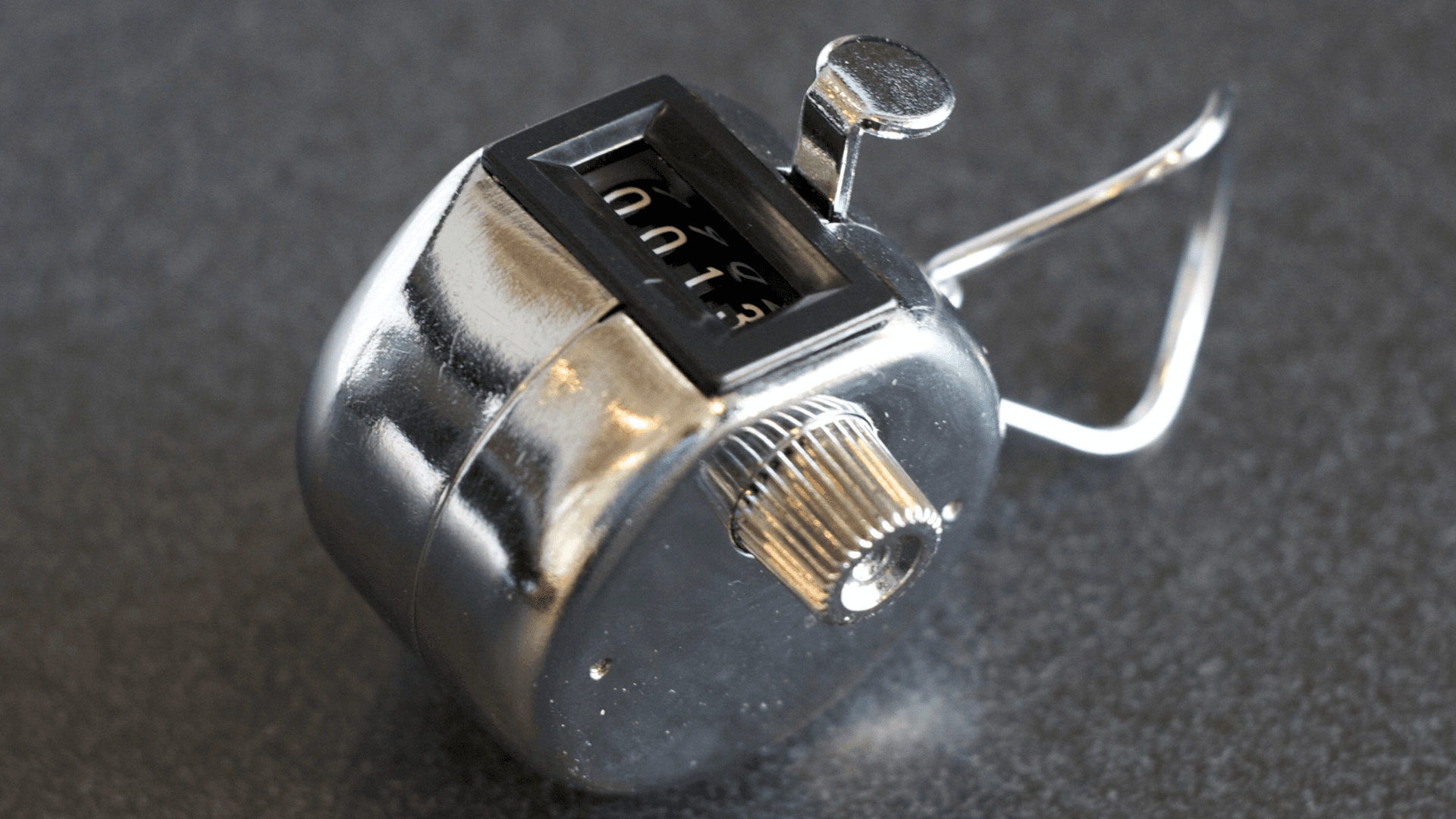
Hero photo: A chrome mechanical hand tally counter with its press plunger, digit wheels, and finger ring. Photo by Marcin Wichary, CC BY 2.0, via Wikimedia Commons (cropped).
Take our professional IQ test
Want to know your IQ? Try the first ever professional online IQ test.