What Is the OLSAT Test? The Otis-Lennon School Ability Test Explained
The OLSAT test is a K-12 verbal and nonverbal reasoning test used for gifted program admissions. Learn its levels A-G, scoring, and NYC G&T history.
Dr. Russell T. WarneChief Scientist
Share
The OLSAT test (Otis-Lennon School Ability Test) is a group-administered test of abstract thinking and reasoning for students from kindergarten through grade 12, published by Pearson and now in its eighth edition, the OLSAT 8. It measures the verbal and nonverbal reasoning skills most closely tied to school learning, which is why it became one of the most widely used instruments for admission to gifted and talented programs in the United States. Scores are reported as a School Ability Index with a mean of 100 and a standard deviation of 16. This article covers the test's structure, its scoring, and its most famous use, New York City's gifted and talented admissions.
From the Otis tests to OLSAT 8
The OLSAT descends from the group intelligence tests Arthur S. Otis developed in the early twentieth century, a lineage that runs through much of American testing history; our history of IQ testing traces the fuller story. The modern test carries both names, Otis and his successor Roger T. Lennon, and the OLSAT 8 technical manual was published by Pearson in 2003. Unlike individually administered clinical tests such as the WISC, the OLSAT is given to whole classes at once in a multiple-choice format.
OLSAT levels A through G
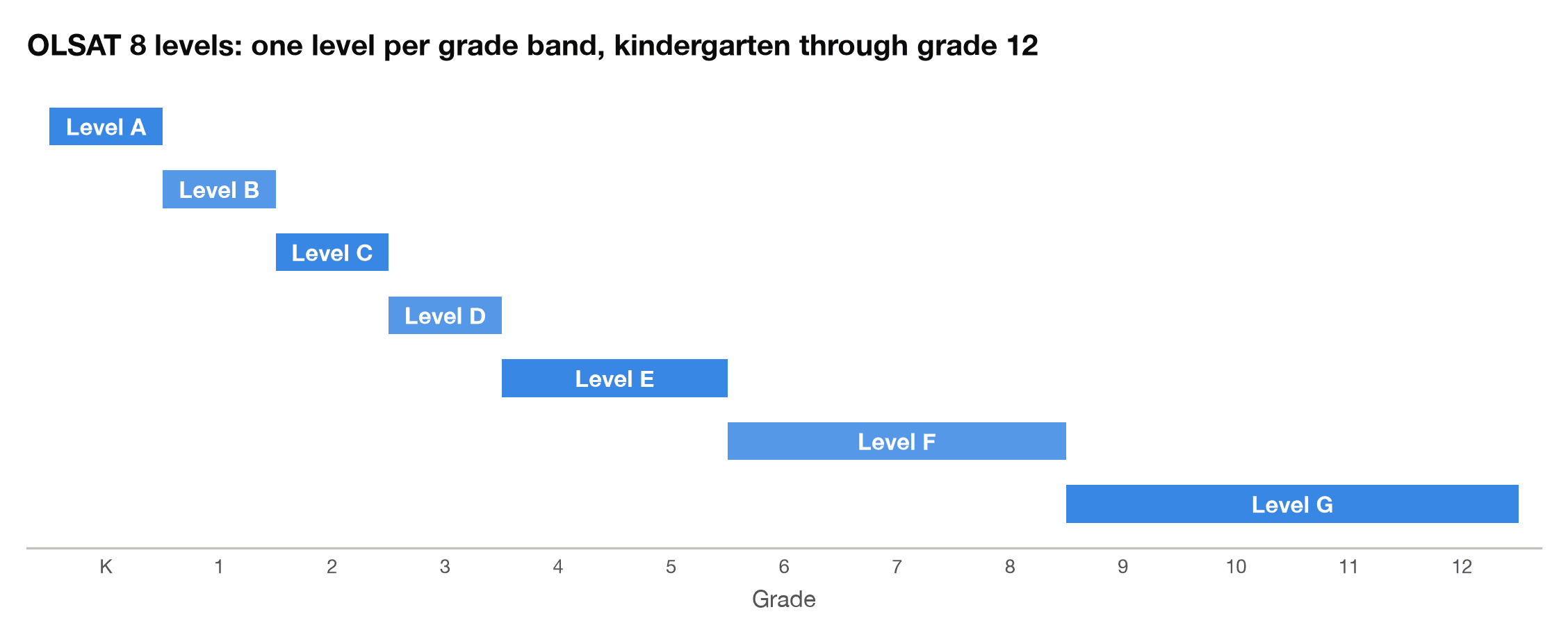
The OLSAT 8 uses seven levels matched to grade: Levels A through D each serve a single grade from kindergarten through grade 3, Level E covers grades 4 and 5, Level F covers grades 6 through 8, and Level G covers grades 9 through 12. A student takes only the level matched to their grade. At the youngest levels the examiner reads every question aloud and children answer by choosing pictures, so no reading is required. Sessions run about 75 minutes including preparation for Levels A through C and about 60 minutes for Levels D through G.
Verbal and nonverbal: what the OLSAT asks
Items are organized into five clusters across two areas. The verbal area has Verbal Comprehension (following directions, understanding relationships in language) and Verbal Reasoning (analogies, classifications, and logical reasoning with words). The nonverbal area has Pictorial Reasoning, Figural Reasoning, and Quantitative Reasoning. Across the clusters the test draws on 21 different question types, and they are not evenly distributed: picture-based and read-aloud types concentrate at the youngest levels, while abstract types such as logical selection appear only at the upper levels.
OLSAT scores explained
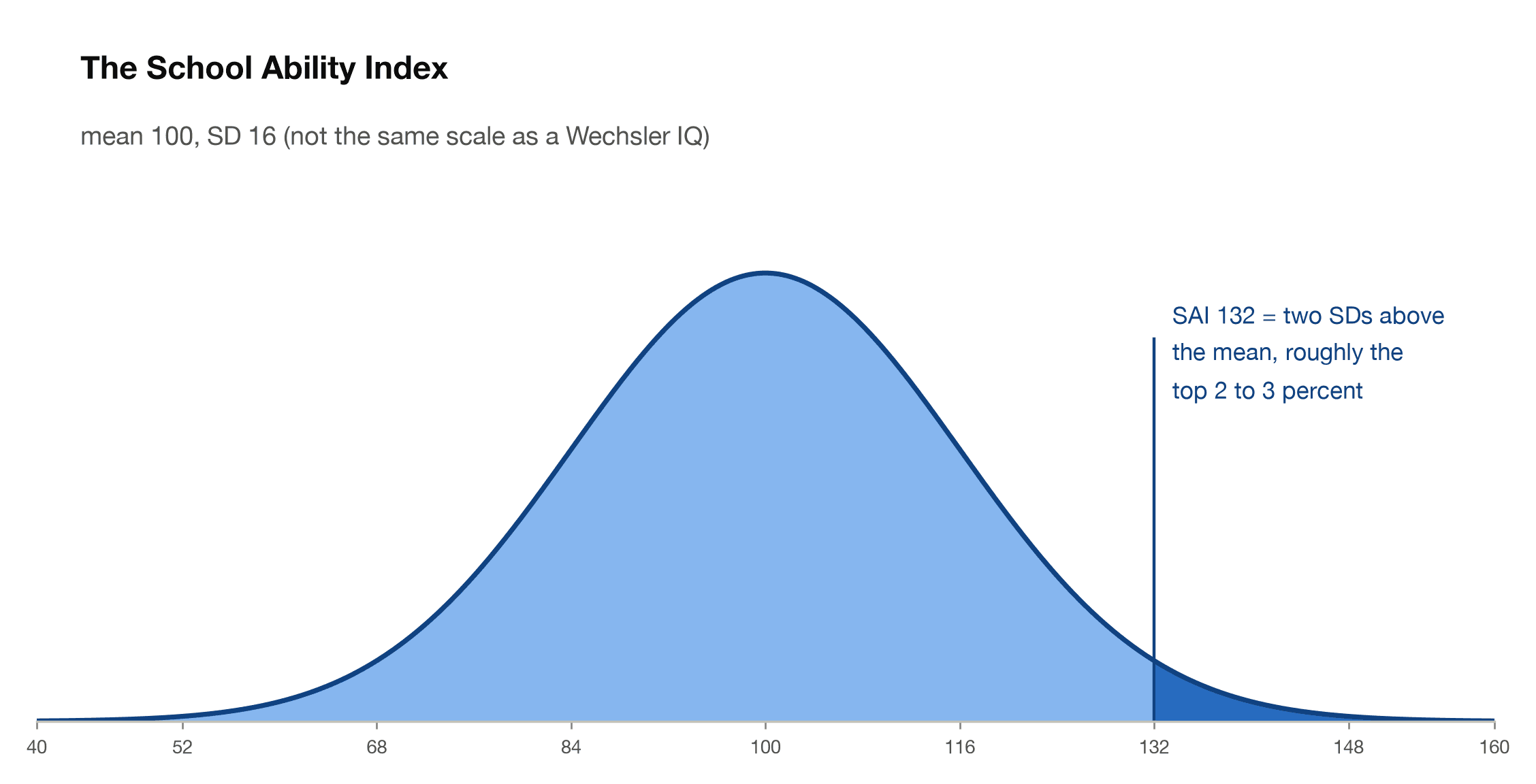
Verbal and nonverbal scores combine into a School Ability Index (SAI), a normalized standard score with a mean of 100 and a standard deviation of 16, alongside percentile ranks and stanines by age and grade. The SAI looks like an IQ score but is not quite one: most IQ scales use a standard deviation of 15, so an SAI is best read as a percentile rank rather than a Wechsler IQ. Simple arithmetic still gives useful landmarks. An SAI of 132 sits two standard deviations above the mean, roughly the top 2 to 3 percent, and district gifted cutoffs commonly demand top percentiles in that neighborhood.
The OLSAT and NYC gifted and talented admissions
For years, New York City screened children ages 4 to 7 for gifted and talented programs with a combined assessment: verbal questions from the OLSAT plus the nonverbal NNAT. The city stood nearly alone in granting gifted admission on a single test given to children before kindergarten, and the results were contentious: Black and Latino students made up almost 60% of kindergartners but 14% of gifted enrollment. In January 2021 the Panel for Educational Policy rejected the testing contract by an 8-7 vote, with roughly 2,500 gifted kindergarten seats at stake, and kindergarten admissions now run through teacher interviews and nominations. Psychometric caution supports at least part of that decision: scores from 4-year-olds are far less stable than scores from older students, so very early one-shot testing carries real error. Our guide to how gifted testing works explains what a sounder identification process looks like.
OLSAT vs. other ability tests
Pearson's validity data show the NNAT3 correlating about .55 with the OLSAT 8 School Ability Index, a moderate figure that reflects the tests' different content: one is matrices only, the other mixes verbal and nonverbal reasoning. Both are group screeners, built to sort large numbers of students efficiently rather than to measure any one student precisely. High-stakes decisions call for a comprehensive, individually administered test and multiple sources of evidence. Adults curious about their own ability have a modern option: the Reasoning and Intelligence Online Test from RIOT IQ is a validated, normed assessment, and the free IQ test shows you where you stand on the standard IQ scale.
Frequently asked questions
What does the OLSAT test measure?
The OLSAT measures abstract thinking and reasoning through five clusters: verbal comprehension and verbal reasoning on the verbal side, and pictorial, figural, and quantitative reasoning on the nonverbal side. Its 21 question types target the reasoning skills most closely tied to school learning.
What is a good OLSAT score?
OLSAT results are reported as a School Ability Index with a mean of 100 and a standard deviation of 16. A score of 116 puts a student about one standard deviation above average, and 132 is two above, roughly the top 2 to 3 percent. Gifted programs typically look for the mid-120s or higher, depending on the district.
Is the OLSAT an IQ test?
It is closely related but not identical. The OLSAT is a group-administered school ability test, and its SAI uses a standard deviation of 16 while most IQ tests use 15, so scores are not directly interchangeable. Percentile ranks are the safest way to compare OLSAT results with IQ test results.
What are the OLSAT levels?
There are seven levels, A through G. Levels A through D each cover one grade from kindergarten to grade 3, Level E covers grades 4-5, Level F covers grades 6-8, and Level G covers grades 9-12. Younger levels are read aloud by the examiner with picture-based answers.
Does New York City still use the OLSAT for gifted admissions?
No. NYC used OLSAT verbal questions together with the NNAT to screen 4-to-7-year-olds for gifted programs, but the Panel for Educational Policy voted 8-7 in January 2021 not to renew the testing contract. Kindergarten gifted admissions now run through teacher interviews and nominations.
Can you prepare for the OLSAT?
Light familiarization with question formats helps young children avoid confusion. Heavy coaching can inflate scores past a child's true ability level, which tends to backfire once a child is placed in an accelerated classroom.
References
1. University of Missouri Assessment Resource Center. (n.d.). OLSAT 8 (Otis-Lennon School Ability Test, Eighth Edition).arc.missouri.edu
2. Chalkbeat New York. (2021, January 28). NYC education panel rejects 'gifted' testing contract, upending mayor's plans.chalkbeat.org
3. Chalkbeat New York. (2021, January 22). NYC education department said gifted testing could widen disparities amid COVID.chalkbeat.org
4. New York City Public Schools. (n.d.). Gifted and talented.schools.nyc.gov
6. TestPrep-Online. (n.d.). NYC Gifted & Talented Test: About the test.testprep-online.com
Hero image: a New York City classroom around 1900. The OLSAT descends from the Otis group tests developed in the early twentieth century. Library of Congress, public domain, via Wikimedia Commons.
Take our professional IQ test
Want to know your IQ? Try the first ever professional online IQ test.