What is a pattern recognition test? A measure of your ability to find rules in shapes or numbers and predict what comes next. Formats, uses, and scoring.
Dr. Russell T. WarneChief Scientist
Share
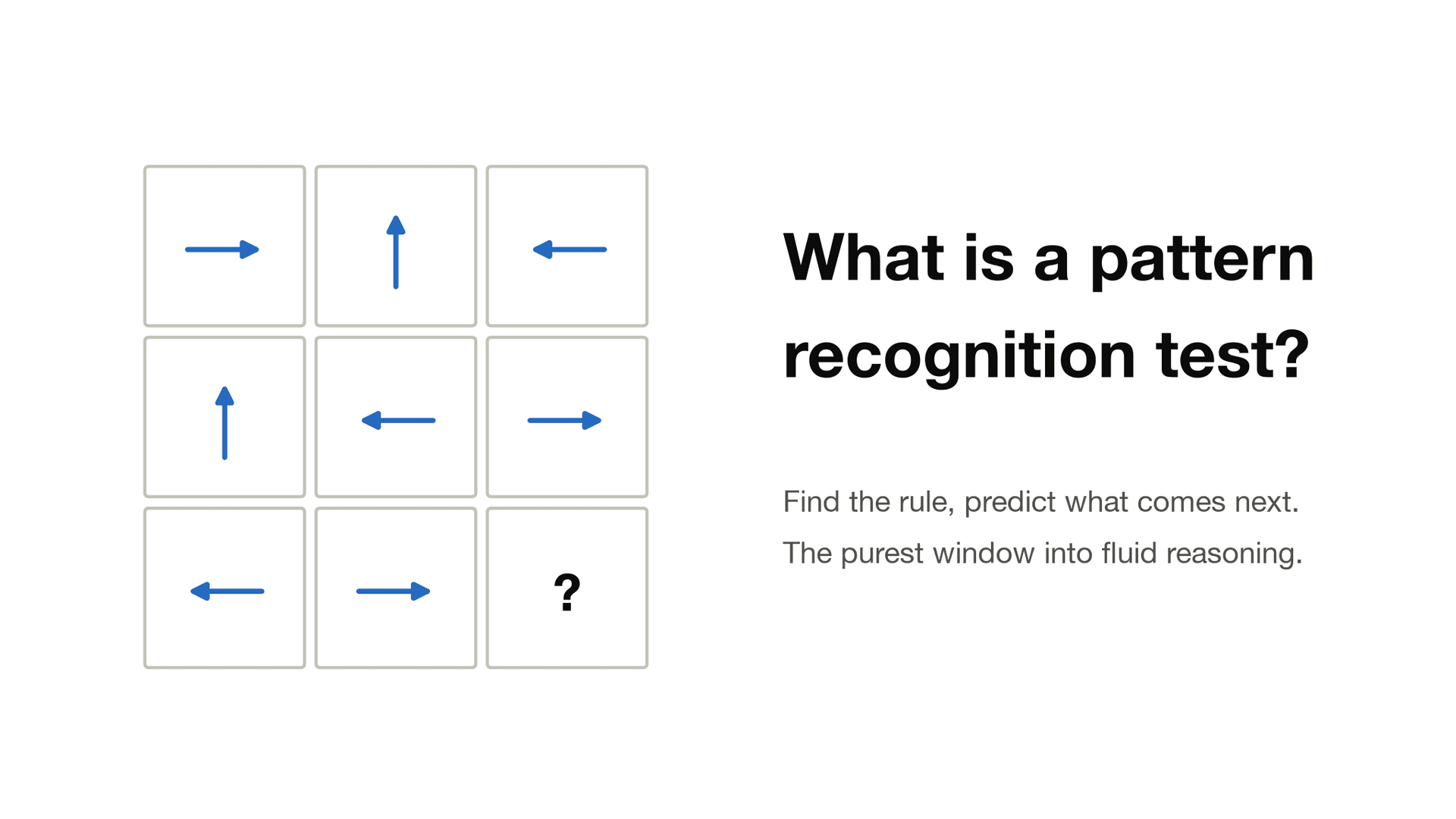
A pattern recognition test measures your ability to find the rule connecting a set of shapes, numbers, or symbols and predict what comes next. The best-known format is the “matrix” puzzle: a 3x3 grid that follows hidden rules, with one cell left blank. Because these tests require no vocabulary or schooling, they are a favorite tool of IQ tests, employers, and gifted programs alike, and psychologists treat them as one of the purest windows into “fluid intelligence,” the ability to reason through novel problems.
What a Pattern Recognition Test Looks Like
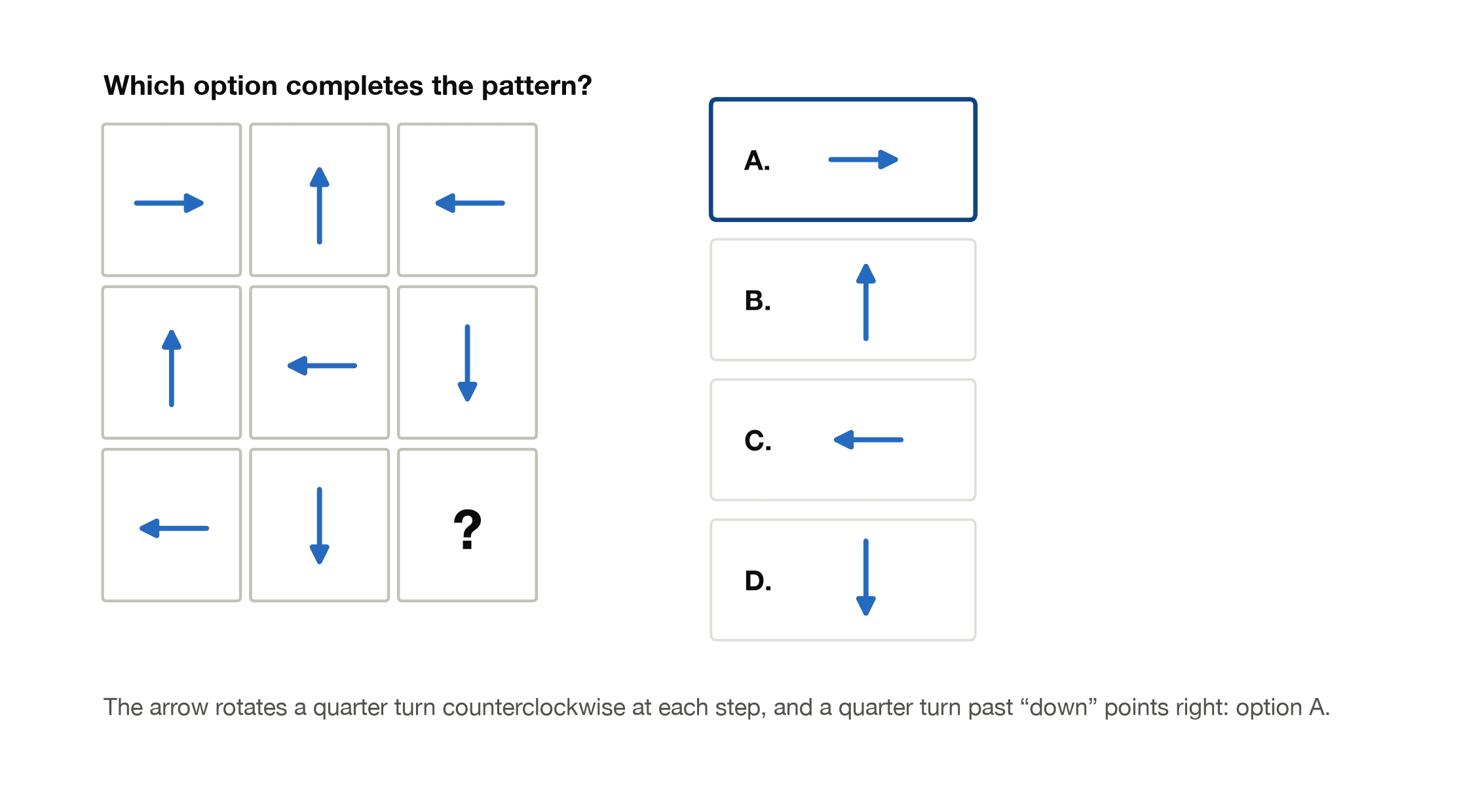
Most pattern tests present a sequence or grid governed by one or more rules, then ask you to choose the option that completes it. Here is a worked example with a single rule.
Real test items grow harder by stacking rules: a rotation rule plus a counting rule plus a shading rule, all operating at once. The skill being measured is not visual sharpness but rule discovery, holding candidate rules in mind, testing them against the evidence, and combining them. Our step-by-step matrix guide breaks down the most common rule types and how to work through them systematically.
Why Psychologists Trust Pattern Tasks
Pattern items have a distinguished history. Raven's Progressive Matrices, introduced in 1938, became the standard research measure of abstract reasoning precisely because it needs no language. A classic analysis by Carpenter, Just, and Shell reverse-engineered what the Raven test actually demands: inducing rules from examples and managing several goals in working memory at once, which is close to a definition of fluid reasoning itself.
• Knowledge-light: No vocabulary, dates, or formulas; a motivated test-taker from any schooling background can attempt every item.
• Strongly g-loaded: Performance on matrix tasks correlates highly with overall cognitive ability, which is why they anchor the fluid reasoning section of modern IQ batteries.
• Hard to cram: Because each item's rule is new, memorized answers help far less than on knowledge tests.
The Rule Families Every Test Draws From
Matrix and series items look endlessly varied, but nearly all of them combine a handful of rule families. Knowing them will not solve an item for you, holding and testing combinations is the measured skill, but it removes the surprise.
• Rotation: An element turns by a fixed amount at each step, as in the worked example above.
• Progression: Something increases or decreases across a row: count, size, or number of sides.
• Alternation: A property cycles through fixed states, such as shading that runs filled, half, empty, and repeats.
• Movement: An element shifts position around the cell, corner to corner or clockwise step by step.
• Distribution: Each row and column contains each variant exactly once, like a small Sudoku of shapes.
• Combination: Two panels merge or cancel to produce the third, the rule family behind the hardest Raven items.
Where You Will Meet These Tests
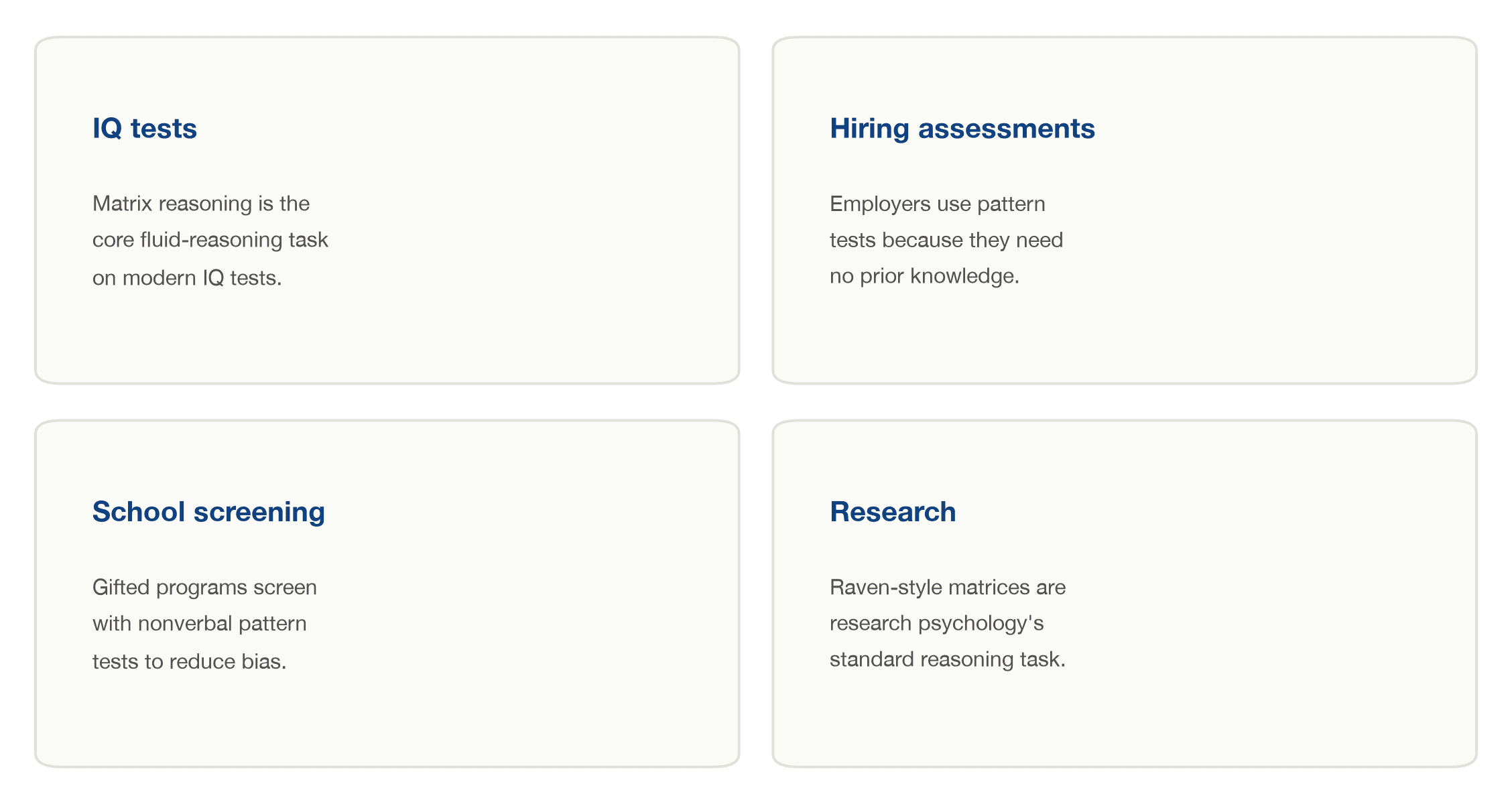
Beyond IQ testing, employers use pattern-based “aptitude” assessments to screen candidates when job knowledge cannot be assumed, and schools use nonverbal pattern tests in gifted screening to reduce language and curriculum bias. The formats differ in difficulty and time pressure, but the underlying task, find the rule, is the same. For how pattern items fit among the other formats on a full test, see our overview of IQ test question types.
How Scoring Works
On professionally built tests, pattern items are arranged from easy to hard, and your raw performance is compared with a “norm group,” a representative sample of people who took the same test. The result lands on the familiar scale with an average of 100 and a “standard deviation,” a measure of spread, of 15 points; our guide to the IQ scale explains what the numbers mean. Free online pattern quizzes without norm groups can be fun practice, but their “scores” compare you with nobody.
Try a Normed Pattern Test
The Reasoning and Intelligence Online Test, developed by a team led by intelligence researcher Dr. Russell T. Warne, uses matrix-style fluid reasoning items as a core section and reports that domain separately in your score profile. Take the RIOT IQ test to see how your pattern reasoning measures up against a modern norm group.
Frequently Asked Questions
What does a pattern recognition test measure?
Rule discovery and abstract reasoning: the ability to infer structure from examples and apply it to new cases, a core component of fluid intelligence.
Are pattern recognition tests IQ tests?
They are a major component of IQ tests rather than the whole thing. A full battery adds verbal, spatial, memory, and speed measures.
How can I get better at pattern tests?
Learn the common rule families (rotation, counting, shading, position) so formats do not surprise you. Familiarity helps a little; it does not change the underlying ability.
Why do employers use pattern tests?
They predict learning speed while requiring no prior job knowledge, and they work across applicants with very different educational backgrounds.
What is Raven's Progressive Matrices?
The classic pattern-matrix test from 1938, still widely used in research as a language-free measure of abstract reasoning.
References
1. American Educational Research Association, American Psychological Association, & National Council on Measurement in Education. (2014). Standards for educational and psychological testing. American Educational Research Association. testingstandards.net
3. Carpenter, P. A., Just, M. A., & Shell, P. (1990). What one intelligence test measures: A theoretical account of the processing in the Raven Progressive Matrices Test. Psychological Review, 97(3), 404–431. doi.org/10.1037/0033-295X.97.3.404
4. McGrew, K. S. (2009). CHC theory and the human cognitive abilities project: Standing on the shoulders of the giants of psychometric intelligence research. Intelligence, 37(1), 1–10. doi.org/10.1016/j.intell.2008.08.004
5. Warne, R. T. (2020). In the know: Debunking 35 myths about human intelligence. Cambridge University Press. doi.org/10.1017/9781108593298
Take our professional IQ test
Want to know your IQ? Try the first ever professional online IQ test.