What Is the SIFT Test? The Army's Flight Aptitude Test Explained
The SIFT is the Army's aviation aptitude test: seven subtests, a 20-80 scale, a cut score of 40, and two lifetime attempts. See how it really works.
Dr. Russell T. WarneChief Scientist
Share
The SIFT, short for Selection Instrument for Flight Training, is the U.S. Army's aviation aptitude test. Anyone who wants to fly Army helicopters, whether as a warrant officer candidate or a commissioned officer, must pass it before selection into Initial Entry Rotary Wing flight training. The computer-based battery packs seven subtests into about two and a half hours, scores run from 20 to 80, and the qualifying score is 40. Two attempts, ever: the Army allows exactly one retest in a lifetime.
The seven SIFT subtests
• Simple Drawings (2 minutes): Rapidly spot the odd item out among similar objects, roughly a hundred items in two minutes.
• Army Aviation Information (30 minutes): Knowledge of Army aviation terminology and concepts, the one section that rewards study directly.
• Spatial Apperception (10 minutes): Judge an aircraft's orientation from cockpit and exterior views, a classic visual-spatial reasoning task.
• Reading Comprehension (30 minutes): Extract information from text passages.
• Math Skills and Mechanical Comprehension (40 and 15 minutes): Both are computer-adaptive, so the number and difficulty of questions varies by examinee, and neither has a fixed length.
How SIFT scoring works
The composite score is a proprietary weighted blend of all seven subtests, reported on a 20-to-80 scale that U.S. Army Recruiting Command describes as having a mean of 50 and a standard deviation of 10. The minimum to qualify for Army aviation is 40, and the Army does not waive it. Scoring is compensatory, meaning a weak subtest can be offset by a strong one, and results appear immediately at the end of the session. One rule deserves bold type: you get two lifetime attempts, a retest requires a mandatory waiting period whose length has changed over the years, and your most recent scores replace the old ones even if they are lower. A passing score also locks you in; retesting to improve a pass is not authorized.
Is the SIFT an IQ test?
No, though it is built from g-loaded material: math, reading, spatial judgment, and mechanical reasoning are exactly the kinds of tasks that draw on general cognitive ability, and military selection research by Ree and Carretta found that g carries most of the predictive weight in pilot selection batteries. But the SIFT's 20-to-80 scale is a "T-score" referenced to the Army's own applicant pool, not the general population. The Army's data show why that matters: the applicant mean drifted from 48.3 in 2012 to 52.4 by 2015 as prep materials spread. A scale whose average moves with the applicant pool cannot be an IQ scale, and no study converting SIFT scores to IQ exists. The Army's revalidation study is also candid about limits: the total score was a negligible-to-weak predictor of classroom grades and a moderate predictor of daily flight grades. Selection tests earn their keep at the margin; see our military IQ and ASVAB guide for the broader picture.
SIFT vs. the other services' flight tests
Each branch runs its own gate: the Air Force uses the AFOQT, and the Navy, Marine Corps, and Coast Guard use the ASTB. The link is closer than it looks: the Army borrowed the SIFT's three cognitive subtests (reading, math, and mechanical comprehension) directly from the Navy's battery, with the Navy's permission, when it built the SIFT to replace the older AFAST in 2013.
Frequently asked questions
What is a good SIFT score?
The cut is 40, but selection boards see the number, so higher helps. In the Army's own study sample, selected flight students averaged 55.3.
Can you retake the SIFT?
Once, after a mandatory waiting period, and only if you failed. Two lifetime attempts total, and the second score stands even if it is worse. Confirm the current waiting period with your education center or recruiter.
How do I prepare for the SIFT?
Study Army aviation fundamentals for the Aviation Information subtest, refresh algebra and geometry, and practice spatial and mechanical problems. On the adaptive math and mechanical sections, work quickly and avoid random guessing; unfinished items can draw a penalty.
Is the SIFT harder than the ASVAB?
It is more specialized. The ASVAB screens all enlistees for general trainability with composites like the GT score, while the SIFT stacks aviation knowledge, spatial judgment, and adaptive math against a self-selected pool of aviation applicants.
References
1. U.S. Army Training and Doctrine Command, Army University, Army Personnel Testing. (2021). Test administration manual for the Selection Instrument for Flight Training (SIFT), Version 2.0. sift.health.mil
2. U.S. Army Recruiting Command. (n.d.). Frequently asked questions about the SIFT. recruiting.army.mil
3. Ingurgio, V. J., & Crawford, C. V. (2017). Revalidation of the Selection Instrument for Flight Training (Research Report 2002). U.S. Army Research Institute for the Behavioral and Social Sciences. apps.dtic.mil
4. Ree, M. J., & Carretta, T. R. (1996). Central role of g in military pilot selection. The International Journal of Aviation Psychology, 6(2), 111-123. doi.org/10.1207/s15327108ijap0602_1
5. ALMamari, K., & Traynor, A. (2019). Multiple test batteries as predictors for pilot performance: A meta-analytic investigation. International Journal of Selection and Assessment, 27(4), 337-356. doi.org/10.1111/ijsa.12258
6. Hunter, D. R., & Burke, E. F. (1994). Predicting aircraft pilot-training success: A meta-analysis of published research. The International Journal of Aviation Psychology, 4(4), 297-313. doi.org/10.1207/s15327108ijap0404_1
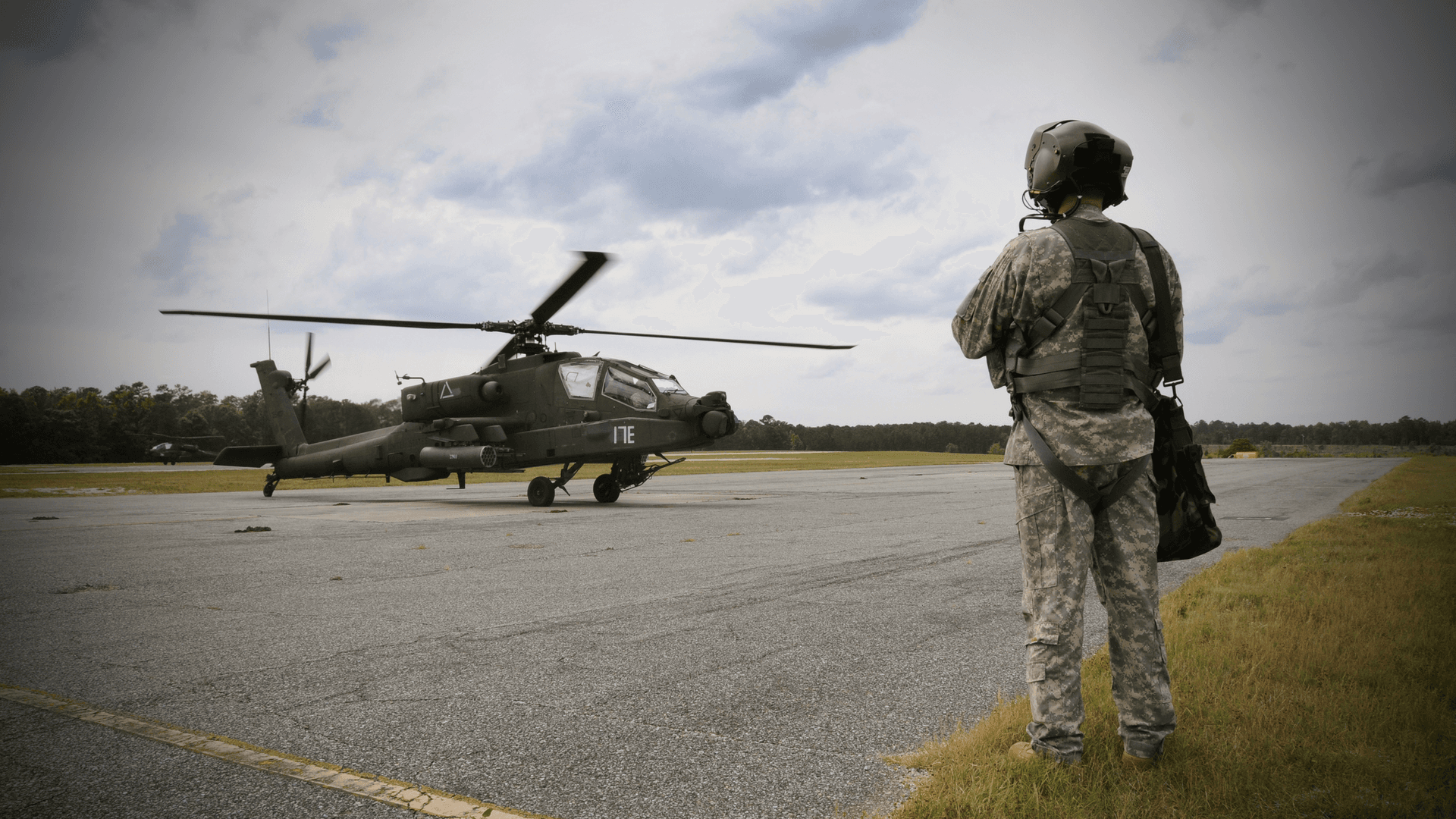
Hero photo: an Army flight student in aviator gear waits to approach an AH-64D Apache during training at Fort Rucker, 2013. Photo: Fort Rucker (U.S. Army), via Wikimedia Commons, CC BY 2.0.
Take our professional IQ test
Want to know your IQ? Try the first ever professional online IQ test.