What Is the NNAT Test? The Naglieri Nonverbal Ability Test Explained
The NNAT test is a 48-question nonverbal ability test used to screen K-12 students for gifted programs. Learn how the NNAT3 works and how it is scored.
Dr. Russell T. WarneChief Scientist
Share
The NNAT test (Naglieri Nonverbal Ability Test) is a 48-question, roughly 30-minute nonverbal measure of general ability, published by Pearson and used widely to screen students in kindergarten through grade 12 for gifted programs. Every item is a "progressive matrix," a visual puzzle built from shapes and patterns, and even the directions are pictorial, so the test requires no spoken or written language. The current edition, the NNAT3, launched in spring 2016 and reports scores on the Naglieri Ability Index, a scale with a mean of 100 and a standard deviation of 16. This article explains how the test works, how to read its scores, and what the research says about using it for gifted screening.
How the NNAT works
The NNAT3 presents 48 multiple-choice matrix puzzles to whole classrooms at once, on paper, online, or on tablets, in about 30 minutes. Directions are given with pictures rather than words, a design Pearson describes as particularly useful for assessing students who are English language learners or who have limited academic skills. Schools typically administer it once or twice per school year, in fall and early spring.
The test spans kindergarten through grade 12 across seven levels, A through G, each matched to a grade band. The lower levels (A through D) come in two forms apiece for test security, while levels E through G have one form each. Norms extend down to age 4, though Pearson does not recommend testing before kindergarten.
NNAT scores explained
The Naglieri Ability Index
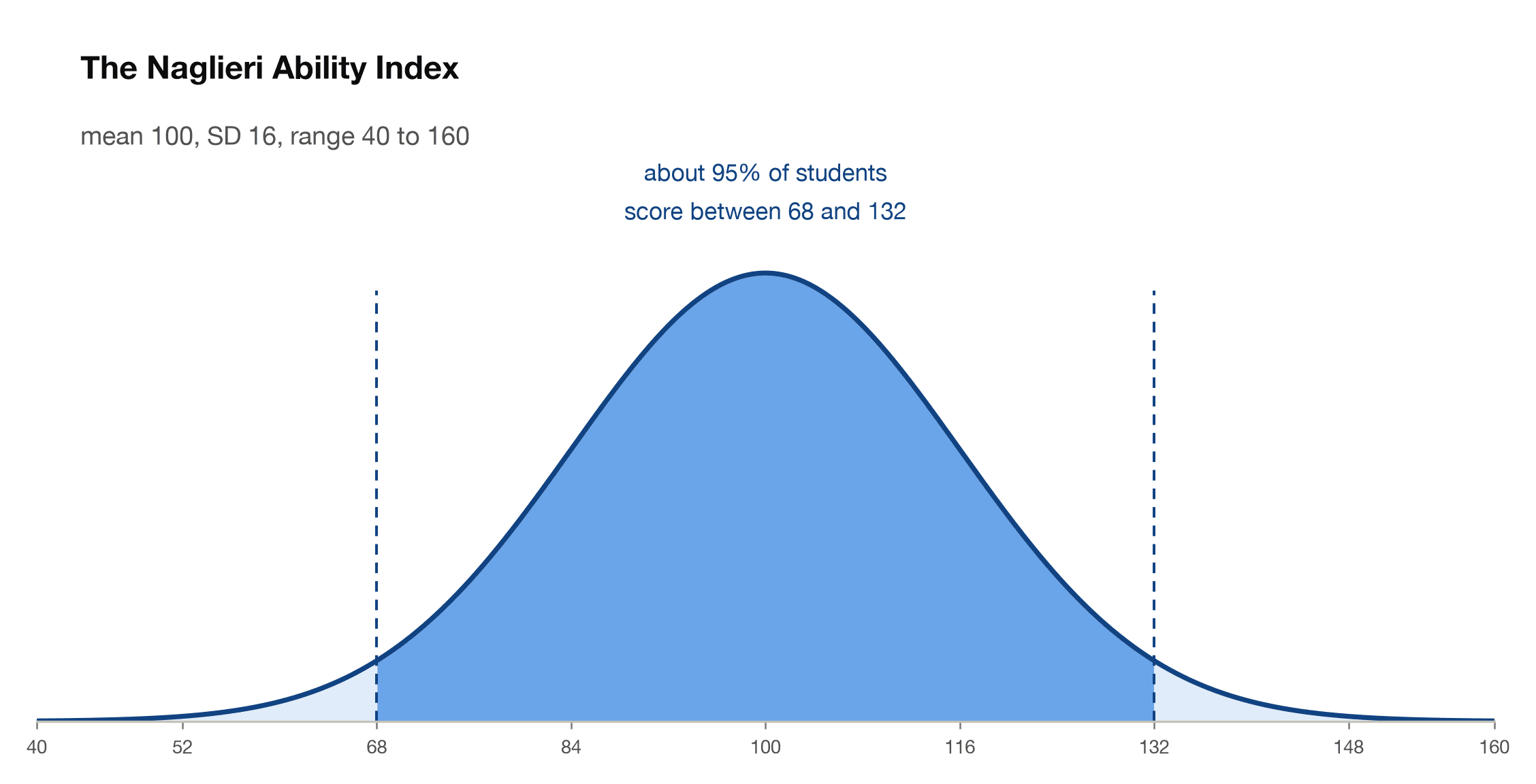
Results come back as a Naglieri Ability Index (NAI), a standard score with a mean of 100, a standard deviation of 16, and a range of 40 to 160, along with percentile ranks, stanines, and other converted scores. About 95% of students score between 68 and 132. One detail matters when comparing tests: because the NAI uses a standard deviation of 16 while most IQ scales use 15, an NAI is not directly interchangeable with a Wechsler-style IQ, and percentile ranks are the safest way to read one.
The 2018 norms update
Pearson renormed the lower levels in 2018 using a nationally representative sample of 85,959 students aged 4 through 11, stratified to match national demographics. The update shifted NAI scores down by about 4.5 points on average, and afterward 10.9% of the sample scored 120 or above, close to the 10.6% a normal curve predicts. Reliabilities at the lower levels run from .80 to .88, which translates to a "standard error of measurement" (the typical wobble around a student's true score) of roughly 5.6 to 6.0 NAI points. A single NNAT score is an estimate with real uncertainty, especially for young children.
Why gifted programs use a nonverbal test
Test author Jack A. Naglieri argued that a nonverbal measure can help address the underrepresentation of minority children in gifted programs, since it does not penalize students for limited English or uneven schooling (Naglieri & Ford, 2003). Many districts use the NNAT for "universal screening," testing every student at a grade level rather than only teacher-nominated children. New York City famously combined NNAT items with verbal items from the OLSAT to screen 4-to-7-year-olds for gifted and talented admissions, until the city ended that testing program in 2021. For the broader process, see our guide to how gifted testing works.
What the research says
The evidence supports the NNAT as one useful screener rather than a complete answer. Lohman, Korb, and Lakin (2008) compared the Raven, NNAT, and CogAT for identifying gifted English language learners, found the three nonverbal tests did not identify the same children, and cautioned against using any nonverbal test as the sole gifted screener. Pearson's own validity data point the same direction: the NNAT3 correlates about .55 with the OLSAT 8 School Ability Index, a solid but moderate figure. A matrices-only test samples a narrower slice of "g" (general cognitive ability) than a battery with verbal and quantitative content, so the two tests partially disagree about which students are strongest.
NNAT vs. full IQ tests
The NNAT trades breadth for accessibility. It measures general ability through one item type, which makes it fast, language-free, and easy to give to a whole school, and also makes it less precise than a comprehensive instrument that samples reasoning, knowledge, memory, and speed. Districts that use it well treat a high NAI as a flag for fuller evaluation rather than a final verdict; where the gifted line sits is its own question, covered in our article on whether an IQ of 120 is gifted. For adults curious where they would land on a full-scale measure, the Reasoning and Intelligence Online Test from RIOT IQ is a validated, normed assessment, and the free IQ test is the fastest way to find out.
Frequently asked questions
What does the NNAT test measure?
The NNAT is a nonverbal measure of general ability. All 48 questions are progressive matrix puzzles built from shapes and patterns, with picture-based directions, so it requires no reading or spoken language. It is designed to estimate reasoning ability independent of language skills.
What is a good NNAT score?
NNAT scores are reported as a Naglieri Ability Index with a mean of 100, a standard deviation of 16, and a range of 40 to 160. About 95 percent of students score between 68 and 132. Gifted programs commonly look for scores well above 120, though each district sets its own cutoff.
What grades take the NNAT?
The NNAT3 spans kindergarten through grade 12 across seven levels, A through G, with each level matched to a grade band. It takes about 30 minutes and can be given on paper or online to whole classes at once.
Is the NNAT an IQ test?
It measures general ability, like an IQ test, but with only nonverbal matrix items. Because its index uses a standard deviation of 16 rather than 15, and because it samples a narrower range of abilities than a full battery, an NAI is best interpreted through percentile ranks rather than as a Wechsler-style IQ.
Can you prepare a child for the NNAT?
Familiarity with the puzzle format can reduce anxiety and prevent misunderstandings, especially for young children. Heavy coaching is another matter: practice inflates scores without raising the underlying ability the test is meant to find, which defeats the purpose of gifted screening.
References
1. Lohman, D. F., Korb, K. A., & Lakin, J. M. (2008). Identifying academically gifted English-language learners using nonverbal tests: A comparison of the Raven, NNAT, and CogAT. Gifted Child Quarterly, 52(4), 275-296. doi.org/10.1177/0016986208321808
2. Naglieri, J. A., & Ford, D. Y. (2003). Addressing underrepresentation of gifted minority children using the Naglieri Nonverbal Ability Test (NNAT). Gifted Child Quarterly, 47(2), 155-160. doi.org/10.1177/001698620304700206
6. Northshore School District. (n.d.). NNAT3 overview.nsd.org
7. Chalkbeat New York. (2021, January 28). NYC education panel rejects 'gifted' testing contract, upending mayor's plans.chalkbeat.org
Hero image: students taking a group-administered test. The NNAT is given to whole classrooms in about 30 minutes. Photo by KF, public domain, via Wikimedia Commons.
Take our professional IQ test
Want to know your IQ? Try the first ever professional online IQ test.