What is the M-CHAT? The toddler autism screening questionnaire explained
The M-CHAT is a free 20-question autism screening checklist for toddlers aged 16 to 30 months. See how its two-stage scoring works and what results mean. (153 chars)
Dr. Russell T. WarneChief Scientist
Share
The M-CHAT, short for Modified Checklist for Autism in Toddlers, is a free parent questionnaire that pediatric practices use to check whether a toddler shows early signs associated with autism. The current version, the M-CHAT-R/F (Revised with Follow-Up), asks parents 20 yes/no questions about their child's everyday behavior and takes less than five minutes to complete. It is designed for children between 16 and 30 months of age and works in two stages: a quick checklist, then a short structured follow-up interview for children whose initial answers suggest an elevated likelihood of autism. This article explains where the M-CHAT came from, how the two stages and the scoring bands work, when pediatricians use it, and what a positive result does and does not mean.
What the M-CHAT is and where it came from
The M-CHAT-R/F is a "screening" tool, meaning a brief first-pass check that flags children who should receive a closer look. It is not a diagnostic test. The instrument was developed by psychologists Diana Robins, Deborah Fein, and Marianne Barton, who hold the copyright to the 2009 revision, and it is distributed through the official site at mchatscreen.com. According to the authors' site, the questionnaire can be downloaded at no cost, and clinicians may use it in their own practices, including inside their electronic health records, free of charge. Nonprofit teaching and research use is also free, while companies that want to build the checklist into software or repost it need a license.
The revision tightened up the original 1999 checklist. In the 2014 validation study published in Pediatrics, Robins and colleagues report that three items which performed poorly were dropped, the remaining 20 items were reordered, and the wording was simplified. For example, a question about using an index finger to point was rephrased as "Does your child point with one finger." The questions cover early social and communication behaviors of this kind, such as pointing to share interest, along with responses to sounds and movement patterns that research links to autism in toddlers.
Parents answer each question yes or no based on what their child usually does. There are no puzzles, no tasks for the child, and no observation component in the first stage. The whole checklist rests on what parents already know about their toddler's daily behavior.
How the two-stage screening works
The "R/F" in the name signals the tool's defining feature: a second stage. According to the validation study, the process runs as follows.
• Stage one, the checklist: a parent completes the 20 yes/no questions, usually in the waiting room or ahead of a well-child visit. This takes under five minutes and requires no professional involvement.
• Stage two, the follow-up interview: if the checklist score falls in the middle band, a nurse, physician assistant, or other trained staff member asks structured follow-up questions about only the flagged items. The interview gathers concrete examples of the behavior and takes roughly five to ten minutes.
The follow-up stage exists to cut down on false positives. Many toddlers pick up a point or two on the checklist for reasons unrelated to autism, such as a parent interpreting a question differently than intended or a behavior that is present but rare. Asking for specific examples sorts these cases out before anyone is referred for a full evaluation. In the 2014 validation sample, the follow-up interview resolved most middle-band scores without a referral.
This design has a practical payoff. The authors report that the revised two-stage version detects autism at a higher rate than the original M-CHAT while requiring fewer families to sit through the follow-up interview.
How the M-CHAT-R/F is scored
Scoring is simple by design. For most items, a "yes" answer counts zero points and a "no" answer counts one point, because the questions mostly describe behaviors that typically developing toddlers show. Three items (numbers 2, 5, and 12) are reverse-scored. The points are summed into a total from 0 to 20, and the official scoring guidelines sort that total into three bands.
• 0 to 2, low likelihood: the child screens negative and no follow-up is needed. The guidelines advise rescreening at the 24-month visit if the child is under two, since some signs emerge later.
• 3 to 7, moderate likelihood: staff administer the follow-up interview for the flagged items only. If two or more items still indicate elevated likelihood after the interview, the screen is positive and the guidelines call for referral to early intervention and a diagnostic evaluation.
• 8 to 20, high likelihood: the child screens positive without the follow-up interview, and the guidelines call for immediate referral for early intervention and diagnostic evaluation.
The official scoring page notes that shortcut scores based on subsets of items are no longer recommended; the full 20-item total is what counts. Readers familiar with broader developmental screeners such as the Denver II, covered in our article on what the Denver II measures, will notice a difference in scope: the M-CHAT-R/F targets autism-related behaviors specifically rather than surveying all developmental domains.
When toddlers are screened: the AAP recommendation
According to the American Academy of Pediatrics, every child should be screened specifically for autism at the 18-month and 24-month well-child visits, in addition to the general developmental surveillance that happens at every checkup. The AAP's parent-facing site, HealthyChildren.org, notes that the M-CHAT-R/F is the most common autism screening tool used in pediatric offices. Screening is universal rather than reserved for children who already show concerns, because signs can be subtle and screening all children catches cases that watchful waiting misses.
The 2014 validation study gives a sense of what universal screening looks like in practice. Just over 16,000 toddlers were screened at 18- and 24-month visits in metropolitan Atlanta and Connecticut. About 93 percent scored in the low band and simply continued routine care, and roughly 6 percent landed in the moderate band and completed the follow-up interview. The study's most striking finding concerned timing: children identified through screening were diagnosed about two years younger than the national median age of autism diagnosis at the time, which matters because early intervention services are most effective when started early.
What a positive screen does and does not mean
A positive M-CHAT-R/F result means a child's likelihood of autism is high enough to justify a full evaluation. It does not mean the child is autistic. The distinction shows up clearly in the validation data. Robins and colleagues report that among children who screened positive after both stages, 47.5 percent were later diagnosed with autism spectrum disorder. In other words, roughly half of screen-positive toddlers did not receive an autism diagnosis.
That said, a positive screen was rarely a false alarm in the broader sense. The same study found that 94.6 percent of screen-positive children had some developmental delay or concern, most often in language or other developmental areas, and nearly all of them could benefit from evaluation or support. This is why the authors advise clinicians to act on positive screens rather than wait: the official FAQ tells families explicitly not to take a wait-and-see approach for a year after a positive result.
An actual diagnosis happens elsewhere. Autism is diagnosed through a comprehensive evaluation by clinicians such as psychologists or developmental-behavioral pediatricians, typically combining a detailed developmental history, direct observation of the child (often with structured tools such as the ADOS-2), and measures of adaptive functioning. Instruments like the Vineland-3, described in our guide to the Vineland-3 adaptive behavior assessment, often form part of that picture. Families can also contact their local early intervention agency directly; in the United States, an eligibility evaluation does not require a diagnosis first.
Autism screening and IQ testing are different questions
The M-CHAT asks whether a toddler shows behaviors associated with autism. An IQ test asks how well a person reasons, remembers, and processes information. These are distinct constructs, and one does not determine the other; autistic people span the full range of intellectual ability. Our article on IQ and autism looks at that relationship in detail.
For readers interested in measuring cognitive ability itself, the Reasoning and Intelligence Online Test is an option for adults 18 and older. The RIOT IQ test was developed by RIOT IQ with psychometrician Dr. Russell T. Warne and includes 15 subtests across six cognitive indices: verbal reasoning, fluid reasoning, spatial ability, working memory, processing speed, and reaction time. It takes about 52 minutes and reports scores on the familiar mean-100 scale with a "standard deviation" (a measure of score spread) of 15. Like any online measure, it does not replace an individually administered diagnostic evaluation, and it is not a screener for autism or any other condition. You can learn more or take the test at riotiq.com.
Frequently asked questions
Is the M-CHAT free?
Yes. The official site offers the M-CHAT-R/F as a free download, and clinicians can use it in their own practices at no cost. The instrument is copyrighted, so companies that want to distribute it in software or post it on their own sites need a license.
What ages is the M-CHAT for?
The M-CHAT-R/F is intended for toddlers between 16 and 30 months of age. The validation study screened children at the 18- and 24-month well-child visits.
Does a positive M-CHAT mean my child has autism?
No. In the validation study, about 47.5 percent of children who screened positive after both stages were diagnosed with autism. A positive screen means an evaluation is warranted, and most screen-positive children had some developmental concern worth addressing, but the screen itself diagnoses nothing.
Can my child pass the M-CHAT and still be autistic?
Yes, screening tools miss some cases. The official FAQ notes that some milder presentations do not become apparent until closer to school age, and it advises parents who have concerns at any age to raise them with their child's healthcare professional regardless of a past negative screen.
Who fills out the M-CHAT?
A parent or regular caregiver answers the 20 yes/no questions based on the child's usual behavior. A trained staff member conducts the follow-up interview only when the initial score falls in the moderate band.
How is autism actually diagnosed after a positive screen?
Through a comprehensive evaluation by an expert clinician, such as a psychologist or developmental-behavioral pediatrician, combining developmental history, standardized observation, and adaptive behavior measures. The M-CHAT result is only the flag that starts this process.
References
1. Robins, D. L., Fein, D., & Barton, M. (2009). M-CHAT-R/F: Modified Checklist for Autism in Toddlers, Revised with Follow-Up (official website).. mchatscreen.com
2. Robins, D. L., Casagrande, K., Barton, M., Chen, C. A., Dumont-Mathieu, T., & Fein, D. (2014). Validation of the Modified Checklist for Autism in Toddlers, Revised with Follow-up (M-CHAT-R/F). Pediatrics, 133(1), 37-45. pmc.ncbi.nlm.nih.gov
3. Robins, D. L. (n.d.). Scoring the M-CHAT-R/F.. mchatscreen.com
4. American Academy of Pediatrics. (n.d.). How doctors screen for autism. HealthyChildren.org. healthychildren.org
5. Robins, D. L. (n.d.). M-CHAT frequently asked questions.. mchatscreen.com
6. Robins, D. L., Fein, D., & Barton, M. (2025 printing). M-CHAT-R/F instrument (PDF download).. mchatscreen.com
Hero image credit: [to be added at staging once the licensed photo is selected; license verified before publish.]
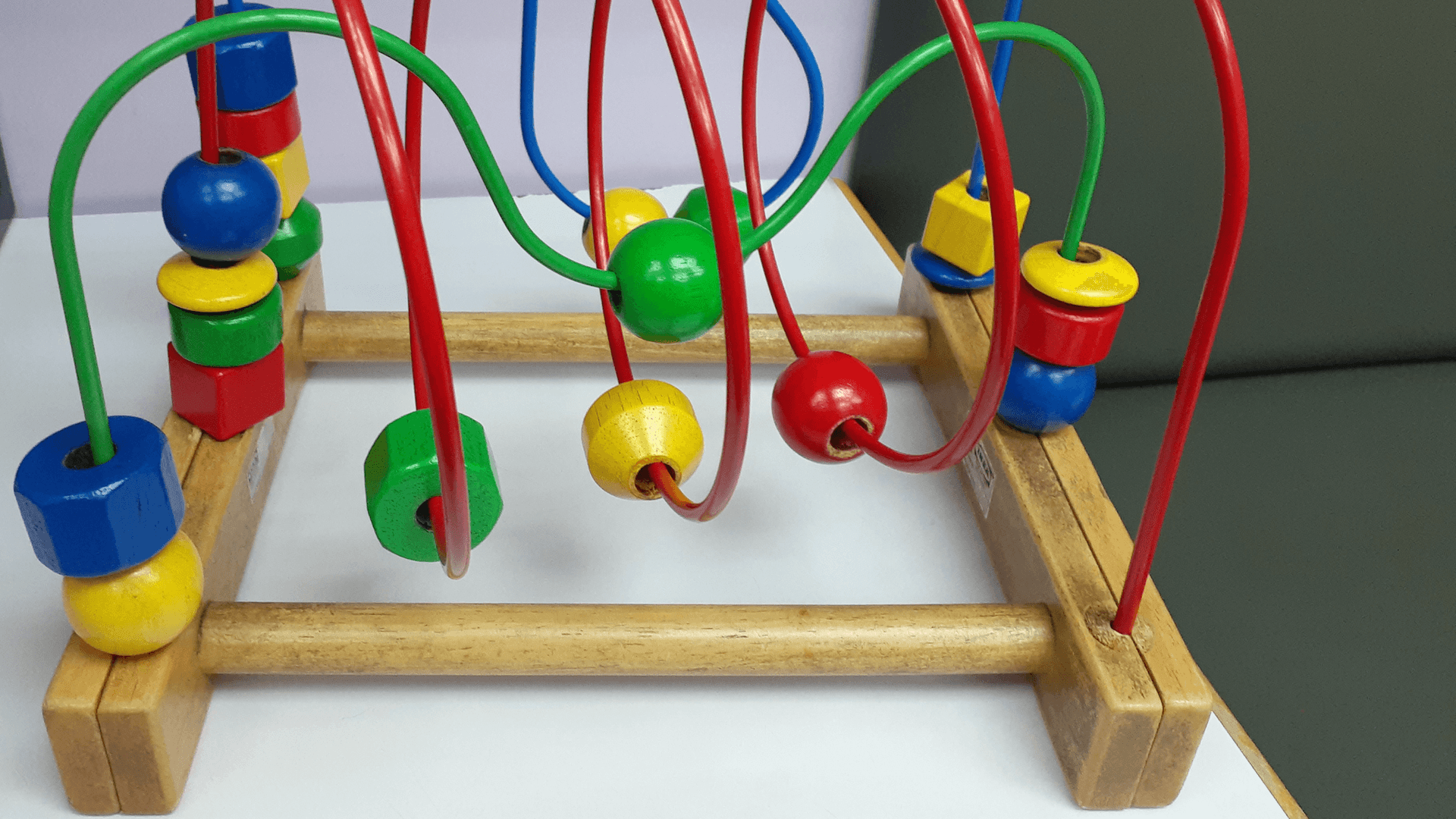
Hero photo: A wooden bead-maze toy on a table at a doctor's clinic. Photo by Huwciwe 2816, CC BY-SA 4.0, via Wikimedia Commons (cropped).
Take our professional IQ test
Want to know your IQ? Try the first ever professional online IQ test.