What Is the Universal Nonverbal Intelligence Test (UNIT2)? | Riot IQ
Aug 31, 2026·Specific IQ Tests & Formats
What Is the Universal Nonverbal Intelligence Test (UNIT2)?
The Universal Nonverbal Intelligence Test (UNIT2) measures intelligence with no spoken language. See who it serves, its six subtests, scores, and limits.
Dr. Russell T. WarneChief Scientist
Share
The Universal Nonverbal Intelligence Test, now in its second edition as the UNIT2, is an individually administered intelligence test that uses no spoken or written language in either its questions or its answers. Developed by psychologists Bruce A. Bracken and R. Steve McCallum and published by PRO-ED in 2016, the UNIT2 measures the intelligence of children and young adults ages 5 years, 0 months through 21 years, 11 months. Because the examiner communicates through demonstrations and gestures rather than words, the test is designed for examinees who would be disadvantaged by a language-loaded test, including deaf and hard-of-hearing students, English learners, and children with speech or language impairments. This article explains how the fully nonverbal format works, who the test serves, how its subtests and scores are organized, and what a nonverbal-only measure can and cannot tell you.
Where the UNIT came from
The original Universal Nonverbal Intelligence Test appeared in 1998 from Riverside Publishing and covered ages 5 through 17. Bracken and McCallum built it for children who could not be fairly assessed with tests like the WISC, which depend heavily on understanding spoken directions and giving spoken answers. The 1998 edition contained six subtests, including two (Object Memory and Mazes) that were later retired.
The second edition, the UNIT2, moved to publisher PRO-ED in 2016. It kept the fully nonverbal format, replaced the retired subtests with two new quantitative tasks, and extended the age range upward to 21 years, 11 months, which allows examiners to use it with older high school students and many college-age examinees. Normative data for the UNIT2 were collected from a national sample of 1,802 individuals in 33 states, keyed to U.S. census estimates.
In the terminology of test publishers, the UNIT2 measures "general intelligence," the broad reasoning ability that underlies performance across many different mental tasks. The test approaches that ability through three narrower channels: memory, fluid reasoning, and quantitative reasoning, all presented without words.
How a fully nonverbal administration works
Most intelligence tests remove language from some tasks. The UNIT is unusual because it removes language from the entire interaction. The publisher describes the format as an "entirely nonverbal stimulus-and-response administration format": the examiner presents full-color visual materials and manipulatives, and the examinee responds by pointing, arranging objects, or placing pieces rather than by speaking or writing.
Since the examiner cannot explain the tasks out loud, the test teaches each task by showing it. Administration relies on demonstration items that the examiner performs, sample items that let the examinee try the task with feedback, and standardized gestures, such as nodding or pointing, that signal approval or direct attention. By the time scored items begin, the examinee has seen the task solved and has practiced it, so no verbal instruction is needed.
This design has a practical consequence worth noting: the UNIT2 is an individually administered instrument that requires a trained examiner, typically a school psychologist or clinician. It is a professional tool used in schools and clinics, and there is no legitimate self-serve or take-at-home version.
Who the UNIT2 is designed for
The publisher identifies several groups for whom a language-free measure gives a fairer estimate of ability.
• Deaf and hard-of-hearing examinees: A test that requires spoken directions confounds hearing with intelligence. Because the UNIT2 uses no spoken language at all, a deaf student can complete every item on exactly the same footing as a hearing student.
• English learners: Students from different cultural or language backgrounds often understand far more than they can show on a verbally loaded test. The UNIT2 removes English proficiency from the equation, which is why it is commonly used in gifted screening and special education evaluations for multilingual students. Group-administered nonverbal screeners such as the Naglieri Nonverbal Ability Test serve a similar purpose in whole-classroom settings, while the UNIT2 offers a deeper individual evaluation. Among individually administered instruments, the Leiter test is the UNIT2's closest cousin, another fully nonverbal scale given one-on-one.
• Speech and language impairments: Children with conditions that affect speech production, and children who are verbally uncommunicative for other reasons, can demonstrate reasoning ability through pointing and object manipulation.
• Age range: The UNIT2 is normed for ages 5-0 through 21-11. It is a test for children, adolescents, and young adults; there are no adult norms beyond age 21.
Structure, subtests, and scores
The UNIT2 contains six subtests, organized in pairs under three composites.
• Memory composite: Symbolic Memory (recalling and re-creating sequences of symbols) and Spatial Memory (recalling where objects appeared on a grid).
• Reasoning composite: Analogic Reasoning (completing visual analogies) and Cube Design (reproducing three-dimensional patterns with patterned cubes).
• Quantitative composite: Nonsymbolic Quantity (reasoning about amounts without numerals) and Numerical Series (completing number patterns). Both quantitative subtests are new to the second edition.
Examiners can give the test at several lengths: an Abbreviated Battery of two subtests takes about 10 to 15 minutes, the two Standard Batteries of four subtests take about 30 minutes, and the Full Scale Battery of all six subtests takes 45 to 60 minutes.
Scoring follows the conventions used by most modern intelligence tests. Each subtest yields a "scaled score" with a mean of 10 and a standard deviation of 3, and the composites, including the Full Scale score, are reported on the familiar IQ metric with a mean of 100 and a standard deviation of 15. The publisher reports strong reliability for a nonverbal instrument: coefficient alpha values range from .88 to .96 for the subtests and from .93 to .98 for the composites. The Full Scale Battery score, drawn from all six subtests, is described in the scoring documentation as the best overall measure of general intelligence available from the test.
What nonverbal-only measurement can and cannot do
The UNIT2's core strength is access. For an examinee who cannot hear directions or cannot yet process English, a nonverbal test measures reasoning instead of measuring the language barrier. Research summarized in the Handbook of Nonverbal Assessment supports the view that well-built nonverbal tests tap the same general intelligence construct as traditional batteries, so a UNIT2 score is a genuine intelligence estimate rather than a score on some separate "nonverbal intelligence."
The format also carries real limitations, and honest interpretation requires keeping them in view.
• It samples a narrower slice of ability: Verbal knowledge and reasoning are among the strongest indicators of general intelligence, and a test with no verbal content simply cannot measure them. For an examinee with typical hearing and fluent English, a full battery that includes verbal subtests usually gives a more complete picture.
• Nonverbal does not mean culture-free: As the Handbook of Nonverbal Assessment notes, nonverbal tests like the UNIT2 still contain cultural elements in their pictured objects and in the administration format itself, such as the choice of gestures. The same caution applies to so-called culture-fair intelligence tests: reduced cultural loading is achievable, zero cultural loading is not.
• A single score still has measurement error: Like any test, the UNIT2 reports scores with confidence intervals, and a composite is an estimate of ability, never a fixed label for a person.
Where an online test like the RIOT IQ test fits
The UNIT2 and an online test serve different people. The UNIT2 is a clinician-administered instrument for examinees ages 5 to 21 who need a language-free format, and nothing online replaces that kind of individualized evaluation. An adult who simply wants a credible measure of their own cognitive ability faces a different situation: UNIT2 norms stop at 21-11, and hiring a psychologist for a full battery is expensive.
That is the gap the Reasoning and Intelligence Online Test fills. The RIOT IQ test is an IQ test built for adults ages 18 and older, developed by RIOT IQ with psychometrician Dr. Russell T. Warne, with 15 subtests across six cognitive indices that include nonverbal domains such as fluid reasoning, spatial ability, and working memory alongside verbal reasoning. It is normed on U.S. adults, follows professional testing standards, and takes about 52 minutes online. Readers who want a normed adult score, including strong nonverbal reasoning measures, can take the RIOT IQ test at riotiq.com.
Frequently asked questions
Is the Universal Nonverbal Intelligence Test a real IQ test?
Yes. The UNIT2 is a professionally published, individually administered intelligence test with national norms, and its composite scores use the standard IQ metric of mean 100 and standard deviation 15.
What ages can take the UNIT2?
The UNIT2 is normed for ages 5 years, 0 months through 21 years, 11 months. Adults past that age need a different instrument, such as an adult battery given by a psychologist or a normed online test like the RIOT IQ test.
How long does the UNIT2 take?
It depends on the battery. The Abbreviated Battery takes about 10 to 15 minutes, the Standard Batteries about 30 minutes, and the Full Scale Battery of all six subtests takes 45 to 60 minutes.
Why would a school use the UNIT2 instead of the WISC?
The UNIT2 requires no spoken language from the examiner or the examinee, so it gives a fairer estimate for deaf and hard-of-hearing students, English learners, and students with speech or language impairments who would be penalized by verbal directions.
Does a nonverbal test measure a different kind of intelligence?
No. Evidence reviewed in the Handbook of Nonverbal Assessment indicates that sound nonverbal tests measure the same general intelligence as traditional tests. They simply measure it through visual and spatial tasks instead of language.
References
1. Bracken, B. A., & McCallum, R. S. (2016). UNIT2: Universal Nonverbal Intelligence Test, Second Edition. PRO-ED. proedinc.com
2. PRO-ED. (2016). UNIT2 Online Scoring and Report System user's guide. proedinc.com
3. Bracken, B. A., & McCallum, R. S. (1998). Universal Nonverbal Intelligence Test (ERIC Record ED436879). Riverside Publishing. eric.ed.gov
4. McCallum, R. S. (Ed.). (2017). Handbook of nonverbal assessment (2nd ed.). Springer. link.springer.com
5. PAR, Inc. (n.d.). Universal Nonverbal Intelligence Test, Second Edition (UNIT2). parinc.com
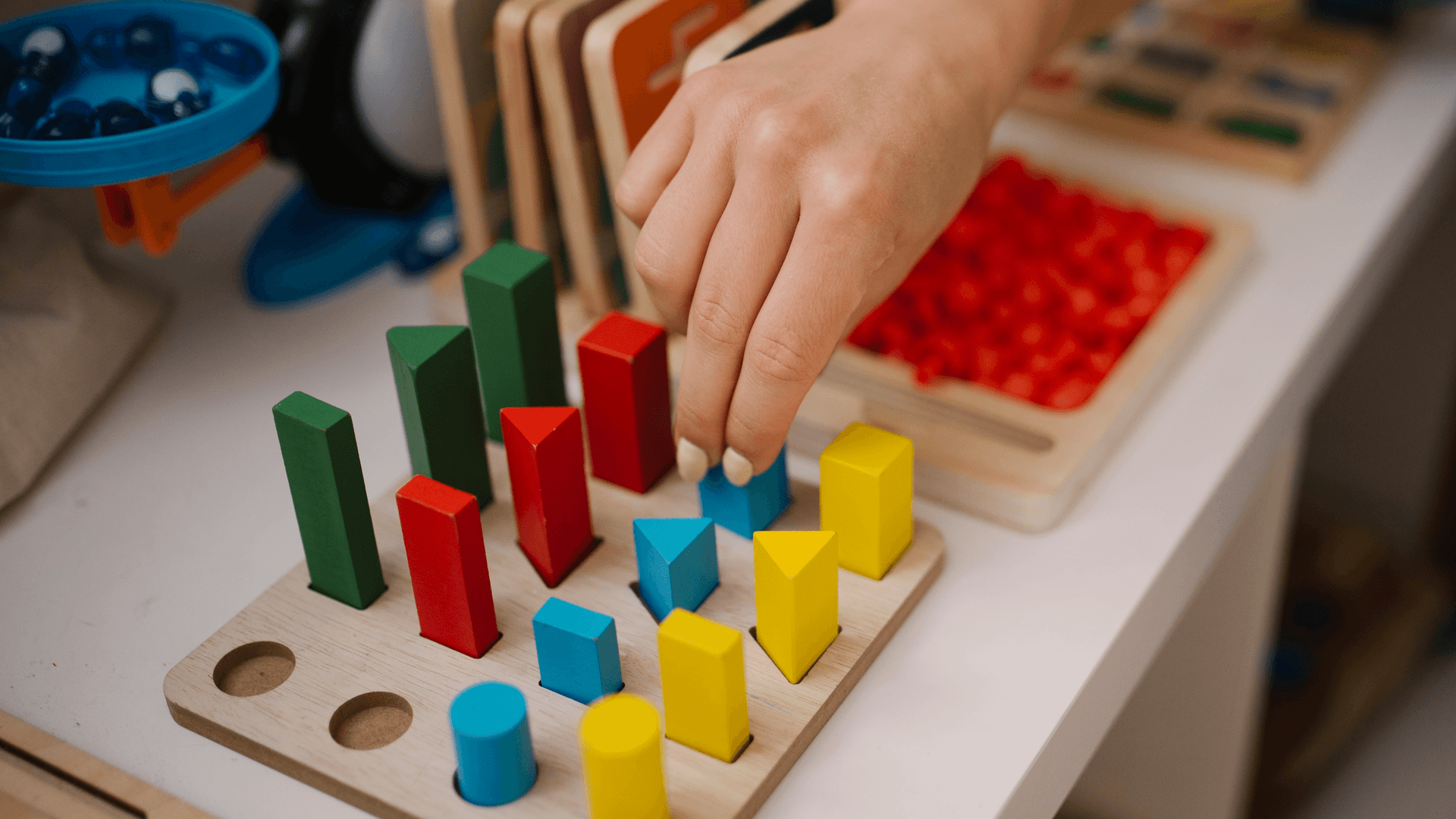
Hero photo: Hand placing colorful wooden geometric blocks on a shape-sorting board. Photo by Shixart1985, CC BY 2.0, via Wikimedia Commons.
Take our professional IQ test
Want to know your IQ? Try the first ever professional online IQ test.