What Is the KABC-II? A Guide to the Kaufman Assessment Battery for Children | Riot IQ
Aug 31, 2026·Specific IQ Tests & Formats
What Is the KABC-II? A Guide to the Kaufman Assessment Battery for Children
The KABC-II is a child intelligence test for ages 3 to 18 that offers two interpretive models. Learn how it is scored and how it differs from the WISC-V.
Dr. Russell T. WarneChief Scientist
Share
The KABC-II (Kaufman Assessment Battery for Children, Second Edition) is an individually administered intelligence test for children and adolescents ages 3 through 18, written by Alan S. Kaufman and Nadeen L. Kaufman and published by Pearson in 2004. Its current version is the KABC-II Normative Update (KABC-II NU), released in 2018 with refreshed scoring norms. The test's signature feature is a dual theoretical model: the examiner can interpret a child's performance through Luria's neuropsychological processing theory or through the Cattell-Horn-Carroll model of cognitive abilities, and the choice changes which global score the child receives. This article explains how the KABC-II is built, what its index scores mean, how it compares with the WISC-V, and what adults who want their own score can do instead.
What the KABC-II is
The Kaufman Assessment Battery for Children, Second Edition is a "clinician-administered" test, meaning a trained examiner gives it to one child at a time rather than to a group. According to Pearson, the publisher, it covers ages 3 years, 0 months through 18 years, 11 months, and the core battery takes roughly 25 to 55 minutes under the Luria model or 35 to 70 minutes under the CHC model.
The full battery contains up to 18 "subtests," short tasks that each target a specific cognitive skill; a study adapting the test for use in Zimbabwe describes it as having "a dual theoretical framework, with up to 18 individual tests (called subtests)." Examiners administer a subset of these depending on the child's age and the interpretive model chosen.
The Kaufmans are among the best-known figures in intelligence testing, and the family of instruments carrying their name also includes a short screening measure, the Kaufman Brief Intelligence Test. The 2018 Normative Update kept the second edition's structure and re-anchored its scores against a new normative sample of 700 children and adolescents, so that results reflect how children perform today rather than in the early 2000s.
The dual theoretical model: Luria and CHC
Most intelligence tests are built on a single theory. The KABC-II was deliberately built on two, and the examiner selects one before testing begins.
• The Luria model: based on the work of the Soviet neuropsychologist Alexander Luria, this framework treats intelligence as a set of mental processes, such as processing information in sequence or handling many pieces of information at once. It downplays what a child has already learned in school. The Luria interpretation is often preferred when acquired knowledge or language would get in the way of measuring thinking itself, for example with children from non-mainstream language or educational backgrounds.
• The CHC model: the "Cattell-Horn-Carroll" model is the consensus framework in modern psychometrics. It organizes cognition into broad abilities such as "fluid reasoning" (solving novel problems) and "crystallized ability" (accumulated knowledge and vocabulary). If those two terms are new to you, our guide to fluid vs. crystallized intelligence covers them in depth.
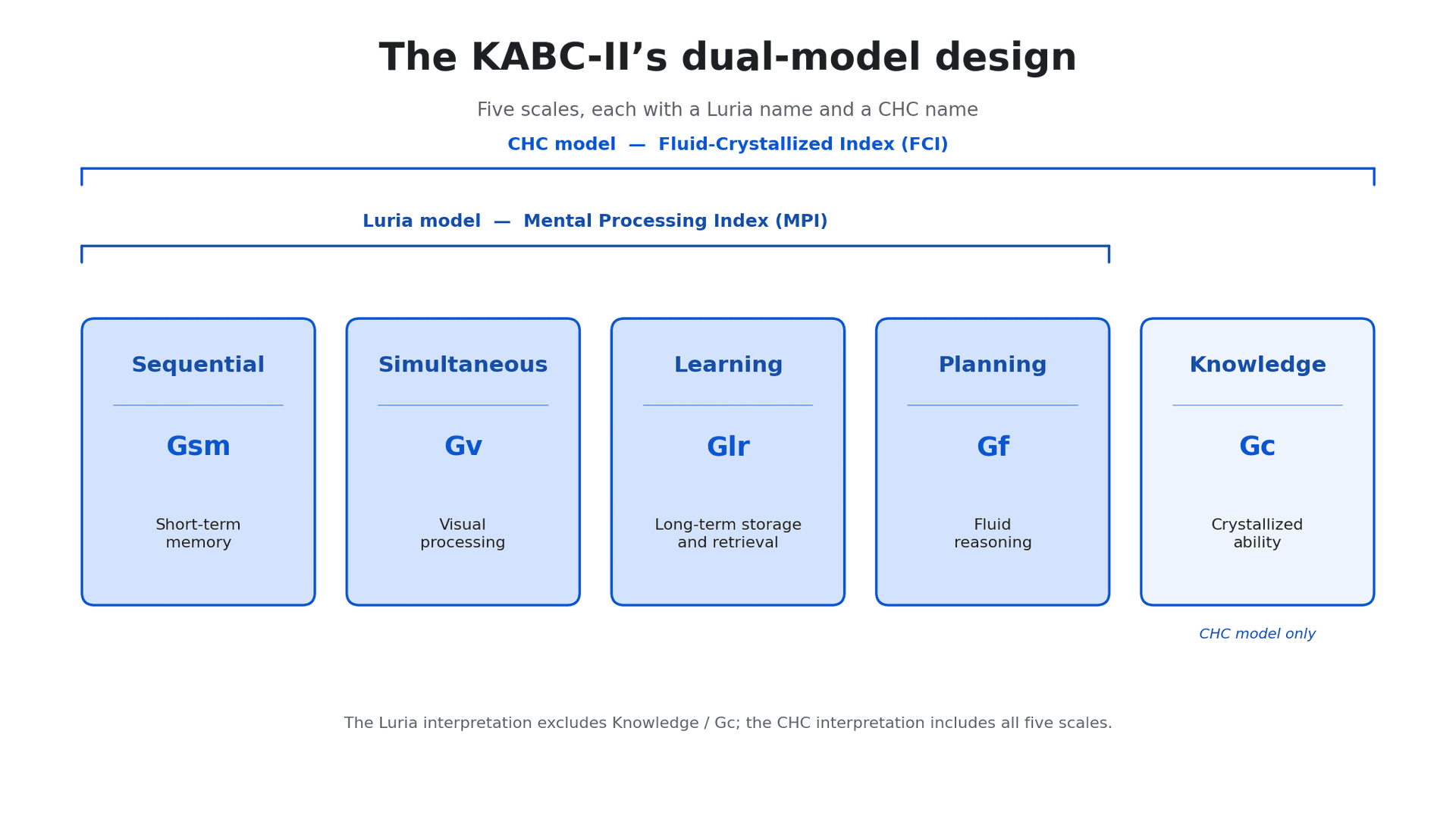
The clever part of the design is that the same scales carry both labels. The KABC-II's five scales are Sequential/Gsm (short-term memory), Simultaneous/Gv (visual processing), Learning/Glr (long-term storage and retrieval), Planning/Gf (fluid reasoning), and Knowledge/Gc (crystallized ability). The first name in each pair is the Luria term and the second is the CHC term. The Knowledge/Gc scale is the exception: it belongs to the CHC interpretation only, because the Luria approach intentionally excludes measures of acquired knowledge.
KABC-II index scores: MPI, FCI, and NVI
The model choice determines the global score, and the KABC-II offers three.
• Fluid-Crystallized Index (FCI): the CHC global score. It is the most comprehensive of the three because it includes the Knowledge/Gc scale, so a child's vocabulary and general information contribute to the total.
• Mental Processing Index (MPI): the Luria global score. As Scheiber and Kaufman put it, the MPI "excludes subtests that assess crystallized knowledge." It is meant to capture processing ability with less influence from schooling.
• Nonverbal Index (NVI): a global score built only from subtests that require no verbal expression, intended for children with limited speech, hearing differences, or very limited English.
All three are standard scores with a mean of 100 and a "standard deviation" (a measure of how spread out scores are) of 15, the same metric used by mainstream IQ tests. A result is an estimate with measurement error attached, so a competent examiner reports it with a confidence interval rather than as a single fixed number.
One research finding is worth knowing. The test authors expected the MPI and NVI to be the fairest options for minority students, since they lean less on language and school knowledge. When Scheiber and Kaufman tested this directly, the comprehensive FCI "emerged as the fairest predictor of achievement across all age and grade groups" in their sample. Stripping knowledge out of a test does not automatically make it fairer, a result that mirrors the broader psychometric literature on test bias.
How the KABC-II differs from the WISC-V
The most common alternative to the KABC-II in schools and clinics is the WISC-V, the Wechsler Intelligence Scale for Children, Fifth Edition, published by Pearson in 2014. The two tests differ in several concrete ways.
• Age range: the KABC-II spans ages 3:0 to 18:11, while the WISC-V covers ages 6:0 to 16:11. For a 4-year-old or a 17-year-old, the KABC-II can be used where the WISC-V cannot.
• Theoretical structure: the WISC-V yields one global score, the "Full Scale IQ" (FSIQ), plus five primary index scores (Verbal Comprehension, Visual Spatial, Fluid Reasoning, Working Memory, and Processing Speed). The KABC-II asks the examiner to pick an interpretive model first, then yields the FCI, MPI, or NVI accordingly.
• What gets measured: the WISC-V includes a Processing Speed Index; the KABC-II's five scales do not include a processing-speed measure. In the other direction, the KABC-II offers built-in ways to reduce verbal and knowledge demands (the MPI and NVI) that go further than the WISC-V's standard battery.
• Testing time: core batteries are broadly similar, with the WISC-V's primary subtests taking about 60 minutes and the KABC-II core running about 25 to 70 minutes depending on the model.
Neither test is simply better. School psychologists tend to choose based on the referral question, the child's age, and the child's language and cultural background.
Where an online test fits for adults
The KABC-II's norms stop at age 18 years, 11 months, so it is never the right instrument for an adult. Adults who want a professionally administered score typically take a Wechsler adult scale through a psychologist, which can cost hundreds of dollars and requires an appointment.
An online option now exists for self-assessment. The RIOT IQ test (the Reasoning and Intelligence Online Test) is a professionally developed online IQ test for adults ages 18 and older, built on the same Cattell-Horn-Carroll model that underlies the KABC-II's CHC interpretation. The full version includes 15 subtests across six cognitive indices, takes about 52 minutes, and is normed on US-born, native English speakers aged 18 and older. It does not replace an individually administered evaluation for diagnostic or legal purposes, and RIOT IQ is direct about that limitation. For an adult who simply wants a rigorous estimate of their own cognitive ability, you can take the RIOT IQ test at riotiq.com.
Frequently asked questions
Is the KABC-II an IQ test?
Yes. It is an individually administered intelligence test whose global scores use the familiar IQ metric, a mean of 100 and a standard deviation of 15, although its Luria-model score is called the Mental Processing Index rather than an IQ.
What ages is the KABC-II for?
Ages 3 years, 0 months through 18 years, 11 months, per the publisher. Adults need a different instrument, such as a Wechsler adult scale or a well-normed online test.
What is the difference between the MPI and the FCI?
Both are global scores with a mean of 100. The FCI comes from the CHC interpretation and includes the Knowledge/Gc scale, so acquired knowledge counts toward it. The MPI comes from the Luria interpretation and excludes subtests that measure crystallized knowledge.
What is the KABC-II NU?
The Normative Update, published by Pearson in 2018. It kept the 2004 test structure and updated the score norms using a new sample of 700 children and adolescents.
Is the KABC-II still used today?
Yes. The KABC-II NU is a current, commercially available instrument, and researchers continue to use and adapt the battery, including in international studies of child development.
References
1. Kaufman, A. S., & Kaufman, N. L. (2018). Kaufman Assessment Battery for Children, Second Edition Normative Update (KABC-II NU). Pearson. pearsonassessments.com
2. Scheiber, C., & Kaufman, A. S. (2015). Which of the three KABC-II global scores is the least biased? Journal of Pediatric Neuropsychology, 1, 21–35. doi.org
3. Piper, J. D., et al. (2024). Piloting the adaptation of the Kaufman Assessment Battery for Children, 2nd edition (KABC-II) to assess school-age neurodevelopment in rural Zimbabwe. Wellcome Open Research, 7, 274. pmc.ncbi.nlm.nih.gov
4. Wechsler, D. (2014). Wechsler Intelligence Scale for Children, Fifth Edition (WISC-V). Pearson. pearsonassessments.com
Take our professional IQ test
Want to know your IQ? Try the first ever professional online IQ test.