What is the Figure Weights subtest on the WISC-V and WAIS-5?
Figure Weights is the balance-scale subtest on the WISC-V and WAIS-5. Here is what it measures, how it is scored, and why one subtest score is not an IQ.
Dr. Russell T. WarneChief Scientist
Share
Figure Weights is a subtest on the Wechsler intelligence scales that shows a balance scale with one or more weights missing and asks the examinee to pick the option that would keep the scale level. It measures quantitative reasoning within the broader fluid reasoning domain, and it is scored as a "scaled score" with a mean of 10 and a standard deviation of 3. A Figure Weights score describes performance on one task inside a much larger battery, and on its own it is not an IQ. This article covers how the task works, which editions include it, and how far one subtest score can honestly be stretched.
How the Figure Weights task works
The examinee sees one or more scales in a stimulus book. Some of the pans hold colored shapes, and one pan is incomplete. The job is to choose, from a small set of response options, the group of shapes that would restore balance. According to Pearson's published WISC-V interpretive report, the child "viewed a scale with a missing weight(s) and identified the response option that would keep the scale balanced."
Nothing is written down and no numerals appear. The relationships between shapes have to be worked out from the scales themselves, so a solver has to notice that two of one shape balance three of another, hold that relationship in mind, and apply it to a second scale. McCrea and Robinson, writing in ISRN Neurology, describe the format as close to the classic Piagetian balance-beam problem with one simplification: the task "only uses different colors and shape tokens as weights without the necessity of incorporating proportional distance from the fulcrum." Distance from the pivot never matters, so the puzzle stays a question about quantity rather than physics.
Items are timed. On the children's scale, Pearson's assessment training materials give an item time limit of 20 or 30 seconds, depending on where the item falls in the sequence. Adult items are timed as well.
Where Figure Weights sits on the WISC-V
On the Wechsler Intelligence Scale for Children, Fifth Edition, Figure Weights is a primary subtest rather than an optional extra, and Pearson's training materials describe the construct it targets as quantitative and analogical fluid reasoning. For the wider picture of the children's battery, our guide to the WISC test walks through the full structure.
• Age range: the WISC-V is used with children aged 6:0 to 16:11, and Figure Weights is available across that whole span.
• Primary index: the Fluid Reasoning Index is derived from exactly two subtests, Matrix Reasoning and Figure Weights. A child's FRI is the sum of those two scaled scores converted to a standard score. The companion task is explained in our article on matrix reasoning tests.
• Full Scale IQ: Figure Weights is one of the seven subtests used to derive the WISC-V FSIQ, which is why an examiner cannot simply skip it when a full-scale score is needed.
• Quantitative Reasoning Index: Pearson's interpretive report states that "Figure Weights and Arithmetic comprise the Quantitative Reasoning Index (QRI), which measures quantitative reasoning skills." The QRI is an ancillary index, reported alongside the five primary indexes rather than inside the FSIQ.
Figure Weights is the one WISC-V subtest that sits in the fluid reasoning composite and the quantitative composite at the same time, which makes it the hinge between abstract pattern reasoning and numerical reasoning on the children's battery.
How Figure Weights changed between the WAIS-IV and the WAIS-5
On the adult side the subtest has been promoted, and anyone reading an older report needs to know the difference. Our overview of the WAIS IQ test covers the adult battery as a whole.
• On the WAIS-IV (2008): Figure Weights was a supplemental subtest attached to the Perceptual Reasoning Index. In his Mental Measurements Yearbook review of that edition, Gary Canivez observes that Figure Weights "is a supplemental subtest, so it does not enter into consideration unless replacing one of the core perceptual reasoning subtests."
• An age ceiling on the WAIS-IV: the same review records that Figure Weights, along with Letter-Number Sequencing and Cancellation, was available "for individuals 16-0 to 69-11 only" and was not administered to adults aged 70 to 90. Canivez notes that neither WAIS-IV manual explains why those examinees were excluded.
• On the WAIS-5 (2024): Pearson's own WAIS-IV to WAIS-5 comparison lists Figure Weights among the primary subtests, having listed it under supplemental subtests in the previous edition. The adult battery also split Perceptual Reasoning into separate Visual Spatial and Fluid Reasoning indexes, and Figure Weights now pairs with Matrix Reasoning to form the adult Fluid Reasoning Index.
• Age range on the WAIS-5: the publisher gives the age range as 16:0 to 90:11, with norms collected in 2023 and 2024, a seven-subtest Full Scale IQ taking about 45 minutes and ten primary index subtests taking about 60 minutes.
Figure Weights scores from a WAIS-IV report and a WAIS-5 report are therefore not interchangeable. The norms differ, the index the subtest belongs to differs, and in the older edition the score usually sat outside the Full Scale IQ altogether.
What a Figure Weights scaled score actually means
Pearson's documentation is explicit about the metric: Wechsler subtests "are on a scaled score metric with a mean of 10 and a standard deviation (SD) of 3," the scores "range from 1 to 19," and scores between 8 and 12 are typically considered average. Index scores and the Full Scale IQ use the familiar standard-score metric with a mean of 100 and an SD of 15.
A scaled score of 13 therefore sits one standard deviation above the subtest mean, which is roughly the 84th percentile for the examinee's age group. Converting a single scaled score into an IQ figure is a category error, because an IQ score summarizes performance across a battery while a scaled score summarizes performance on one task.
Measurement error matters here as much as it does at the index level. Every subtest has a standard error of measurement, so a scaled score of 12 is better read as a band than as a point. Small differences between two subtest scores, or between one subtest and a child's own average, are common in the general population and are not by themselves clinical findings.
What Figure Weights does and does not measure
The subtest is a strong marker of general cognitive ability. McCrea and Robinson report that in Benson and colleagues' independent analysis of the WAIS-IV, Figure Weights loaded 0.78 on the general factor, "the highest of all of the 15 WAIS-IV subtests," ahead of Arithmetic at 0.75 and Vocabulary at 0.74.
There are real limits on what one score supports.
• It is not a mathematics achievement test. No calculation is required and no numerals are shown. A child who is behind in arithmetic instruction can still score well, and a strong mental calculator can still stumble on the harder multi-scale items.
• Speed is part of the score. Because items are timed, a slow and accurate reasoner does not earn the same score as a fast and accurate one. Pearson's sample interpretive report describes exactly this pattern in a child who had "greater difficulty balancing scales under a time constraint."
• Profile reading is weaker than it looks. Marley Watkins tested four ways of quantifying Wechsler subtest scatter against a sample of 1,592 students with learning disabilities and found that the scatter indices produced correct classifications "only 50% to 55% of the time," an accuracy level he notes chance would also afford. Differences between subtests can be worth a clinician's attention as hypotheses, and they are poor diagnostic evidence on their own.
The sensible reading of a Figure Weights score is comparative. It tells you how a person handled quantitative fluid reasoning relative to peers of the same age, and it is one input into the Fluid Reasoning Index, the Quantitative Reasoning Index and the Full Scale IQ.
Getting a score you can actually interpret
A Figure Weights scaled score means something because it comes from an individually administered battery with a representative normative sample and standard administration rules. Free online balance-scale puzzles copy the surface of the task without any of that, so they produce a number with no reference group behind it.
For a properly normed measure of your own reasoning, the RIOT IQ test is a professionally developed option for adults aged 18 and over. The Reasoning and Intelligence Online Test was developed by RIOT IQ with psychometrician Dr. Russell T. Warne, uses 15 subtests across six cognitive indices covering verbal reasoning, fluid reasoning, spatial ability, working memory, processing speed and reaction time, takes about 52 minutes, and reports scores on the mean-100, SD-15 scale. It does not replace an individually administered diagnostic evaluation by a qualified psychologist, which is what a WISC-V or WAIS-5 report is for.
Frequently asked questions
Is Figure Weights a math test?
No. The task uses colored shapes rather than numerals and requires no calculation. It measures quantitative reasoning, meaning the ability to work out and apply relationships of quantity, which is related to but distinct from taught arithmetic skill.
What is a good Figure Weights score?
Scaled scores run from 1 to 19 with a mean of 10 and a standard deviation of 3, and Pearson treats scores from 8 to 12 as the typical average band. A score of 13 or higher is above average for the examinee's age group.
Does Figure Weights count toward the Full Scale IQ?
On the WISC-V it is one of the seven subtests used to derive the Full Scale IQ. On the WAIS-IV it was supplemental and entered the calculation only as a substitute for a core subtest. On the WAIS-5 it is a primary subtest and pairs with Matrix Reasoning to form the adult Fluid Reasoning Index.
Why was Figure Weights not given to older adults on the WAIS-IV?
The WAIS-IV made Figure Weights available only for examinees aged 16:0 to 69:11, and reviewers have noted that the published manuals give no stated reason for excluding the 70 to 90 age band. The WAIS-5 covers ages 16:0 to 90:11.
How long do you get for each Figure Weights item?
On the WISC-V, Pearson's assessment training materials give an item time limit of 20 or 30 seconds depending on the item. Adult items are timed as well.
Can you practice for Figure Weights?
Familiarity with balance-scale puzzles can reduce surprise, and coached practice undermines the meaning of the score, since the norms assume an examinee meeting the task for the first time. A qualified examiner will also note any obvious prior exposure in the report.
2. Maccow, G. (2014). Clinical utility of the WISC-V [Assessment training handout]. Pearson. cdn.ymaws.com
3. Pearson. (2025). WAIS-IV vs. WAIS-5: What's new and improved [Comparison flyer, US version]. Pearson Clinical Assessment. pearsonclinical.ca
4. Pearson. (2025). Measure more with WAIS-5 [Overview brochure]. NCS Pearson. pearsonassessments.com
5. Canivez, G. L. (2010). Review of the Wechsler Adult Intelligence Scale, Fourth Edition. In R. A. Spies, J. F. Carlson, & K. F. Geisinger (Eds.), The eighteenth mental measurements yearbook (pp. 684-688). Buros Institute of Mental Measurements. ux1.eiu.edu
6. McCrea, S. M., & Robinson, T. P. (2011). Visual Puzzles, Figure Weights, and Cancellation: Some preliminary hypotheses on the functional and neural substrates of these three new WAIS-IV subtests. ISRN Neurology, 2011, 123173. pmc.ncbi.nlm.nih.gov
7. Watkins, M. W. (2005). Diagnostic validity of Wechsler subtest scatter. Learning Disabilities: A Contemporary Journal, 3(2), 18-27. files.eric.ed.gov
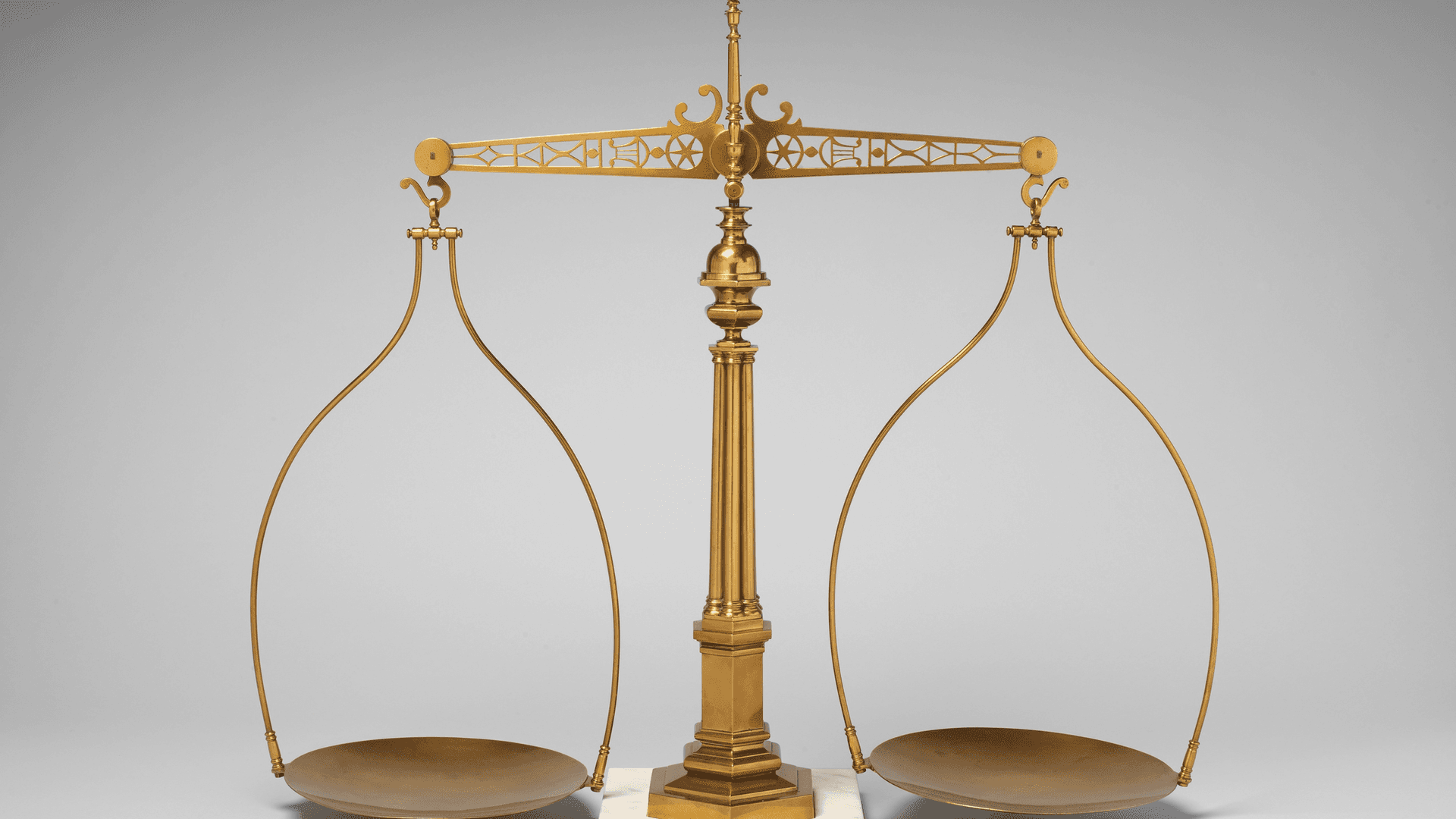
Hero photo: a nineteenth-century American two-pan balance scale, the visual logic behind the Figure Weights task. Metropolitan Museum of Art, CC0, via Wikimedia Commons; cropped to 16:9.
Take our professional IQ test
Want to know your IQ? Try the first ever professional online IQ test.