Dec 1, 2025·History & Origins Of IQ Testing
Are Online IQ Tests Scams?
Are online IQ tests scams? Most are—fake scores, hidden subscriptions, and no real science. Discover the red flags and the only legit online IQ test that actually meets professional standards.
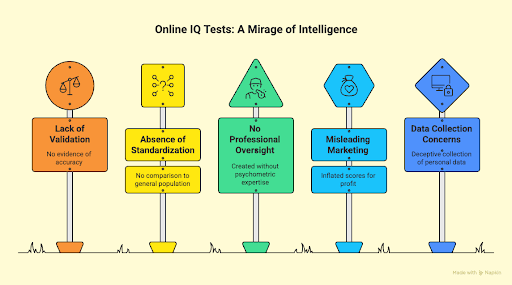
Online IQ tests attract large audiences because they are quick, accessible, and often promise instant feedback. However, convenience rarely equals scientific accuracy. Most of these tests are entertainment products that imitate the structure of professional assessments without following any of the procedures required for valid measurement. Their results, no matter how sophisticated they appear, cannot be interpreted as real indicators of intelligence.
What Defines a Legitimate IQ Test
A genuine intelligence test is a highly refined instrument, requiring significant investment in research and professional design. It is a carefully structured measurement tool defined by its scientific properties:
- Reliability: A test must be reliable, meaning it produces consistent results if the same person takes it multiple times under the same conditions. Think of it like a ruler: if you measure an object twice, you expect the reading to be the same. Psychologists achieve this through rigorous statistical methods to ensure the test items accurately reflect the underlying trait.
- Validity: This is the most critical element: the question of validity is whether the test actually measures what its creators or users claim it measures. A homemade IQ test might produce reliable data if it is extremely easy (and test takers get 100% correct every time they take it), but it wouldn't be valid to interpret that score as measuring a person’s intelligence.
- Standardization and Norms: Legitimate tests are standardized on a representative sample of the general population the test is designed for. This process generates normative data, which allows an individual's raw score to be converted into a meaningful IQ score (where 100 is the population average). Without these norms, a score is just a number with no context or comparative value.
Why Most Online Tests Are Unreliable
The majority of online IQ tests are created by individuals without training in psychometrics or psychology. Their questions often lack calibration, their scoring is arbitrary, and their claimed accuracy is unsupported by evidence. Many websites use inflated scores to encourage users to pay for certificates or detailed reports. Because these tests lack norm data and peer review, their results bear no relationship to scores on established measures of intelligence, such as the Wechsler or Stanford–Binet scales.
Recognizing Questionable Tests
Questionable intelligence tests, especially those found online, share several clear red flags that indicate a lack of scientific rigor and professional backing. The primary feature is often a complete lack of any technical documentation (such as a manual) that describes their creation and validation. This is important because this documentation is essential for the test to be externally evaluated. This evaluation is standard procedure for legitimate psychological tests. Note that the manual may not always be available to the public; access may be limited to testing professionals. But there should be evidence that the manual exists and that outside professionals have examined the test.
Furthermore, unreliable tests rarely have named authors or acknowledged institutional backing. Legitimate assessments are published by established psychological or educational testing corporations and are associated with known psychometricians and researchers. When a test's origin is anonymous, there is no way to verify the credentials of its creators or to hold them accountable for their work.
The Role of Professional Standards
Psychological testing must comply with the Standards for Educational and Psychological Testing issued jointly by the American Educational Research Association (AERA), the American Psychological Association (APA), and the National Council on Measurement in Education (NCME). These standards specify how tests should be constructed, validated, and reviewed for fairness. Instruments that ignore these requirements cannot be considered scientifically credible.
Watch “Are IQ Tests Accurate?” with Dr. Russell T. Warne on the Riot IQ YouTube channel to learn how to tell real intelligence tests from online scams.
Watch “Are IQ Tests Accurate?” with Dr. Russell T. Warne on the Riot IQ YouTube channel to learn how to tell real intelligence tests from online scams.
Article Categories
All ArticlesUnderstanding IQ ScoressTaking an IQ TestRIOT-Specific InformationGeneral IQ & IntelligenceAdvanced Topics & ResearchIQ Scores & InterpretationMensa & High-IQ SocietiesOnline IQ Tests IQ Test Basics & FundamentalsAverage IQ & DemographicsFamous People & IQHistory & Origins Of IQ TestingAccuracy, Reliability & CriticismSpecial Population & Related ConditionsImproving IQ / PreparationSpecific IQ Tests & Formats
Related Articles
Take our IQ testsCompare all tests
Basic IQ Test
5 subtests + 5 cognitive abilities
Features
- ~13 Minutes
- IQ score
- Cognitive abilities breakdown
- ±5.6 IQ margin of error
5/15 Subtests
Learn moreVocabulary
Matrix Reasoning
SToVeS
Visual Reversal
Symbol Search
Full IQ Test
15 subtests + all cognitive abilities
Features
- ~52 Minutes
- IQ score
- Cognitive abilities breakdown
- ±3.7 IQ margin of error
15/15 Subtests
Learn moreVocabulary, Information, Analogies
Matrix Reasoning, Visual Puzzles, Figure Weights
Object Rotation, SToVeS, Spatial Orientation
Computation Span, Exposure Memory, Visual Reversal
Symbol Search, Abstract Matching
Simple Reaction Time, Choice Reaction Time

Community
Intelligence Journals & Organizations
News & Press
Our Articles
Our Articles
Our Articles
Our Articles
Our Articles