Nov 30, 2025·Improving IQ / Preparation
ChatGPT’s IQ
What is ChatGPT's IQ? It doesn’t have one—AI predicts text, not truly reasons. Discover why ChatGPT has no real IQ and what human intelligence actually means.
IQ tests were created to measure human reasoning, not artificial systems. They assess how people learn, solve unfamiliar problems, and adapt their thinking to new situations. These abilities arise from human biology and development.
ChatGPT, in contrast, is a language model trained to predict word sequences. It generates responses based on statistical patterns rather than understanding or reasoning. Assigning it an IQ score, therefore, misunderstands what both IQ and intelligence mean.
AI Performance on IQ-Type Tasks
Some researchers have tested ChatGPT with questions drawn from standardized assessments like IQ tests. The results differ sharply depending on the version of the model, the test’s format, and the overlap between training data and test content.
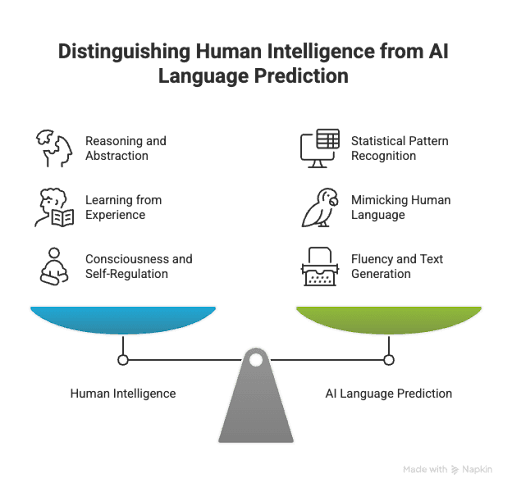
On some items, ChatGPT produces correct answers similar to those of high-performing humans; on others, it fails simple reasoning tasks. This inconsistency reflects the difference between statistical pattern recognition and genuine problem solving. The model identifies information it was trained on and it can reorganize information, but ChatGPT and other large language models do not interpret or evaluate the information given to them because, fundamentally, they do not think or understand.
Intelligence Versus Language Prediction
Intelligence involves reasoning, abstraction, and learning from experience. ChatGPT does none of these. It appears knowledgeable because it mirrors human language, not because it understands ideas. It can summarize complex theories, yet cannot form new ones or apply principles in unfamiliar contexts. IQ tests measure how humans reason under novelty and uncertainty; ChatGPT generates text without awareness or comprehension.
Why AI Seems Intelligent
The model’s fluency gives the illusion of thought because its training data encode patterns of human reasoning. By replicating those patterns, it produces responses that resemble understanding. However, this process depends entirely on exposure to existing text. When faced with problems requiring inference outside that data or its training dataset, performance declines rapidly. Apparent intelligence arises from mimicry, not cognition.
Psychologists define intelligence as the general mental ability that enables purposeful behavior, abstract thought, and learning through experience. This definition presupposes consciousness and self-regulation capacities that artificial models lack. Statistical processing power and cognitive ability are not equivalent. While AI can simulate reasoning, it does not possess insight, motivation, or awareness.
Ultimately, ChatGPT can imitate intelligent expression, but does not think or reason. Its outputs are linguistic predictions, not demonstrations of cognitive ability. In short, it does not have intelligence the way that humans do, which means that “artificial intelligence” isn’t a type of intelligence at all. Assigning an IQ to ChatGPT and other large language models confuses fluency with intellect and overlooks the important differences between human understanding and algorithmic pattern recognition. IQ tests such as the professionally developed RIOT measure human reasoning, not computational performance. Recognizing this distinction preserves the integrity of intelligence testing and the meaning of human intellect.
Watch “Human Intelligence vs. AI: What Really Defines ‘Smart’?” with Gilles Gignac on the Riot IQ YouTube channel for a fascinating look at how artificial intelligence compares to human IQ.
Article Categories
All ArticlesUnderstanding IQ ScoressTaking an IQ TestRIOT-Specific InformationGeneral IQ & IntelligenceAdvanced Topics & ResearchIQ Scores & InterpretationMensa & High-IQ SocietiesOnline IQ Tests IQ Test Basics & FundamentalsAverage IQ & DemographicsFamous People & IQHistory & Origins Of IQ TestingAccuracy, Reliability & CriticismSpecial Population & Related ConditionsImproving IQ / PreparationSpecific IQ Tests & Formats
Related Articles
Take our IQ testsCompare all tests
Basic IQ Test
5 subtests + 5 cognitive abilities
Features
- ~13 Minutes
- IQ score
- Cognitive abilities breakdown
- ±5.6 IQ margin of error
5/15 Subtests
Learn moreVocabulary
Matrix Reasoning
SToVeS
Visual Reversal
Symbol Search
Full IQ Test
15 subtests + all cognitive abilities
Features
- ~52 Minutes
- IQ score
- Cognitive abilities breakdown
- ±3.7 IQ margin of error
15/15 Subtests
Learn moreVocabulary, Information, Analogies
Matrix Reasoning, Visual Puzzles, Figure Weights
Object Rotation, SToVeS, Spatial Orientation
Computation Span, Exposure Memory, Visual Reversal
Symbol Search, Abstract Matching
Simple Reaction Time, Choice Reaction Time

Community
Intelligence Journals & Organizations
News & Press
Our Articles
Our Articles
Our Articles
Our Articles
Our Articles