Dec 9, 2025·Special Population & Related Conditions
Which IQ Test Should I Take?
Which IQ test should I take? For clinical or legal needs get the WAIS from a psychologist; for kids choose the WISC or school test; for accurate personal insight only the professional online RIOT meets real scientific standards. Clear guide to the right choice.
There are dozens of IQ tests available, and choosing the right one can be confusing. The best test for you depends on several factors: your age, why you need the test, your budget, and how you plan to use the results.
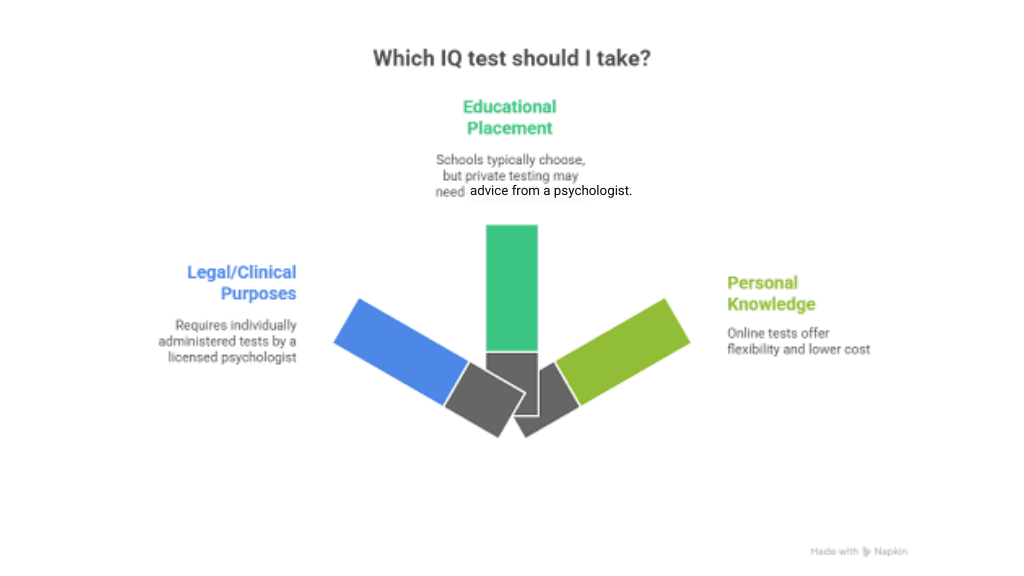
Consider Your Purpose
Before selecting an IQ test, ask yourself why you want to take it. Different situations call for different tests.
For legal or clinical purposes, you need an individually administered test given by a licensed psychologist. Courts, disability determinations, and clinical diagnoses require this level of professional oversight. Tests like the Wechsler Adult Intelligence Scale (WAIS), Stanford-Binet, or Woodcock-Johnson are standard in these settings.
For educational placement, schools typically choose the test. Gifted program admissions often use group-administered tests like the Cognitive Abilities Test (CogAT). If a child is suspected of having a disability, then a school psychologist may choose to administer an IQ test as part of the diagnostic process. If you're seeking private testing to supplement school evaluations, a psychologist can advise which test best suits your needs.
For personal knowledge, you have more flexibility. A professionally developed online test can provide accurate results at a fraction of the cost of traditional testing. This is the situation where test selection matters most.
Age Matters
IQ tests are designed for specific age ranges. Using a test outside its intended population produces unreliable results.
For young children (preschool through early elementary), the Wechsler Preschool and Primary Scale of Intelligence (WPPSI) is a common choice. The Stanford-Binet also covers this age range. These tests must be administered by trained professionals because young children require expert guidance to stay engaged and follow directions.
For school-age children and adolescents, the Wechsler Intelligence Scale for Children (WISC) is the most widely used individually administered test, though other tests, such as the Woodcock-Johnson, are valid options. Group tests like the CogAT are also popular in school settings. Currently, there are no legitimate online IQ tests for children.
For adults, options include the WAIS (administered by psychologists) and the Reasoning and Intelligence Online Test (RIOT), which is designed for people ages 18-65.
Test Content and Structure
Some tests are "single-format tests" that use only one type of task. The Raven's Progressive Matrices, for example, consists entirely of visual pattern recognition problems. These tests are quick to administer and have advantages in certain situations, like testing people with language barriers.
Other tests are "test batteries" that include multiple subtests measuring different abilities. The WAIS, Stanford-Binet, and RIOT fall into this category. Test batteries sample a broader range of cognitive abilities, reducing the risk that your score will be distorted by a particular strength or weakness. They also provide subscores showing your performance across different cognitive domains.
For most purposes, a test battery is preferable. An overall IQ score is useful, but subscores can reveal important patterns. Someone might have strong verbal reasoning but struggle with processing speed, or excel at spatial tasks but have weaker working memory. These nuances matter.
Evaluating Quality
Regardless of which test you're considering, check these quality indicators:
Identified creator with credentials. The test developer's name and qualifications should be easy to find. Legitimate test creators are proud to attach their name to their work. Anonymity enables fraud and prevents accountability.
Documented norm sample. The test should clearly state how many people were in its norming sample, how they were recruited, and their demographic characteristics. Self-selected samples produce distorted results.
Evidence of reliability and validity. This information appears in technical manuals or published research. Even if you can't access the full documentation, there should be indication it exists.
Adherence to professional standards. Legitimate tests are developed following guidelines from organizations like the American Psychological Association. The Standards for Educational and Psychological Testing outline these expectations.
Independent evaluation. Has the test been reviewed by outside experts? Used in peer-reviewed research? You can check this by searching for the test name in Google Scholar.
A Professional Online Option
The Reasoning and Intelligence Online Test is the first online IQ test that meets professional standards for psychological assessment. Created by Dr. Russell T. Warne, who has over 15 years of experience in intelligence research, the RIOT experienced rigorous development including expert review, the first ever proper US-based online norm sample, and adherence to testing standards from APA, AERA, and NCME.
The RIOT functions as a test battery, measuring verbal reasoning, fluid reasoning, spatial ability, working memory, processing speed, and reaction time in addition to providing an overall IQ score. This comprehensive approach provides the nuanced picture that single-format tests cannot offer.
Whatever test you choose, do your homework. Check the creator's credentials, verify the test has a representative norm sample, and look for evidence of professional development. These few minutes of research can save you from wasting time and money on meaningless results.
Watch “Why Are the Tasks on the RIOT Relevant to Intelligence?” with Dr. Russell T. Warne on the Riot IQ YouTube channel to see what sets legitimate online IQ tests apart from the rest.
Article Categories
All ArticlesUnderstanding IQ ScoressTaking an IQ TestRIOT-Specific InformationGeneral IQ & IntelligenceAdvanced Topics & ResearchIQ Scores & InterpretationMensa & High-IQ SocietiesOnline IQ Tests IQ Test Basics & FundamentalsAverage IQ & DemographicsFamous People & IQHistory & Origins Of IQ TestingAccuracy, Reliability & CriticismSpecial Population & Related ConditionsImproving IQ / PreparationSpecific IQ Tests & Formats
Related Articles
Take our IQ testsCompare all tests
Basic IQ Test
5 subtests + 5 cognitive abilities
Features
- ~13 Minutes
- IQ score
- Cognitive abilities breakdown
- ±5.6 IQ margin of error
5/15 Subtests
Learn moreVocabulary
Matrix Reasoning
SToVeS
Visual Reversal
Symbol Search
Full IQ Test
15 subtests + all cognitive abilities
Features
- ~52 Minutes
- IQ score
- Cognitive abilities breakdown
- ±3.7 IQ margin of error
15/15 Subtests
Learn moreVocabulary, Information, Analogies
Matrix Reasoning, Visual Puzzles, Figure Weights
Object Rotation, SToVeS, Spatial Orientation
Computation Span, Exposure Memory, Visual Reversal
Symbol Search, Abstract Matching
Simple Reaction Time, Choice Reaction Time

Community
Intelligence Journals & Organizations
News & Press
Our Articles
Our Articles
Our Articles
Our Articles
Our Articles