Nov 30, 2025·Famous People & IQ
How Are IQ Tests Created
How are IQ tests made? From theory to norming: discover the rigorous science behind designing real IQ tests like WAIS, Stanford-Binet, and professional online RIOT.
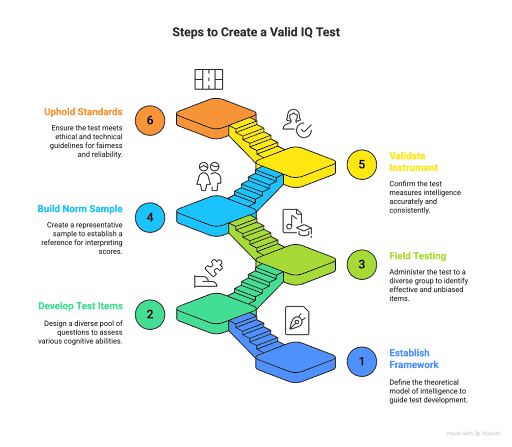
Creating an IQ test begins with defining what the test will measure. Psychologists start with a theoretical model of intelligence, most often the Cattell–Horn–Carroll framework, which identifies key domains of intelligence. These include reasoning, memory, knowledge, and processing speed. This foundation determines which abilities will be assessed and ensures that the instrument reflects accepted scientific understanding rather than intuition.
Developing Test Items
Once the framework is set, psychologists design a large pool of potential questions, or items, to represent each ability. These items may involve patterns, vocabulary, analogies, or numerical reasoning.
The goal is to sample thinking skills broadly while keeping language and content clear and culturally accessible. Because some preliminary items will not perform as intended, developers create far more than they plan to keep for the final version. That makes it easy to drop an item that doesn’t function as intended.
Field Testing and Statistical Review
The initial item pool is administered to diverse participants who reflect the population for which the test is intended. Psychologists then analyze the results statistically to identify items that accurately distinguish among levels of ability.
Statistical analysis reveals which questions are too easy, too difficult, or biased toward certain groups. Only items that measure reasoning well and without bias are retained, establishing the foundation for test accuracy.
Building the Norm Sample
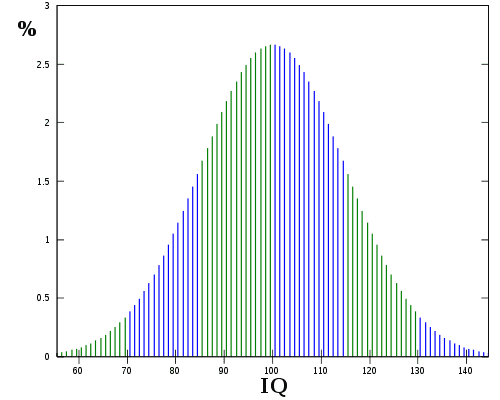
After the best items are selected, the final version of the test is assembled, and the complete test is given to a large, representative sample of people. These data form the norms used to interpret individual scores. IQ is a comparative measure: an individual’s performance is evaluated relative to others of the same age. The average score is set at 100, with a standard deviation of 15, creating a consistent frame of reference across age groups and populations.
Validating the Instrument
Validation confirms that the test measures intelligence rather than unrelated traits (or -- even worse -- measures nothing at all). Psychologists examine correlations between IQ scores and external criteria such as academic achievement or job performance to verify predictive accuracy. They can also examine how well test scores correlate with scores on established IQ tests. Reliability studies confirm that scores remain stable over different conditions, such as repeated administrations. Together, these analyses demonstrate that the instrument measures cognitive ability consistently and meaningfully.
Upholding Professional Standards
All professional test development follows ethical and technical requirements set by the American Educational Research Association (AERA), the American Psychological Association (APA), and the National Council on Measurement in Education (NCME). These guidelines mandate documentation of the development process, evidence of reliability and validity, and verification that the test functions fairly across demographic groups. Any item showing systematic disadvantage for irrelevant reasons must be revised or removed before publication.
The RIOT as an Example
The Reasoning and Intelligence Online Test (RIOT), developed by Dr. Russell T. Warne, illustrates how these principles apply in contemporary testing. It was built around a clear theory of intelligence, refined through multiple stages of pilot testing and analysis, and standardized on a U.S. norm sample representative of the general population. Created in accordance with AERA, APA, and NCME standards, the RIOT demonstrates that online assessment can achieve the same scientific rigor as traditional in-person tests when constructed through proper psychometric methods.
Watch “What Is an IQ Test?” on the Riot IQ YouTube channel to see how intelligence tests are designed, structured, and validated before they’re used.
Article Categories
All ArticlesUnderstanding IQ ScoressTaking an IQ TestRIOT-Specific InformationGeneral IQ & IntelligenceAdvanced Topics & ResearchIQ Scores & InterpretationMensa & High-IQ SocietiesOnline IQ Tests IQ Test Basics & FundamentalsAverage IQ & DemographicsFamous People & IQHistory & Origins Of IQ TestingAccuracy, Reliability & CriticismSpecial Population & Related ConditionsImproving IQ / PreparationSpecific IQ Tests & Formats
Related Articles
Take our IQ testsCompare all tests
Basic IQ Test
5 subtests + 5 cognitive abilities
Features
- ~13 Minutes
- IQ score
- Cognitive abilities breakdown
- ±5.6 IQ margin of error
5/15 Subtests
Learn moreVocabulary
Matrix Reasoning
SToVeS
Visual Reversal
Symbol Search
Full IQ Test
15 subtests + all cognitive abilities
Features
- ~52 Minutes
- IQ score
- Cognitive abilities breakdown
- ±3.7 IQ margin of error
15/15 Subtests
Learn moreVocabulary, Information, Analogies
Matrix Reasoning, Visual Puzzles, Figure Weights
Object Rotation, SToVeS, Spatial Orientation
Computation Span, Exposure Memory, Visual Reversal
Symbol Search, Abstract Matching
Simple Reaction Time, Choice Reaction Time

Community
Intelligence Journals & Organizations
News & Press
Our Articles
Our Articles
Our Articles
Our Articles
Our Articles