Dec 3, 2025·Famous People & IQ
What is Considered a Low IQ?
What is considered a low IQ? Below 85 is below average (1 in 6 people), 70–75+ is borderline, and <70 may qualify as intellectual disability with daily-life struggles. Discover where the cutoffs really are and what they mean.
IQ scores fall along a normal distribution (often called a “bell curve), with most people clustered near the average and fewer individuals as scores move towards the extremes. But what counts as "low"? The answer depends on context and some subjective judgment because there are no sudden breaks or changes in the curve as it goes from its peak at the average to extreme scores. Rather, the transition is very gradual and smooth.
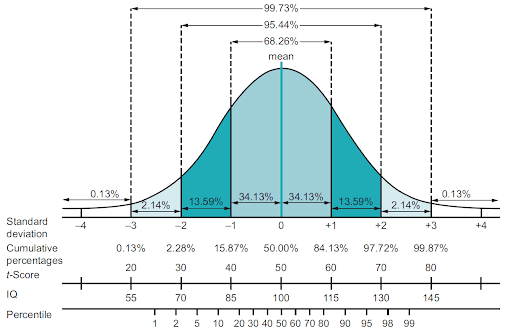
Most IQ tests use a scale where 100 is average and 15 points represent one standard deviation, which is a measure of how spread out scores are. A common definition of “the average range” is a score within one standard deviation (i.e., 15 points) of 100. In the general population, about 68% of people have a score in the average range of 85 to 115, and about 14% of people have a score below 85.
But whether a score is “low” also depends on the purpose that the score will be used for. The absolute minimum IQ that a person can have to join the United States military is 80, and people with this intelligence level can be trained to complete important jobs in transport, food service, and other areas. An IQ of 80 or 85 is not considered “low” for these jobs. But the same scores are very low for high-skill jobs, such as in medicine or law.
When Low IQ Becomes a Disability
Although there is no strict cutoff, an IQ below 65 to 75 is generally considered the threshold for intellectual disability (formerly called mental retardation). However, a low IQ score alone isn't sufficient for this diagnosis. Professional guidelines require that the person also show significant limitations in adaptive functioning, or the practical skills needed for daily life.
Adaptive functioning includes:
• Conceptual skills: Language, reading, writing, math, reasoning, memory
• Social skills: Interpersonal relationships, following rules, avoiding victimization
• Practical skills: Personal care, job responsibilities, money management, transportation
Someone with an IQ of 65 who can hold a job, manage their household, and maintain relationships might not qualify for an intellectual disability diagnosis. Conversely, someone with an IQ of 75 who struggles with basic self-care might need support services. The diagnosis requires both cognitive and functional impairment.
IQ 70-85: Below Average but Functional
Scores in the 70-85 range represent below-average intelligence without crossing into disability territory.
People in this range typically:
People in this range typically:
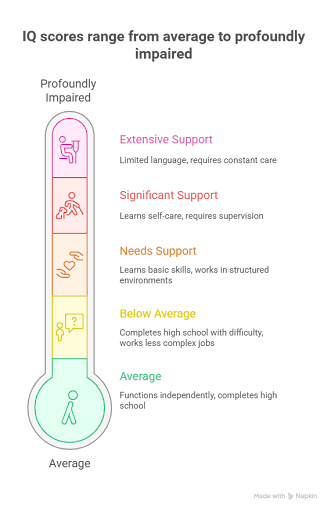
• Complete high school, though often with difficulty
• Work in jobs requiring less cognitive complexity
• Live independently with varying degrees of success
About 16% of the population scores in this range. That's roughly 1 in 6 people. These individuals aren't intellectually disabled, but they face real challenges in a world that increasingly demands complex cognitive skills.
The minimum IQ for stable employment and independent functioning is generally estimated to be around 75 to 80. Below this threshold, finding and maintaining work becomes progressively more difficult, though not impossible.
What Causes Low IQ?
Intelligence has both genetic and environmental components. Heritability estimates suggest that about 50-60% of IQ differences in typical environments come from genetic factors, with the remainder from environmental influences.
Environmental factors that can lower IQ include:
• Prenatal exposure to alcohol or drugs
• Severe malnutrition in early childhood
• Brain trauma
• Lack of educational opportunities
• Extremely neglectful environments
Some cases of low IQ result from genetic syndromes (like Down syndrome) or brain injuries. But most people with low IQs don't have an identifiable medical cause—they simply fall on the lower end of the normal distribution of intelligence.
The Practical Implications
What does low IQ mean for daily life? It depends on how low.
IQ 70-84: These individuals generally function independently. They may struggle in academic settings and gravitate toward jobs with less cognitive demand, but they manage their own lives. The challenges are real but often surmountable with appropriate support and realistic goal-setting.
IQ 55-69: People in this range typically need some support. They can often learn basic academic skills (reading at an elementary level, simple math), work in structured environments, and live semi-independently with oversight. Many attend special education programs during school years.
IQ 40-54: Significant support is usually necessary. These individuals can learn basic self-care and communication skills but require supervision for most activities. Independent living is rarely possible.
Below 40: Extensive support is required for all aspects of daily living. These individuals may develop very limited language and self-care abilities.
These are generalizations. Individual outcomes vary based on personality, family support, educational opportunities, and other factors beyond IQ.
Is Low IQ Permanent?
IQ is relatively stable throughout adulthood, but it's not entirely fixed. Schooling raises IQ by roughly 1-2 points per year. Adoption into more cognitively stimulating environments can raise IQ by about 3 points. These gains are modest but real.
However, making dramatic changes is difficult. Someone with an IQ of 75 isn't going to reach 115 through any known intervention. The goal isn't to "fix" low IQ but to help individuals maximize their potential and develop compensatory strategies.
Avoiding Fatalism
Low IQ creates challenges, but it doesn't make a meaningful life impossible. Intelligence is one factor among many that shape outcomes. Work ethic, personality traits like conscientiousness and agreeableness, family support, and cultural values all matter.
That said, dismissing IQ differences as irrelevant is unhelpful. Pretending someone with an IQ of 75 can master algebra (let alone become a neurosurgeon) sets them up for failure and frustration. A realistic understanding of cognitive limitations and strengths helps people make better educational and career choices.
Getting Assessed
If you're concerned about your own cognitive functioning or that of a family member, a professional assessment can provide clarity. For situations involving disability determination, educational placement, or clinical diagnosis, seek evaluation from a licensed psychologist who can conduct a comprehensive assessment beyond just IQ testing.
Article Categories
All ArticlesUnderstanding IQ ScoressTaking an IQ TestRIOT-Specific InformationGeneral IQ & IntelligenceAdvanced Topics & ResearchIQ Scores & InterpretationMensa & High-IQ SocietiesOnline IQ Tests IQ Test Basics & FundamentalsAverage IQ & DemographicsFamous People & IQHistory & Origins Of IQ TestingAccuracy, Reliability & CriticismSpecial Population & Related ConditionsImproving IQ / PreparationSpecific IQ Tests & Formats
Related Articles
Take our IQ testsCompare all tests
Basic IQ Test
5 subtests + 5 cognitive abilities
Features
- ~13 Minutes
- IQ score
- Cognitive abilities breakdown
- ±5.6 IQ margin of error
5/15 Subtests
Learn moreVocabulary
Matrix Reasoning
SToVeS
Visual Reversal
Symbol Search
Full IQ Test
15 subtests + all cognitive abilities
Features
- ~52 Minutes
- IQ score
- Cognitive abilities breakdown
- ±3.7 IQ margin of error
15/15 Subtests
Learn moreVocabulary, Information, Analogies
Matrix Reasoning, Visual Puzzles, Figure Weights
Object Rotation, SToVeS, Spatial Orientation
Computation Span, Exposure Memory, Visual Reversal
Symbol Search, Abstract Matching
Simple Reaction Time, Choice Reaction Time

Community
Intelligence Journals & Organizations
News & Press
Our Articles
Our Articles
Our Articles
Our Articles
Our Articles