Dec 9, 2025·IQ Test Basics & Fundamentals
Why Were IQ Tests Created
Why were IQ tests created? In 1905, Binet invented the first IQ test to spot kids needing extra school help—not to label genius. Discover why IQ tests were invented and how their original purpose still shapes them today.
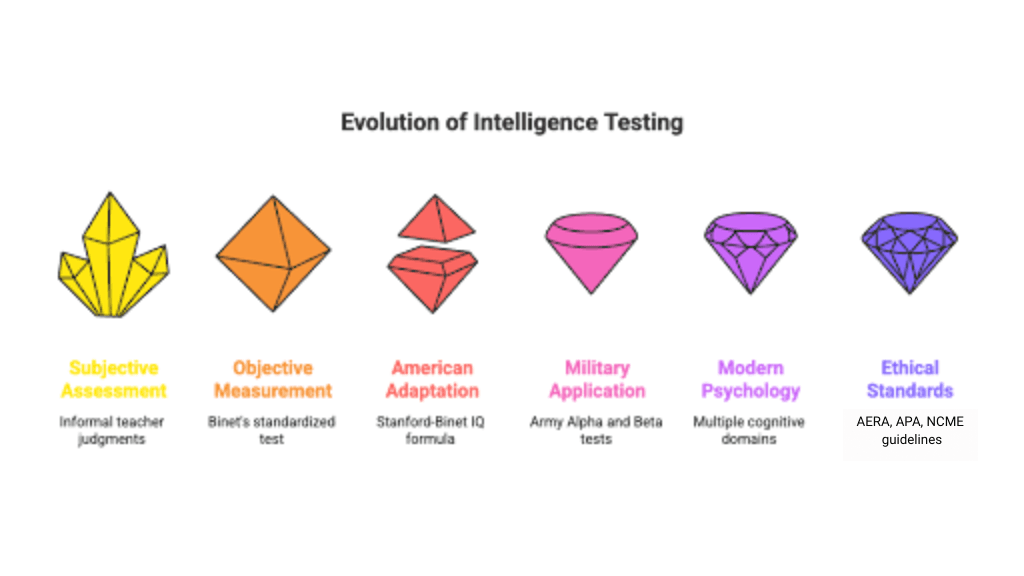
IQ tests were created from a need to evaluate learning ability through standardized methods rather than subjective opinion. In 1905, French psychologist Alfred Binet, assisted by Théodore Simon, developed the first intelligence test to identify children who were struggling in school. Binet’s work introduced a scientific approach to handling learning differences in the classroom, something that had never happened before.
Binet’s Educational Purpose
Binet designed his test to assess current reasoning ability, not as fixed level of intelligence. By comparing a child’s mental age to the level at which they performed intellectually to their chronological age, educators could determine who might benefit from additional support. Binet believed that intelligence was modifiable and that education could enhance performance. His test provided teachers with actionable information rather than permanent classifications.
The American Adaptation
In 1916, Stanford University psychologist Lewis Terman revised and adapted Binet’s work for use in the United States, creating the Stanford–Binet Intelligence Scale. Terman refined scoring procedures and introduced the IQ formula, which expressed performance relative to age-based norms. The test’s reliability and predictive accuracy established it as a key tool in education, research, and psychological evaluation.
Expansion Beyond Education
The early success of standardized intelligence testing led to applications outside the classroom. During World War I, the U.S. Army developed the Army Alpha and Beta tests to assess recruits’ reasoning ability and assign them to appropriate military roles. These large-scale programs demonstrated that mental ability could be measured efficiently and objectively in group settings, shaping the future of both military and civilian testing.
Following its adoption in education and the military, IQ testing became a foundation of modern psychology. It is used to identify intellectual disabilities, giftedness, and patterns of cognitive strength and weakness. Modern instruments measure multiple domains such as reasoning, memory, and processing speed, providing a comprehensive view of cognitive functioning. The consistent aim has been to understand individual differences and use that knowledge to support learning and development.
Contemporary test development follows strict professional guidelines set by the American Educational Research Association (AERA), the American Psychological Association (APA), and the National Council on Measurement in Education (NCME). These standards govern test construction, fairness, and validation. Continuous revisions ensure that IQ tests remain reliable, culturally fair, and scientifically credible.
The RIOT and Modern Intelligence Measurement
The Reasoning and Intelligence Online Test (RIOT), developed by Dr. Russell T. Warne, reflects the modern continuation of Binet’s principles. It was standardized on a representative U.S. norm sample and developed in accordance with APA, AERA, and NCME standards. Designed specifically for digital administration, the RIOT provides a professional measure of reasoning ability using the same psychometric rigor as traditional in-person assessments.
IQ tests were created to replace subjective judgments with objective measures of reasoning and learning potential. From Binet’s early work in education to modern instruments like the RIOT, their purpose has remained constant: to assess cognitive ability accurately, fairly, and in ways that inform understanding and opportunity.
Watch “Intro to Intelligence Tests: What Is an IQ Test, and Why Do We Use Them?” with Dr. Warne on the Riot IQ YouTube channel to learn how and why IQ tests were first developed.
Article Categories
All ArticlesUnderstanding IQ ScoressTaking an IQ TestRIOT-Specific InformationGeneral IQ & IntelligenceAdvanced Topics & ResearchIQ Scores & InterpretationMensa & High-IQ SocietiesOnline IQ Tests IQ Test Basics & FundamentalsAverage IQ & DemographicsFamous People & IQHistory & Origins Of IQ TestingAccuracy, Reliability & CriticismSpecial Population & Related ConditionsImproving IQ / PreparationSpecific IQ Tests & Formats
Related Articles
Take our IQ testsCompare all tests
Basic IQ Test
5 subtests + 5 cognitive abilities
Features
- ~13 Minutes
- IQ score
- Cognitive abilities breakdown
- ±5.6 IQ margin of error
5/15 Subtests
Learn moreVocabulary
Matrix Reasoning
SToVeS
Visual Reversal
Symbol Search
Full IQ Test
15 subtests + all cognitive abilities
Features
- ~52 Minutes
- IQ score
- Cognitive abilities breakdown
- ±3.7 IQ margin of error
15/15 Subtests
Learn moreVocabulary, Information, Analogies
Matrix Reasoning, Visual Puzzles, Figure Weights
Object Rotation, SToVeS, Spatial Orientation
Computation Span, Exposure Memory, Visual Reversal
Symbol Search, Abstract Matching
Simple Reaction Time, Choice Reaction Time

Community
Intelligence Journals & Organizations
News & Press
Our Articles
Our Articles
Our Articles
Our Articles
Our Articles