Struggling to find your path? Career aptitude tests act as an impartial mirror. Discover how objective feedback helps you identify hidden talents and avoid chasing trends.
Dr. Russell T. WarneChief Scientist
Share
When a career assessment includes cognitive ability, it begins to overlap with what an IQ test measures: reasoning, problem-solving, and learning potential. Finding the right career path often feels like navigating a maze without a map. Career aptitude tests serve as objective guides by cutting through the noise of societal expectations and personal uncertainty. By grounding professional decisions in data rather than guesswork, these assessments help individuals align their career trajectories with their actual strengths rather than just their perceived interests.
Why Is It Difficult to See Personal Strengths Clearly?
One of the biggest hurdles in career planning is the difficulty of being objective about one's own abilities. People are often poor judges of their own abilities. Some people overestimate their competence, while others may have hidden talents that they are unaware of. Relying on feedback from friends or family can also be misleading, as personal relationships often prevent honest, critical assessment.
A career aptitude test acts as an impartial mirror. It provides a comprehensive profile of a person’s strengths, weaknesses, and hidden talents. This objective feedback allows for informed decisions based on reality. Instead of guessing where talent lies, a candidate can use standardized metrics to identify transferable skills that apply across various industries, preventing the common mistake of chasing a career simply because it seems popular or fun.
What Assessments Do US Employers Actually Use?
Understanding the specific tools used by major employers provides a significant advantage. In the United States, aptitude is often viewed holistically. Employers tend to look beyond raw intelligence and place equal weight on how well a person’s traits align with the demands of a particular role and work environment. This is why many organizations rely on structured assessments designed to evaluate overall job fit rather than isolated skills.
Some of these assessments function as predictive instruments that examine how certain behavioral traits correlate with performance in specific roles. Instead of assigning broad personality labels, they focus on patterns such as initiative, persistence, influence, and attention to detail, then assess how those patterns tend to map onto different job demands. This approach helps clarify whether someone is naturally inclined toward proactive, outward-facing roles or toward positions that require consistency, precision, and operational focus.
Other assessment frameworks emphasize how traits express themselves under pressure, along with the core values that guide motivation and decision making. These tools are often used to evaluate leadership potential by identifying tendencies that may remain subtle during calm conditions but become more pronounced under stress or tight deadlines. Looking at both everyday behavior and stress responses provides a more realistic picture of workplace fit. It reveals not only how someone performs at their best, but also how they are likely to respond when demands increase. This broader perspective supports better role alignment by placing individuals in environments where their natural tendencies are more likely to function as strengths rather than sources of friction.
Can You Prepare for a Career Aptitude Test?
Many candidates assume that because career tests measure potential or personality, studying is unnecessary. However, preparation can significantly impact performance, particularly on the skills or knowledge sections. Getting familiar with standard question formats helps reduce anxiety and improve response times. Doing a little research beforehand allows the candidate to recognize question formats so that he or she can focus on performing their best.
How Do Cognitive Performance Metrics Influence Hiring?
Some employers use tests that measure mental abilities, essentially gauging how quickly a candidate can learn and adapt. If a job hunter knows their performance on a series of cognitive tests, it can help them target roles that match their abilities. For example, a high score on a processing speed test suggests suitability for fast-paced, dynamic environments, while a lower score might favor roles allowing for deep, methodical analysis.
Similarly, general aptitude batteries are widely administered to measure critical thinking and the ability to digest new information. These assessments typically focus on verbal, math, and spatial reasoning to predict training success. Understanding these metrics is not about labeling oneself as "smart" or "not smart," but about identifying the types of challenges that are stimulating versus those that are overwhelming. When a career path aligns with these objective aptitude metrics, the likelihood of long-term success increases significantly.
Why Is Cognitive Ability Testing Essential for Career Planning?
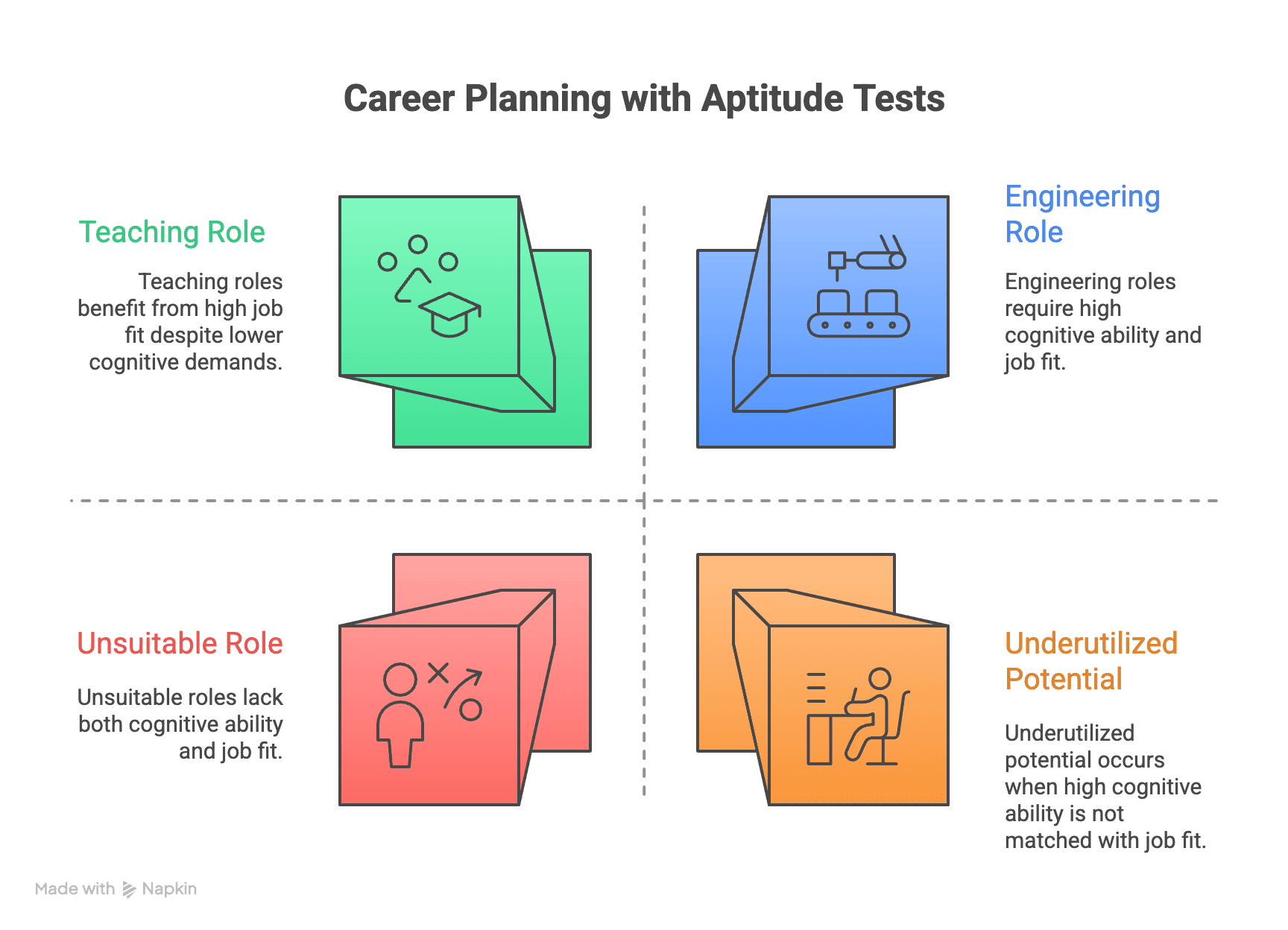
While interest inventories indicate what a person wants to do, they do not necessarily reflect what a person is equipped to handle. This is where cognitive ability testing becomes a vital component. Different professions have different cognitive minimum thresholds of ability required to learn new tasks efficiently. Psychometric data suggest that highly complex fields, such as engineering, law, and medicine, typically have a minimum IQ of about 115 for a person to obtain and keep a job. Even above this minimum, though, high scorers will tend to be better at those jobs.
Understanding this cognitive baseline is essential for ensuring that professional ambitions align with mental processing power. A mismatch here can be problematic; entering a field that exceeds one's cognitive grasp often leads to chronic stress and failure, while entering a field that underutilizes potential leads to boredom. Cognitive assessments measure the raw "horsepower" available for learning, providing a realistic check on career feasibility.
Integrating cognitive testing into the hiring process does not need to be complicated. Platforms like RIOT IQ empower hiring managers to validate candidate potential with ease. Through the "Administer" dashboard, employers can create custom "studies" for open positions and send direct invitations to applicants via email or a secure link. Once the assessments are complete, the platform provides immediate access to detailed score reports, allowing HR teams to move beyond guesswork and base their selection decisions on objective, verified performance data.
Watch “What Does an IQ Test Measure?” with Dr. Russell T. Warne on the Riot IQ YouTube channel to understand how aptitude testing identifies strengths that align with long-term career fit.
Take our professional IQ test
Want to know your IQ? Try the first ever professional online IQ test.