How Do You Conduct A Skills Assessment For A Potential Job Candidate?
Learn how to create an effective skills assessment test for hiring. From cognitive ability testing to technical skills, we explain what to measure to predict job performance.
Dr. Russell T. WarneChief Scientist
Share
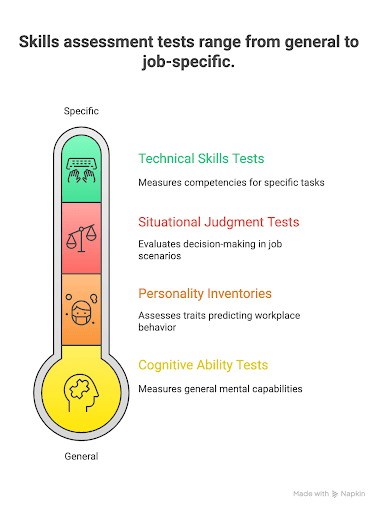
Skill assessment tests help employers evaluate job candidates' abilities and determine fit for specific roles. These assessments can include technical knowledge tests, personality inventories, situational judgment scenarios, and cognitive ability measures. Understanding how to conduct effective skills assessment requires knowing what to measure, which tools to use, and how to interpret results appropriately.
While skills assessments vary widely depending on the position and industry, cognitive ability testing represents one component that predicts job performance across virtually all occupations.
What Are Skills Assessment Tests?
Skills assessment tests measure specific abilities, knowledge, or characteristics relevant to job performance. They can evaluate technical competencies like programming or accounting skills, soft skills like communication or teamwork, personality traits that predict workplace behavior, or general cognitive abilities that affect learning and problem-solving.
These assessments serve multiple purposes in hiring and employee development. They help identify candidates most likely to succeed in specific roles, reduce bias by providing objective data, predict training requirements and learning curves, and identify development needs for current employees. When properly administered and interpreted, skills assessments improve hiring decisions beyond what interviews and resumes alone can provide.
Why Should You Include Cognitive Ability Testing in Skills Assessment?
Cognitive ability testing measures general mental capabilities, which include reasoning, problem-solving, learning speed, and abstract thinking. This might seem disconnected from specific job skills, but research consistently shows that cognitive ability predicts job performance across virtually all occupations, making it one of the most useful components of comprehensive skills assessment.
The reason is straightforward: most jobs require learning. Employees must master new procedures, adapt to changing circumstances, solve unexpected problems, and improve their performance over time. Cognitive ability determines how quickly and effectively people can do these things. Someone who learns quickly requires less training time and reaches proficiency faster than someone who learns slowly, regardless of their initial skill level. A smarter employee becomes a more effective and more profitable worker sooner than a less intelligent employee.
For cognitively complex roles like engineering, finance, law, medicine, and research, the minimum education requirements act as a natural filter. Typically the minimum IQ needed to enter these fields is between about 110 and 120. Without meeting these baseline cognitive levels, success in these industries becomes almost completely unachievable, and extra training or motivation simply can’t fix that.
Importantly, cognitive ability testing provides information that other assessments don't capture. A candidate might have impressive technical skills today but lack the cognitive capacity to keep those skills current as the field evolves. Another candidate might have fewer current skills but possess the cognitive ability to master new ones quickly. Cognitive testing reveals these differences.
How Should Cognitive Ability Be Assessed in Hiring?
To effectively assess cognitive ability, employers should follow these core guidelines:
• Select the right test type: Choose between general mental capability tests (similar to IQ tests) or assessments targeting specific domains like verbal, numerical, or spatial reasoning.
• Align with job requirements: Ensure the specific abilities being tested matter for the role. For example, prioritizing abstract reasoning for management or spatial ability for engineering.
• Determine the setting: Decide between in-person testing for controlled security or online assessments for broader reach and initial screening.
• Contextualize the results: Use scores as one part of the puzzle rather than the sole deciding factor; high scores shouldn't automatically override a lack of experience or poor interpersonal skills.
How Do Other Assessment Components Complement Cognitive Testing?
A comprehensive skills assessment test includes multiple components beyond cognitive ability. Technical skills tests directly measure job-specific competencies: can the candidate actually perform the tasks the job requires? These might include coding challenges for programmers, case studies for consultants, writing samples for content creators, or practical demonstrations for trades positions. Portfolios and previous work samples can also provide this information.
Personality assessments measure traits like conscientiousness, agreeableness, emotional stability, and openness to experience. Research shows that personality, particularly conscientiousness, predicts job performance independent of cognitive ability. Combining cognitive ability with personality measures produces better predictions than either alone. Someone highly intelligent but unreliable may perform worse than someone moderately intelligent but exceptionally conscientious.
Situational judgment tests present hypothetical workplace scenarios and ask candidates how they would respond. These assess practical decision-making, values alignment, and judgment in contexts relevant to the job. While they correlate somewhat with cognitive ability, they also capture experience and domain-specific knowledge.
Structured interviews provide additional information about communication skills, cultural fit, motivation, and specific experiences. The key is "structured," which means using standardized questions and scoring rubrics rather than free-form conversations that invite bias. Structured interviews predict job performance better than unstructured ones.
What Does an Effective Skills Assessment Look Like?
Effective skills assessment isn't a single test, but a combination of measures targeting different aspects of potential. It pairs cognitive ability testing (to gauge learning speed and proficiency) with technical evaluations (for current competencies) and personality insights (for workplace behavior). Crucially, this process must be fair, standardized, and validated to ensure that what you are measuring actually predicts success in the role.
For organizations ready to implement cognitive testing, the Reasoning and Intelligence Online Test (RIOT) offers a streamlined, professional solution. Developed by Dr. Russell T. Warne, the platform allows hiring managers to easily administer valid IQ tests directly to candidates. Through a simple dashboard, you can create specific cognitive tasks or tests for different roles and invite applicants via email or a direct link. You retain full control over the process, including a toggle to decide if candidates can view their own results. Once completed, the platform provides immediate access to detailed reports, displaying each candidate's specific IQ score and allowing for a deep dive into their results to inform your hiring decision.
Watch “The Hidden Problem in Every Classroom: Why Teaching by Age Doesn’t Work” with Dr. Karen Rambo-Hernandez on the Riot IQ YouTube channel to understand how ability-based assessment can reveal strengths traditional methods often miss.
Take our professional IQ test
Want to know your IQ? Try the first ever professional online IQ test.