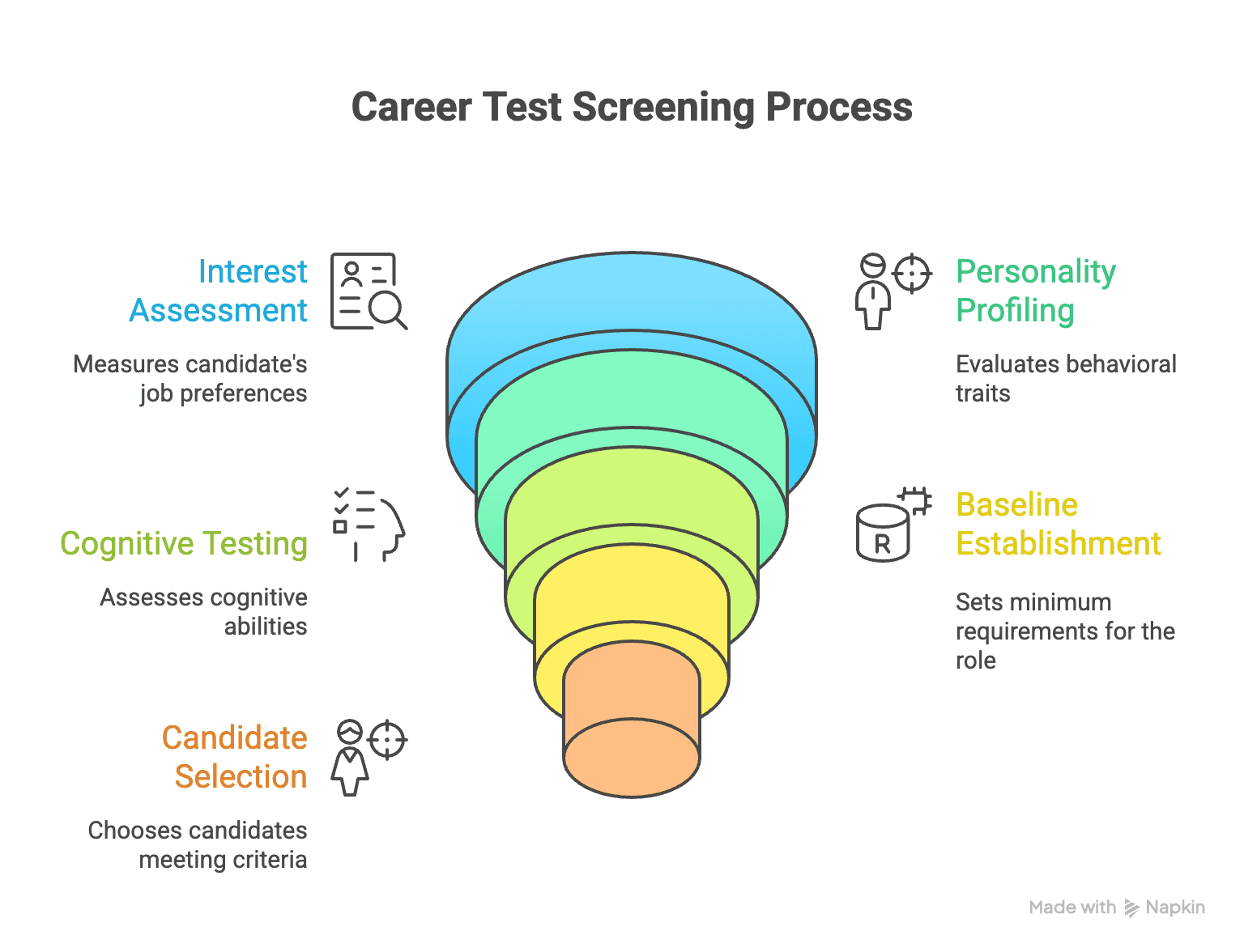
Career tests use a triangulation method. We explain how interest inventories, personality profiles, and cognitive aptitude combine to create a candidate profile.
Dr. Russell T. WarneChief Scientist
Share
Career tests are sophisticated data instruments designed to bridge the gap between human potential and professional requirements. At their core, these assessments function by gathering data points about an individual, ranging from preferred work styles to cognitive ability, and comparing that profile against validated benchmarks for various occupations. Understanding how these tests work requires looking beyond simple subjective judgments of “fit” to the rigorous psychometrics that power modern employment decisions.
While many associate career tests with self-discovery, in the professional world, they are created to answer two fundamental questions: Will this person enjoy the role? and Can this person perform the role effectively?
What Are the Components of a Career Test?
Most robust career assessments rely on a "triangulation" method, combining three distinct types of data to create a holistic profile:
Interest Inventories: These measure what you enjoy. They typically utilize frameworks like the Holland Codes (RIASEC), which categorize work environments into six types (such as Artistic, Enterprising, or Investigative). This component predicts job satisfaction but not necessarily competency.
Personality Profiling: These assess behavioral tendencies. Using models like the "Big Five" (Openness, Conscientiousness, Extraversion, Agreeableness, Neuroticism), these tests predict how a candidate will interact with teams, handle stress, and approach tasks.
Aptitude & Cognitive Testing: This is the performance engine of the assessment. Unlike the first two components, which are self-reported, aptitude tests measure objective capabilities like logical reasoning, verbal comprehension, and spatial visualization. Platforms like the Reasoning and Intelligence Online Test (RIOT) use scientifically validated models to quantify cognitive strengths.
Why Is Cognitive Ability the "Anchor" of Career Testing?
While interest and personality determine whether a person "will do" a job, cognitive ability determines whether a person "can do" the job. In the context of career testing, cognitive assessments measure general mental ability and the brain's efficiency in learning new information and solving novel problems.
This distinction is important because research has consistently demonstrated that cognitive ability is the single strongest predictor of future job performance. A candidate may have the perfect personality for a high-stakes engineering role (high conscientiousness, low neuroticism), but without the necessary cognitive threshold to process complex physics and mathematics, they cannot succeed in that career path.
For this reason, hiring managers prioritize the cognitive component of career tests to predict "trainability." A high score indicates that the individual can absorb training quickly and adapt to changing environments, which is often more valuable than specific prior knowledge.
How Do Hiring Managers Use These Tests for Screening?
For HR professionals and hiring managers, career tests function as an objective funnel, and modern platforms have made the administration of these tests seamless. In the early stages of recruitment, reviewing every resume in depth is often impossible. To solve this, hiring managers can use platforms like RIOT IQ to administer IQ tests by setting up dedicated groups of tests specifically assigned to a job opening. Through a central dashboard, a manager can create a study (e.g., "Junior Data Analysts"), generate a secure invite link, and email it directly to a pool of candidates. As applicants complete the assessment, the dashboard updates in real-time. Hiring managers can then access individual score reports to establish "baselines" or cut-off scores relevant to the role. For example, a data analyst position might require a minimum threshold in numerical reasoning. Candidates who meet these criteria are then moved to the interview stage, while those who do not are filtered out early.
This process removes subjective bias. Instead of relying on a subjective judgment or the prestige of a candidate's university, the hiring manager uses the verified test data, viewable directly in the platform's "Manage Assessments" tab, to confirm that the candidate possesses the cognitive skills required for the job.
How Do These Tests Predict Retention and Satisfaction?
Career tests don't just predict who gets hired; they predict who stays. This is known as "Person-Environment Fit" (P-E Fit). When a candidate’s cognitive abilities and personality traits align with the demands of the job, they experience less friction and burnout.
A mismatch here is costly. If an individual is placed in a role that exceeds their cognitive processing limits, they will experience chronic stress and likely fail. By using comprehensive career tests that include cognitive measures, hiring managers can ensure they aren't just filling a seat, but placing a candidate in a zone of "optimal challenge," leading to higher long-term retention.
Ultimately, career tests work by converting human attributes and behaviors into actionable data. By systematically measuring interests, personality, and cognitive aptitude, they provide a roadmap for both individuals and employers.
For the candidate, they offer a reality check and a direction. For the employer, they serve as a risk-management tool. When used correctly, specifically by integrating validated cognitive testing alongside behavioral profiling, they allow organizations to look past the resume and identify the genuine potential within a candidate. However, they are most effective when used as one part of a broader evaluation strategy, informing the human judgment of hiring managers rather than replacing it entirely.
Watch “The Ability That Predicts STEM Success Better Than IQ” with Dr. Thomas Coyle on the Riot IQ YouTube channel to see how cognitive abilities are used to guide meaningful career assessment.
Take our professional IQ test
Want to know your IQ? Try the first ever professional online IQ test.