Dec 3, 2025·Online IQ Tests 
IQ and Autism
Are IQ tests accurate for autistic people? Yes, but results can be misleading—autism often causes uneven cognitive profiles and lower scores due to language, social, or sensory issues. Discover how autism really affects IQ testing and why subscores matter more.
The relationship between IQ and autism is more complex than most people realize. Autism spectrum disorder (ASD) is a developmental condition affecting social communication and behavior, while IQ measures general cognitive ability. These are separate traits, but they interact in important ways.
Contrary to popular stereotypes, autistic people don't all have the same cognitive profile. Some have intellectual disabilities, some have average intelligence, and some have exceptionally high IQs.
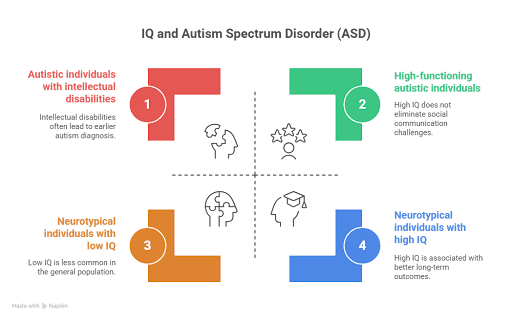
The IQ Distribution in Autism
Historical estimates suggested that about 70% of autistic people had intellectual disabilities (IQ below 70). Modern numbers are lower because the criteria to be diagnosed with autism have changed. Earlier diagnostic criteria required significant language delays for an autism diagnosis, which naturally skewed samples toward individuals with lower cognitive abilities.
Recent studies indicate that roughly 30-40% of individuals diagnosed with autism have intellectual disabilities, about 30-40% have average to above-average intelligence, and the remainder fall in the borderline to low-average range.
This distribution differs from the general population, where only about 2-3% have intellectual disabilities. Autism is associated with increased rates of both intellectual disability and, intriguingly, high intelligence.
Uneven Cognitive Profiles
A defining feature of autism is often an uneven cognitive profile. An autistic person might excel at spatial reasoning or mathematical tasks but struggle with verbal comprehension. Another might have strong verbal abilities but weak processing speed. These patterns appear much more commonly in autism than in the general population.
This unevenness creates challenges for measuring IQ in autism. A single overall IQ score can be misleading when someone scores in the 95th percentile on some subtests but the 20th percentile on others. That's why comprehensive assessment in autism should include subscores showing performance across different cognitive domains, not just an overall number.
Measuring IQ in Autism
Standard IQ tests can work for individuals with autism, but several factors complicate assessment.
Language requirements. Many IQ tests rely heavily on verbal instructions and verbal responses. This may cause some people with autism to score artificially lower because they can't demonstrate their abilities through language.
Social demands. Individually administered tests require sustained interaction with an examiner, which is something that can be challenging for autistic individuals. Test anxiety, difficulty with unfamiliar people, or sensory issues in the testing environment can all depress scores.
Nonverbal IQ Tests and Autism
Because of language challenges in some autistic individuals, nonverbal IQ tests are sometimes used. Tests like the Raven's Progressive Matrices assess reasoning using visual patterns without requiring verbal responses.
These tests can be useful, but they are not perfect solutions. Research shows that supposedly "culture-fair" nonverbal tests still contain cultural content and do not eliminate group differences. More importantly, nonverbal tests measure only certain aspects of intelligence and miss verbal abilities entirely. For a complete picture, a test battery measuring multiple cognitive domains is preferable when possible.
High-Functioning Autism and IQ
"High-functioning autism" is an informal term (not an official diagnosis) typically referring to autistic individuals with average or above-average IQ who don't have intellectual disabilities and whose social impairment is more mild than what is seen in severe cases of autism. These individuals face their own set of challenges.
Higher IQ in autism is associated with better long-term outcomes in areas like independent living, employment, and social relationships. However, high IQ doesn't eliminate autism's challenges. Autistic people with high IQs still struggle with social communication, sensory sensitivities, executive function, and other core features of autism.
Interestingly, some conditions are more common in high-IQ autistic individuals, including anorexia nervosa. The reasons for these associations remain unclear.
Intelligence and Autism Diagnosis
IQ doesn't determine whether someone has autism. Autism is diagnosed based on social difficulties, communication impairment, and restricted/repetitive behaviors -- not cognitive ability. Autism can be found in people at any IQ level.
However, IQ affects when and how autism gets diagnosed. Children with severe autism and intellectual impairments are typically identified earlier because their developmental delays are more obvious. People with autism and a high IQ might not be diagnosed until adolescence or adulthood because their intelligence helps them compensate for social difficulties.
Practical Implications
Understanding an autistic person's IQ and cognitive profile has practical value. It helps:
• Set realistic educational and vocational goals
• Identify areas needing support
• Recognize hidden strengths that might be overlooked
• Tailor interventions to match cognitive abilities
• Avoid both underestimation (assuming someone can't learn) and overestimation (expecting abilities that aren't there)
IQ testing should be part of a comprehensive evaluation that also assesses adaptive functioning, academic skills, language abilities, and other relevant areas.
The Bottom Line
IQ and autism are separate but interacting traits. Autism increases the likelihood of both intellectual disability and high intelligence compared to the general population. Autistic people show more uneven cognitive profiles than neurotypicals, making single overall IQ scores less informative.
Intelligence matters for predicting outcomes in autism, but it's not the whole story. An autistic person with a high IQ still has autism. An autistic person with intellectual disability still deserves support, respect, and opportunities to develop their potential.
The goal of assessment is not to label or limit people but to understand their cognitive strengths and weaknesses well enough to provide appropriate support and realistic expectations.
Article Categories
All ArticlesUnderstanding IQ ScoressTaking an IQ TestRIOT-Specific InformationGeneral IQ & IntelligenceAdvanced Topics & ResearchIQ Scores & InterpretationMensa & High-IQ SocietiesOnline IQ Tests IQ Test Basics & FundamentalsAverage IQ & DemographicsFamous People & IQHistory & Origins Of IQ TestingAccuracy, Reliability & CriticismSpecial Population & Related ConditionsImproving IQ / PreparationSpecific IQ Tests & Formats
Related Articles
Take our IQ testsCompare all tests
Basic IQ Test
5 subtests + 5 cognitive abilities
Features
- ~13 Minutes
- IQ score
- Cognitive abilities breakdown
- ±5.6 IQ margin of error
5/15 Subtests
Learn moreVocabulary
Matrix Reasoning
SToVeS
Visual Reversal
Symbol Search
Full IQ Test
15 subtests + all cognitive abilities
Features
- ~52 Minutes
- IQ score
- Cognitive abilities breakdown
- ±3.7 IQ margin of error
15/15 Subtests
Learn moreVocabulary, Information, Analogies
Matrix Reasoning, Visual Puzzles, Figure Weights
Object Rotation, SToVeS, Spatial Orientation
Computation Span, Exposure Memory, Visual Reversal
Symbol Search, Abstract Matching
Simple Reaction Time, Choice Reaction Time

Community
Intelligence Journals & Organizations
News & Press
Our Articles
Our Articles
Our Articles
Our Articles
Our Articles