Dec 1, 2025·Online IQ Tests Should I Take An IQ Test?
Should I take an IQ test? Yes—if you want real insight into your cognitive strengths, career planning, or understanding learning challenges. Discover when it’s worth it and how to get accurate results.
Dr. Russell T. WarneChief Scientist

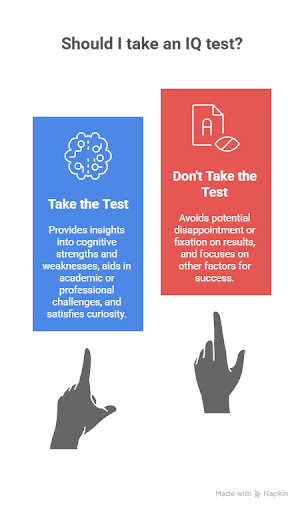
Whether you should take an IQ test depends on your reasons for wanting one and what you plan to do with the results. Taking a professionally developed IQ test can provide valuable insights into your cognitive strengths and weaknesses, help explain academic or workplace challenges, or satisfy genuine curiosity about your intellectual abilities. However, IQ testing isn't necessary for everyone, and the decision should be based on whether the information will serve a practical purpose in your life.
Good reasons to take an IQ test
There are several legitimate reasons why taking an IQ test might be beneficial. If you're struggling academically or professionally and want to understand whether cognitive factors are contributing to these challenges, an IQ test can provide clarity. The results might reveal specific areas of strength you can leverage or weaknesses you can work around.
Parents often seek IQ testing when their child shows signs of being exceptionally advanced or struggling more than expected. Early identification of giftedness or learning disabilities can lead to appropriate educational interventions. Adults may benefit from testing if they suspect they have undiagnosed learning differences that affect their work or daily life.
Some people take IQ tests for personal insight and self-understanding. Just as some people are curious about their personality type or ancestry, wanting to know your IQ score is a legitimate form of self-exploration. Understanding your cognitive profile can help you make better decisions about education, career paths, and personal development strategies.
Professional or educational requirements sometimes necessitate IQ testing. Certain gifted programs, educational accommodations, and even some employment positions require documented IQ scores. Military enlistment, for example, requires taking the ASVAB, which functions as an intelligence test even though it's not called an IQ test.
When IQ testing might not be helpful
Taking an IQ test isn't always beneficial or necessary. If you're primarily seeking validation or a self-esteem boost, an IQ test might disappoint you. Intelligence is just one factor in life success, and research shows that while IQ correlates with various positive outcomes, it's not deterministic. A high score won't solve your problems, and a lower score doesn't limit your potential for a meaningful, successful life. IQ testing can be counterproductive if you're likely to fixate on the results negatively. Some people become overly focused on their scores, either developing an inflated ego from high scores or experiencing decreased motivation from scores lower than expected. If you tend toward perfectionism or have anxiety about performance evaluation, consider whether you can receive the results with an appropriate perspective.
Testing isn't useful if you're looking for excuses or limitations. Your IQ score should never be used to avoid challenges or justify not trying. People across the IQ spectrum achieve remarkable things through effort, persistence, and leveraging their unique strengths.
Understanding the costs and commitments
Professional IQ testing requires investment of both time and money. Individually administered tests through a psychologist typically cost $500-2000 and require at least 2 hours of testing plus additional time for scoring and feedback. This option provides the most comprehensive assessment and professional interpretation.
Online professional tests offer a more affordable alternative, usually ranging from $20-100. While you won't get personal interpretation from a psychologist, quality online tests provide detailed score reports explaining your results. The testing can be completed at your convenience without scheduling appointments.
Free IQ tests should be avoided. Most are not scientifically valid and exist primarily to collect email addresses or drive advertising revenue. If a test doesn't charge anything and doesn't clearly explain its scientific basis, it's probably not measuring IQ accurately. Even free tests created by psychologists are only good for research purposes.
What to expect from testing
Professional IQ tests measure various cognitive abilities through different types of tasks. You might solve visual puzzles, define words, remember sequences of numbers, or identify patterns. The variety ensures the test captures different aspects of intelligence rather than just one narrow skill.
Testing conditions matter for accurate results. Take the test when you're well-rested, in a quiet environment, and feeling physically well. Don't consume alcohol beforehand or take the test when stressed about other matters.
Most people find IQ testing challenging but engaging. Most tasks are designed to be progressively difficult, so everyone encounters questions they can't answer. This is normal and necessary for the test to accurately measure the upper limits of your abilities.
Interpreting and using your results
Receiving your IQ score is just the beginning. A good professional test provides not just an overall IQ score but also subscores measuring specific cognitive abilities. You might discover you have exceptional spatial reasoning but average verbal skills, or vice versa. These patterns can be more informative than the overall score.
Remember that IQ scores are normative, meaning they compare you to others your age. An IQ of 100 is average by definition, with about 68% of people scoring between 85 and 115. Scores should be interpreted as ranges rather than exact measurements; if you score 118, you're essentially equivalent to someone scoring 115 or 121.
Use your results constructively. If testing reveals cognitive strengths, consider how to leverage them in your education or career. If it identifies relative weaknesses, you can develop strategies to compensate. Never use scores as excuses or limitations, but as information to make better-informed decisions.
If you do decide to take an IQ test, invest in a professional assessment that will provide accurate, meaningful results, such as the RIOT IQ Test. The insights gained from quality testing can be valuable for self-understanding and practical decision-making, making it worth the investment for many people. AuthorDr. Russell T. WarneChief Scientist