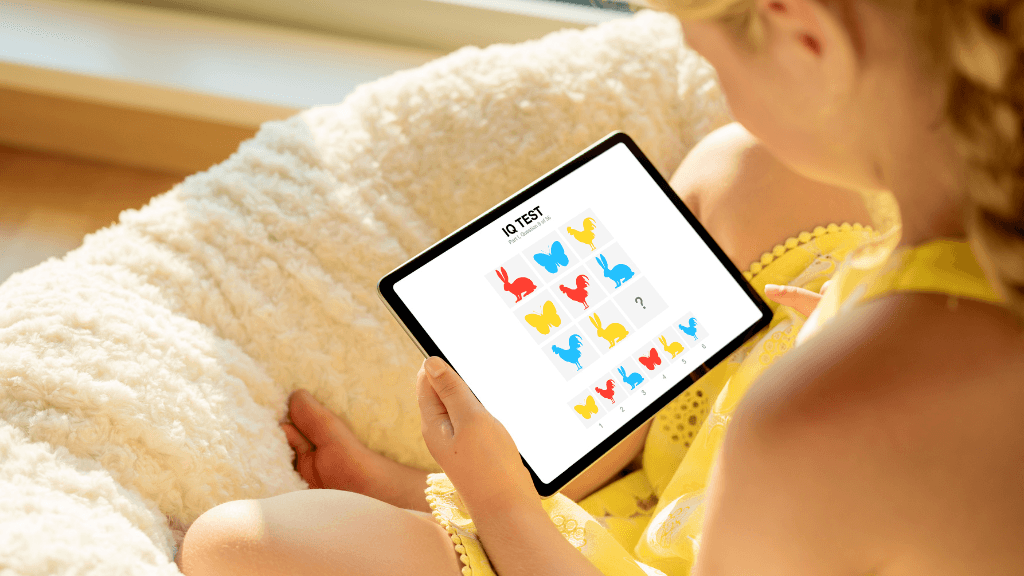
Looking for a free IQ test for kids? We explain why online quizzes lack psychometric standards and why accurate age-based norming is impossible to find for free.
Dr. Russell T. WarneChief Scientist
Share
While the internet abounds with "free IQ tests" for children, none meet the professional psychometric standards necessary for accurate cognitive assessment. The lack of legitimate cost-free options stems from the immense complexity involved in creating valid instruments, leaving parents with a marketplace filled with unreliable quizzes.
Why Aren’t There Any Professionally Developed Free IQ Tests for Kids?
Developing a valid IQ test for kids is a resource-intensive undertaking that requires years of research, extensive field testing, and sophisticated statistical analysis. Unlike adult assessments, children’s tests face the unique challenge of rapid cognitive development. A six-year-old processes information differently than an eight-year-old, necessitating distinct norms for narrow age bands. Creating these age-specific benchmarks requires massive sample sizes to ensure accuracy, significantly driving up production costs that are typically recovered through purchase fees.
Consequently, free online alternatives for children lack this rigor. They are often created by individuals without psychometric training, utilizing questions that have not been validated to measure intelligence. Because they bypass the expensive norming process, the scores they generate are mathematically disconnected from any representative population, rendering the results meaningless for determining whether a child is advanced, average, or delayed.
What Problems Exist with Free Online IQ Tests for Children?
Beyond lacking a professional pedigree, free tests suffer from critical methodological flaws. The most significant is the absence of appropriate norming; without comparing a child’s raw score to a demographically representative sample of same-age peers, the resulting IQ score is arbitrary and meaningless. Many sites inappropriately apply adult norms to children or rely on skewed data from self-selected users, producing inflated or erratic results.
Furthermore, the test items themselves are rarely vetted for quality or bias. While professional tests undergo rigorous review to ensure they measure specific cognitive domains, free versions often include ambiguous or irrelevant questions. Security is another major deficit; legitimate assessment requires controlled environments to prevent coaching or retakes, whereas online quizzes allow unlimited attempts and parental assistance, completely undermining the standardization required for a valid score.
What Legitimate Options Exist for Assessing Children's Cognitive Abilities?
For parents seeking accurate evaluations, legitimate pathways exist, though they generally involve working with professionals and not buying a test on a website. The primary route for no-cost assessment is through the public school system. Schools are federally mandated to evaluate students suspected of having learning disabilities or other educational needs. These assessments are administered by school psychologists using gold-standard instruments like the Wechsler Intelligence Scale for Children (WISC) at no direct cost to the family.
Alternatively, private psychological evaluations offer comprehensive testing for a fee. Licensed psychologists administer battery tests such as the WISC, Stanford-Binet, or Woodcock-Johnson, providing detailed reports and determining eligibility for gifted programs or disability services. For families who do not qualify for school-based testing but cannot afford private rates, university psychology clinics often offer reduced-cost evaluations performed by graduate students under faculty supervision.
What Do Professionally Developed Children's IQ Tests Measure?
Legitimate assessments go far beyond a single number, measuring a spectrum of cognitive abilities based on frameworks like the Cattell-Horn-Carroll (CHC) theory. Modern tests evaluate distinct domains such as verbal comprehension, fluid reasoning, visual-spatial processing, working memory, and processing speed. This multi-dimensional approach reveals a child’s specific cognitive profile, highlighting relative strengths and weaknesses that a solitary score would obscure.
These instruments also utilize strict age-based norming, comparing a child only to their exact age peers to account for natural developmental curves. Crucially, professional results include confidence intervals, or statistical ranges that acknowledge measurement error. Rather than presenting an IQ as a fixed, absolute point, psychologists present it as a likely range, preventing the over-interpretation of minor score differences.
When Is Formal Cognitive Assessment Important for Children?
Formal evaluation is a diagnostic tool, not a recreational activity, and is best reserved for specific needs. It is most frequently warranted when a child struggles academically despite adequate support, helping to identify learning disabilities or attention issues. Conversely, suspected giftedness is another common trigger; if a child consistently demonstrates abilities far beyond their age level, testing can secure placement in accelerated programs.
Casual curiosity is rarely a sufficient reason to subject a child to the time and expense of professional testing. Unless the results will actively inform an educational decision, intervention strategy, or medical diagnosis, the process may not offer enough value to justify the investment.
What Can Parents Learn Without Formal Testing?
Valuable insights into a child's cognitive development can be gathered through observation without formal instrumentation. Developmental milestones serve as the first benchmark; tracking whether a child meets expected targets for speech and problem-solving provides a baseline for normality. Academic performance offers further data, as report cards and teacher feedback reveal how a child functions in a learning environment relative to peers.
Informal comparisons during play and social interaction also yield useful information. Observing how a child handles puzzles, remembers instructions, or articulates complex ideas compared to playmates can provide an intuitive sense of their cognitive standing. Engaging in these stimulating activities is ultimately more beneficial than testing, as it actively supports development rather than merely measuring it.
What Should Parents Know About Interpreting Any IQ Test Results?
Whether derived from a school evaluation or a private psychologist, IQ scores must be interpreted with nuance. They represent performance at a single moment in time, not an immutable biological destiny. Scores can and do change, particularly during the rapid developmental phases of childhood. Therefore, the cognitive profile, or the pattern of highs and lows across different mental tasks, is far more actionable for teachers and parents than the full-scale IQ number.
It is also helpful to recognize what these tests do not measure. Attributes such as creativity, emotional intelligence, and social skills are invisible to cognitive assessments yet are sometimes important contributors of a child’s educational success. A child with average cognitive scores but high motivation often outperforms a higher-scoring peer who lacks persistence.
What Is the Best Approach for Parents Interested in Their Child's Cognitive Abilities?
Parents concerned about their child's development should bypass the internet and engage with professional systems. If learning difficulties are suspected, a written request to the school administration is the appropriate first step to trigger a cost-free evaluation. For giftedness inquiries, contacting the local school district about their specific identification protocols ensures adherence to relevant standards.
For those requiring private assessment, referrals from pediatricians or local psychological associations lead to qualified evaluators. Ultimately, there are no shortcuts to valid cognitive testing for children. The Reasoning and Intelligence Online Test (RIOT), while a valid instrument, is calibrated strictly for adults and should not be used for minors. Reliance on legitimate, supervised assessment channels remains the only way to obtain accurate, actionable data regarding a child’s cognitive potential.
Watch “What IQ Can and Can’t Explain” with Dr. James J. Lee on the Riot IQ YouTube channel to understand the limits and appropriate use of IQ testing for children.
Take our professional IQ test
Want to know your IQ? Try the first ever professional online IQ test.