Dec 1, 2025·Taking an IQ Test
How Old Are IQ Tests?
How old is the IQ test? Over 120 years! The first IQ test was created in 1905 by Binet & Simon. Discover how IQ testing has evolved from 1905 to today’s professional online tests.
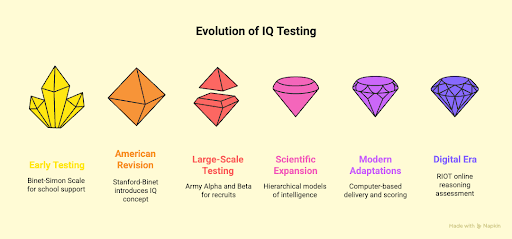
IQ tests have existed for more than a century. The first appeared in 1905, when French psychologist Alfred Binet and his collaborator Théodore Simon created the Binet–Simon Scale to identify schoolchildren who required additional educational support.
Their test introduced systematic procedures for measuring reasoning and memory, establishing intelligence assessment as an empirical science.
The American Revision
In 1916, Stanford University psychologist Lewis Terman adapted Binet’s work for use in the United States. His Stanford–Binet Intelligence Scale standardized the test on an American sample and expanded the range of scores so that the test could identify bright children also.
By quantifying performance relative to age-based norms, Terman transformed Binet’s experimental tool into a foundational instrument for research, education, and clinical evaluation.
Early Large-Scale Testing
During World War I, the U.S. Army developed the Army Alpha and Beta tests to evaluate recruits’ reasoning and learning ability. These group-administered assessments demonstrated that mental ability could be measured efficiently across large populations. Their success led to widespread adoption of psychometric testing in schools, workplaces, and government institutions, firmly establishing intelligence testing as part of applied psychology.
The tests were spearheaded by a committee of psychologists, including Robert M. Yerkes and Lewis M. Terman, with the express purpose of classifying and assigning the massive influx of U.S. military recruits efficiently. The goal was to place men according to their cognitive ability for tasks ranging from officer training to basic labor.
• Army Alpha Test: This was a verbal test designed for literate recruits. Its content was based on earlier tests, but adapted for large-group administration to adults.
• Army Beta Test: This was a nonverbal, pictorial test created specifically for recruits who were illiterate or who were not proficient in English (such as recent immigrants). It aimed to measure intelligence without relying on language, using visual tasks like maze tracing, picture completion, and symbol-digit coding.
Expanding Scientific Foundations
The scientific foundations of IQ testing underwent a significant transformation in the twentieth century, moving past the singular general intelligence score to adopt more complex theories that offer a far more complete picture of the mind.
The most impactful of these models is the Cattell–Horn–Carroll (CHC) framework, which synthesized the work of prominent psychologists to establish a tiered structure of cognitive abilities. At the top of this hierarchy is a general intelligence factor, g, but beneath it are several broad domains of ability, such as Fluid Reasoning (Gf), which is the capacity to solve novel problems and reason abstractly, independent of acquired knowledge. This contrasts with Crystallized Knowledge (Gc), which represents accumulated knowledge, language skills, and cultural information.
The model also defines other broad abilities like Processing Speed (Gs), the rate at which an individual can perform simple cognitive tasks, and Working Memory (Gsm), the ability to hold and manipulate information mentally over a short period. This detailed framework allows modern tests to provide a profile of an individual's specific cognitive strengths and weaknesses, not just a single IQ number.
The Wechsler scales (like the WAIS and WISC) and the recent versions of the Stanford–Binet test are built directly upon the foundation of these hierarchical theories, particularly the CHC model. David Wechsler developed his initial scale (the Wechsler-Bellevue in 1939) partly because he felt the Stanford-Binet was too verbally focused and did not adequately assess nonverbal or 'performance' aspects of intelligence.
Subsequent revisions of both the Wechsler scales and the Stanford-Binet adopted the multi-factor approach, replacing the simple Verbal and Performance IQ split with a structured index of scores that align with CHC broad abilities, thus providing a much more comprehensive and diagnostically useful understanding of a person's cognitive landscape. For a more in-depth look into the history of IQ tests, read here.
Ethical and Professional Oversight
Test construction and revision follow the standards set by the American Educational Research Association (AERA), the American Psychological Association (APA), and the National Council on Measurement in Education (NCME). These guidelines ensure reliability, validity, and fairness across time and populations, preserving the integrity of results as testing methods become more advanced.
IQ testing began in 1905 with Binet and Simon’s pioneering research and has evolved through more than a century of refinement and innovation. From paper-based assessments to validated online instruments such as the RIOT, the goal has remained constant: to measure human reasoning with accuracy, fairness, and empirical rigor.
Watch “What Does an IQ Test Measure?” with Dr. Russell T. Warne on the Riot IQ YouTube channel to see how the purpose of IQ testing has evolved since its earliest forms.
Article Categories
All ArticlesUnderstanding IQ ScoressTaking an IQ TestRIOT-Specific InformationGeneral IQ & IntelligenceAdvanced Topics & ResearchIQ Scores & InterpretationMensa & High-IQ SocietiesOnline IQ Tests IQ Test Basics & FundamentalsAverage IQ & DemographicsFamous People & IQHistory & Origins Of IQ TestingAccuracy, Reliability & CriticismSpecial Population & Related ConditionsImproving IQ / PreparationSpecific IQ Tests & Formats
Related Articles
What Should Psychological Assessment Look Like Today?Setting Time Limits for Tests: Lessons LearnedHow to Take an IQ Test: A Comprehensive Online Guide 5 Best IQ Tests in 2025Are There Any Professional and Real Online IQ Tests?How Old Are IQ Tests?The Stanford–Binet Intelligence TestHow to Take an IQ TestAre IQ Tests Legit?What is Marilyn Monroe's IQ?IQ and EQ How to Take a Real IQ TestHow to Take an IQ Test at HomeHow Much Does an IQ Test Cost?How to Get an IQ TestWhere to take a REAL IQ TestWhere Can I Take an IQ Test?IQ Test for KidsProfessional IQ TestsIQ Test TypesIQ Test Usage
Take our IQ testsCompare all tests
Basic IQ Test
5 subtests + 5 cognitive abilities
Features
- ~13 Minutes
- IQ score
- Cognitive abilities breakdown
- ±5.6 IQ margin of error
5/15 Subtests
Learn moreVocabulary
Matrix Reasoning
SToVeS
Visual Reversal
Symbol Search
Full IQ Test
15 subtests + all cognitive abilities
Features
- ~52 Minutes
- IQ score
- Cognitive abilities breakdown
- ±3.7 IQ margin of error
15/15 Subtests
Learn moreVocabulary, Information, Analogies
Matrix Reasoning, Visual Puzzles, Figure Weights
Object Rotation, SToVeS, Spatial Orientation
Computation Span, Exposure Memory, Visual Reversal
Symbol Search, Abstract Matching
Simple Reaction Time, Choice Reaction Time

Community
Intelligence Journals & Organizations
News & Press
Our Articles
Our Articles
Our Articles
Our Articles
Our Articles