Dec 3, 2025·Taking an IQ TestIQ and EQ
What’s the difference between IQ and EQ? IQ measures reasoning & problem-solving (strong science, predicts success). EQ claims to measure emotional skills—but it overlaps heavily with IQ + personality and adds little unique value. Discover the truth about IQ vs EQ tests.
Dr. Russell T. WarneChief Scientist
“Intelligence” and “emotional intelligence” are often presented as two different abilities that help people navigate their environment. These are measured with IQ (which originally stood for “intelligence quotient,” but which now stands for nothing) and EQ, a term created to mimic the traditional IQ. Both IQ and EQ have their own tests. IQ tests measure cognitive abilities like reasoning, problem-solving, and abstract thinking, while EQ tests measure the capacity to understand, use, and manage emotions effectively.
Popular writers and bloggers suggest that IQ and EQ are separate and that EQ is often more important than IQ in determining life success. However, the relationship between these two concepts is more complicated than most popular discussions suggest. While IQ is well-established in psychology with over a century of research, EQ is more controversial, and the evidence for its usefulness is mixed at best.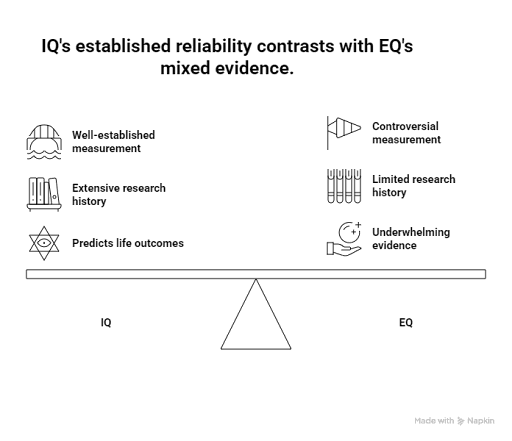
What is IQ?
IQ is a score derived from intelligence tests designed to measure general mental ability. According to one consensus definition signed by leading intelligence researchers, intelligence is "a very general mental capability that, among other things, involves the ability to reason, plan, solve problems, think abstractly, comprehend complex ideas, learn quickly and learn from experience." IQ tests have been refined over 120 years of research and development. They are among the most reliable and valid psychological tests ever created. IQ scores predict many important life outcomes, including academic performance, job success, health, and longevity.
What is EQ?
Emotional intelligence emerged as a concept in the 1990s. According to one leading group of theorists, emotional intelligence is "the capacity to reason, understand, and manage emotions. In addition, emotional intelligence plausibly reflects the emotion system's capacity to use emotion to enhance thought." In this framework, emotional intelligence helps people (1) perceive emotions accurately, (2) make decisions with the assistance of their emotions, (3) understand emotions in themselves and others, and (4) manage their emotions effectively.
The concept gained widespread attention through Daniel Goleman's 1995 bestselling book Emotional Intelligence, which claimed that EQ might matter more than IQ for success in life. This was an appealing idea, but the evidence supporting it has been underwhelming.
How are IQ and EQ measured?
IQ is measured through standardized tests like the Wechsler Adult Intelligence Scale, Stanford-Binet, or the Reasoning and Intelligence Online Test (RIOT). These tests present a variety of tasks requiring reasoning, problem-solving, and decision-making. Professional IQ tests meet rigorous technical and ethical standards for psychological assessment. These tests have clear-cut right and wrong answers that make objective scoring possible. There is much more disagreement among psychologists about how to measure emotional intelligence. For example, the Mayer-Salovey-Caruso Emotional Intelligence Test (MSCEIT) presents scenarios and asks test-takers to identify emotions or choose appropriate responses. This test is graded with an answer key, but the “right” and “wrong” choices are not objective the way they are in an IQ test. Self-report measures like the Trait Emotional Intelligence Questionnaire ask people to rate their own emotional abilities, which is even less objective.
The difference in measurement approaches creates challenges for EQ tests. Self-report measures essentially ask people how emotionally intelligent they think they are, which may not reflect their actual abilities. Performance-based measures like the MSCEIT function more like traditional ability tests but face questions about whether they truly measure a unique construct.
The relationship between IQ and EQ
Here's where things get problematic for emotional intelligence theory: IQ and EQ are not independent. Studies show they correlate with each other, meaning people who score high on IQ tests tend to score somewhat higher on EQ tests as well. This correlation isn't necessarily fatal to the concept of emotional intelligence. After all, different cognitive abilities correlate with each other too; that's part of why we have an overall IQ score. The real problem is that EQ tests also overlap substantially with personality traits, particularly traits like agreeableness and emotional stability. When researchers control for both IQ and personality, there's little unique information left for emotional intelligence to explain. In technical terms, this means EQ tests lack "incremental validity" and they don't add much new information beyond what we already know from IQ tests and personality assessments.
Do EQ tests predict anything useful?
EQ tests do show modest correlations with important outcomes. They predict performance in school and the workplace, typically with correlations ranging from 0 to .25. This is weaker than IQ's predictions for the same outcomes, but it's not nothing. However, these predictions become much weaker or disappear entirely when researchers control for IQ and personality. This suggests that what EQ tests measure is mostly a combination of cognitive ability and personality traits, not a distinct form of intelligence.
This doesn't mean emotional skills are unimportant. Understanding and managing emotions clearly matters for relationships, mental health, and professional success. The question is whether these skills constitute a separate intelligence that can be measured distinctly from cognition and personality.
Can you improve your EQ?
Many books, courses, and workshops promise to boost your EQ. The evidence for these programs is weak. Because "emotional intelligence" appears to be largely a combination of IQ and personality and both are relatively stable traits, dramatically improving your EQ is unlikely.
That said, people can certainly develop better emotional skills through practice and experience. Learning to recognize your emotional patterns, practicing empathy, and developing strategies for managing stress can all be valuable. But these improvements are better understood as developing emotional skills or emotional competencies rather than raising a form of intelligence.
Understanding both your cognitive abilities and your emotional patterns can provide valuable self-knowledge. But be skeptical of claims that EQ is more important than IQ, or that you can dramatically boost your emotional intelligence through simple training programs. The science simply doesn't support these assertions.
Take our professional IQ test
Want to know your IQ? Try the first ever professional online IQ test.
AuthorDr. Russell T. WarneChief Scientist
