How to test your IQ at home: Get accurate results with a legit online test (quiet room, good rest). Skip free fakes; here’s how to check IQ level at home properly.
Dr. Russell T. WarneChief Scientist
Share
While it's absolutely possible to take a legitimate IQ test at home, the vast majority of "IQ tests" found online are not legitimate. Most are created by amateurs with no training in psychometrics (the science of psychological testing) and provide scores that are essentially meaningless.
The good news is that professional-quality home IQ testing does exist. Online testing technology has advanced to the point where it is possible to measure intelligence accurately without sitting in a psychologist's office. The challenge is distinguishing between legitimate tests and the countless low-quality alternatives flooding the internet.
What You Need Before Taking an IQ Test at Home
If you want your at-home IQ test to produce accurate results, you'll need to prepare properly:
A quiet, distraction-free environment. Background noise, interruptions from family members, or notifications from your phone can be distractions that lower your score. Choose a time and place where you won't be disturbed for the duration of the test.
Adequate time. Most professional IQ tests are not quick. A comprehensive test battery typically takes 60-90 minutes to complete. Don't try to squeeze it in during your lunch break or between other commitments.
A reliable internet connection and computer. Technical problems during testing can affect your performance. Make sure your internet connection is stable and your computer is functioning properly. A larger screen is better than a phone for some test formats.
Mental and physical readiness. Take the test when you're well-rested and alert. Fatigue, hunger, or illness can all negatively impact your performance.
How to Find a Legitimate At-Home IQ Test
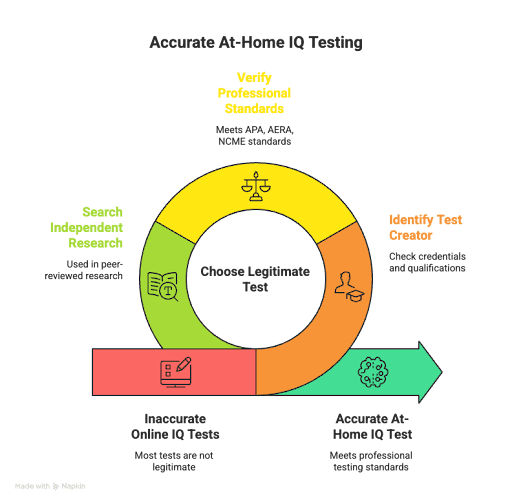
Separating out legitimate online IQ tests from low-quality tests can be difficult for many people. Here's what to look for:
Identify the test creator. Legitimate test creators proudly attach their names to their work, and their credentials are easy to verify. If you cannot find out who created the test or what their qualifications are, that's a red flag. Anonymous test creators avoid accountability, and there is usually a good reason they're hiding.
Look for professional credentials. The person who created the test should have advanced training in psychometrics or a related field. A PhD in psychology (including clinical, educational, and school psychology), statistics, or a related field is typically necessary to gain the expertise needed to create a valid psychological test.
Check for a norm sample. A legitimate IQ test compares your performance to a representative sample of the population. The test should clearly explain how this norm sample was collected and who it represents. If the comparison group is just other people who happened to take the test online, any test scores from that test will be highly inaccurate.
Verify it meets professional standards. The test should be designed to meet theStandards for Educational and Psychological Testing, published by the American Educational Research Association, American Psychological Association, and National Council on Measurement in Education. This information will be documented on the web site or in a test manual. (Note that many test manuals are not available to the general public, but there should be evidence that the test manual exists.)
Search for independent research. UseGoogle Scholar to search for the test name. If the test has been used in peer-reviewed research, that's strong evidence that it's legitimate. Amateur tests don't appear in scientific publications.
Common Mistakes When Taking an IQ Test at Home
Even with a legitimate test, people make errors that compromise their results:
Taking the test multiple times. Practice effects are real. Research shows thatretaking an IQ test can raise scores by about 5 points on the second attempt, and about 3 points on the third. These are "hollow gains," which means that the examinee’s increased, but they didn't actually get smarter.
Studying test strategies in advance. Some people try to learn the "tricks" for solving IQ test items before taking the test. While this can raise your score, it defeats the purpose. The goal of taking an IQ test should be to measure intelligence, not test-taking skill.
Not reading or understanding the instructions. Different subtests require different approaches. Legitimate tests provide clear instructions and often include practice items to use them.
Rushing or running out of time. Many IQ tests have time limits for individual questions or entire subtests. Rushing leads to careless errors, but running out of time means unanswered questions. Find a sustainable pace.
Testing under poor conditions. Being distracted, tired, sick, or stressed will lower an examinee’s score artificially.
Free vs. Paid At-Home IQ Tests
Most free online IQ tests are not legitimate scientific instruments. Test development is expensive, requiring years of research, expert review, pilot testing, and norm sample collection. Professional test creators need to charge for their tests to cover these costs.
Some legitimate researchers offer free tests designed for research purposes. These can provide useful information, but they may have limitations (such as non-representative norm samples). Some tests also offer abbreviated versions. These can help examinees prepare for a full-length assessment, but should not be treated as definitive measures of your intelligence.
Check out “Are Online Intelligence Tests Legitimate?” on the Riot IQ YouTube channel to see which at-home IQ tests are actually worth your time.
Take our professional IQ test
Want to know your IQ? Try the first ever professional online IQ test.