Mar 18, 2026·Famous People & IQ

Was Ozzy Osbourne Intelligent?

Does the Prince of Darkness actually have a low IQ? Discover the truth behind Ozzy Osbourne's IQ score, his struggles with dyslexia, and his real intellect.

Dr. Russell T. WarneChief Scientist

Share
Was Ozzy Osbourne Intelligent?
Ozzy Osbourne's actual intelligence is not something the scientific record can speak to with precision. No verified IQ score exists for the "Prince of Darkness," and any specific figure circulating online lacks a credible source. However, his biographical record offers a far more textured picture than either his chaotic public persona or inevitable internet speculation would suggest. Osbourne built and sustained one of the most durable careers in rock music history, navigated extraordinary personal disruptions, and demonstrated forms of capability that deserve examination on their own terms.


What do his early academic struggles indicate?

Osbourne has always spoken openly about his difficulties in the classroom. Growing up in a working-class household in Aston, Birmingham, he left school at fifteen without any qualifications. He frequently described himself as a poor student who struggled severely with reading and concentration. Later in life, he was officially diagnosed with both dyslexia and attention deficit hyperactivity disorder (ADHD).
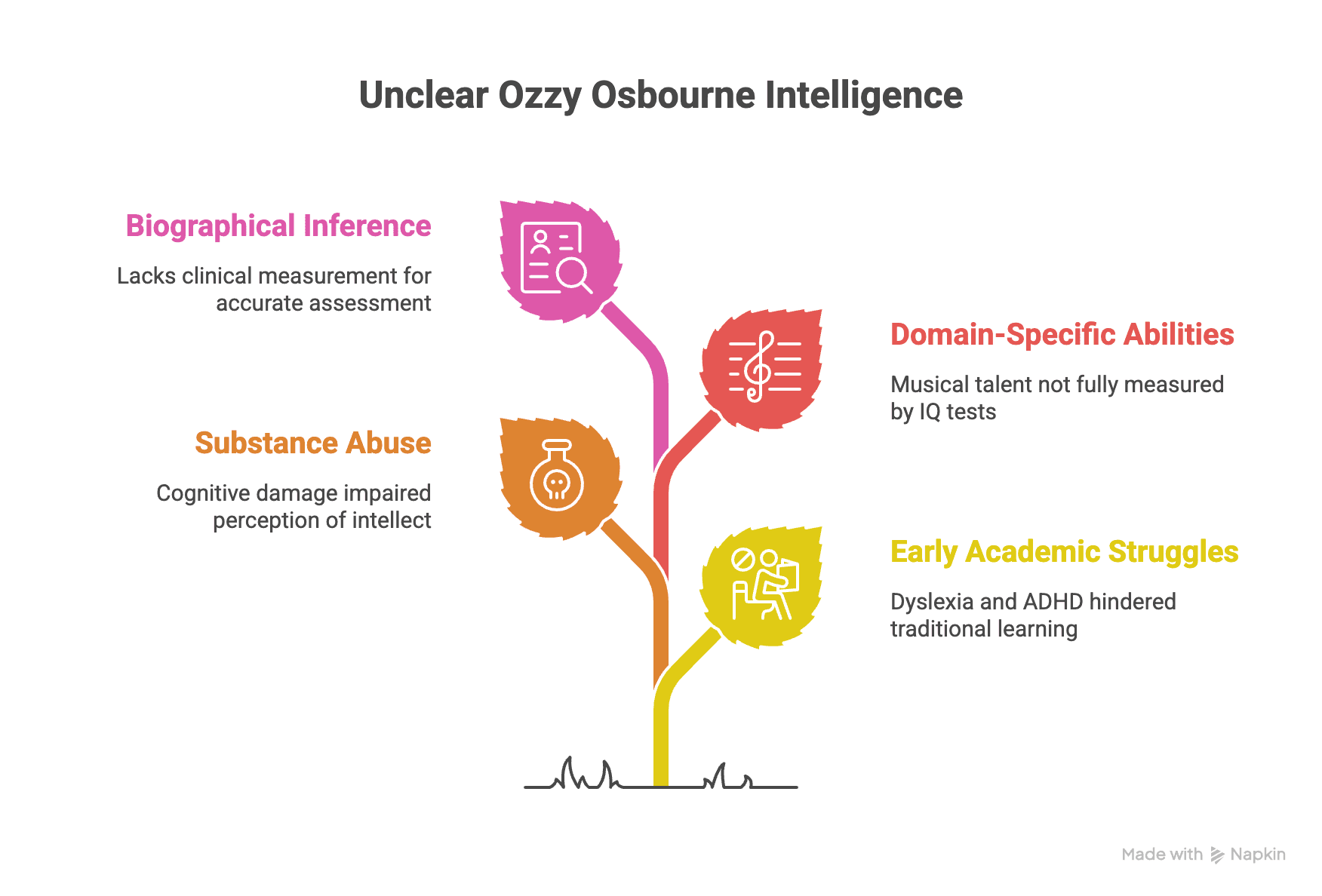
While these conditions create genuine, frustrating obstacles to traditional academic performance, they are not indicators of low general intelligence. Dyslexia is a specific learning difficulty affecting the processing of written language; it is not a measure of overall cognitive ability. Research consistently shows no meaningful relationship between dyslexia and general intelligence. Many people with the condition score in the average to above-average range on IQ assessments once the reading component is appropriately accommodated. Osbourne's academic struggles almost certainly reflect these processing differences rather than a limited mental capacity.


What does his fifty-year career suggest about his cognitive abilities?

The massive scope of Osbourne's career offers much more relevant evidence than his grade school report cards. As a founding member of Black Sabbath in the late 1960s, he helped establish the sonic template for an entire genre of music. Following his firing from the band in 1979, he did not fade into obscurity. Instead, he completely rebuilt his career as a highly successful solo artist, discovering generational guitar talents like Randy Rhoads and Zakk Wylde, and producing commercially dominant records across four decades.

What is frequently overlooked is the sharp business dimension required for this kind of longevity. Surviving in the notoriously predatory music industry for over fifty years—navigating shifting commercial landscapes, legal disputes, and major management changes while maintaining audience relevance—requires a sustained capacity for strategic decision-making. While his wife and manager, Sharon Osbourne, is widely credited with architecting much of his business empire, the two operated as partners. Osbourne's own role in dictating his artistic direction was consistent, deliberate, and entirely incompatible with significantly below-average intelligence.


How did extreme substance abuse affect public perception of his intellect?

Osbourne's decades of extreme alcohol and drug abuse are legendary, and he has acknowledged their devastating effects with complete candor. Chronic substance abuse, particularly at the staggering levels he described, causes measurable cognitive damage, often resulting in long-term impairments in memory, processing speed, and executive function.

During his most visible pop-culture period—the MTV reality series The Osbournes, which aired from 2002 to 2005—the public was presented with a version of him that many viewers interpreted as cognitively diminished. However, this interpretation almost certainly conflated the severe, residual effects of decades of neurological chemical abuse with his underlying baseline intelligence. Observing a person's cognitive functioning after years of extreme substance use tells you relatively little about their natural, uncompromised intellectual capacity.


Does musical achievement correlate with general intelligence?

The relationship between musical ability and general cognitive ability is positive but highly domain-specific. While cognitive abilities generally intercorrelate—meaning people who perform well in one mental domain tend to perform better in others—musical talent draws heavily on auditory processing, pattern recognition, and working memory capacities that traditional IQ tests only partially measure. High achievement in music is consistent with a broad range of general intelligence levels, particularly when it reflects a lifetime of deep immersion rather than purely abstract reasoning.

What Osbourne demonstrated throughout his career was an elite capacity to absorb a wide range of musical influences, communicate a consistent artistic vision to a rotating cast of collaborators, and maintain creative output under conditions of intense personal instability. These are not trivial cognitive achievements, even if they do not map neatly onto a standardized test.


What does research say about succeeding despite early constraints?

The scientific literature on resilience and cognitive development is highly relevant to Osbourne's story. Severe environmental factors—such as poverty, inadequate schooling, learning difficulties, and chaotic home environments—can aggressively suppress academic performance and constrain the expression of intelligence. However, people who achieve monumental success despite these constraints often possess deep cognitive strengths that simply could not develop through conventional channels.

Osbourne's trajectory from a struggling, working-class kid with undiagnosed learning difficulties to global cultural prominence perfectly aligns with this pattern. While it does not establish a specific IQ number, it makes the assumption of below-average intelligence highly improbable.


How is a person's intelligence actually measured?

Biographical inference, no matter how careful, is never a substitute for direct clinical measurement. The only reliable way to determine a person's cognitive profile is through a professionally developed intelligence test. For those seeking an empirically grounded assessment outside a doctor's office, the Reasoning and Intelligence Online Test (RIOT) represents the clinical standard.

Developed by Dr. Russell Warne—an expert with over fifteen years of intelligence research experience—it is the first digital assessment built to meet the uncompromising joint standards of the American Educational Research Association, the American Psychological Association, and the National Council on Measurement in Education. Normed on a representative United States sample, it provides a Full Scale IQ alongside specific index scores across Verbal Reasoning, Fluid Reasoning, Spatial Ability, Working Memory, Processing Speed, and Reaction Time. It represents the strict empirical standard that real psychological measurement requires—a standard that internet speculation about rock stars can never replicate.

Watch “How Intelligence and IQ Work in the Brain” with Dr. Richard Haier on the Riot IQ YouTube channel to understand how intelligence extends beyond public perception and personality.
Author
Dr. Russell T. WarneChief Scientist

Contact