Mar 16, 2026·Famous People & IQ

What is Forrest Gump's IQ?

In the 1994 film, Forrest Gump's IQ score is stated as 75. Discover what a 75 IQ meaning actually entails in the real world and where the movie gets the science wrong.

Dr. Russell T. WarneChief Scientist
Share
What is Forrest Gump's IQ?
Forrest Gump is a fictional character, meaning he does not possess a real IQ score. He exists entirely within the pages of Winston Groom's 1986 novel and Robert Zemeckis's 1994 film adaptation. Any number attached to his name is simply a narrative device crafted by his creators, rather than a genuine cognitive profile. However, exploring how his intelligence is depicted offers a fascinating lens into what IQ actually measures, what it leaves out, and how popular culture misunderstands cognitive science.


What IQ does the story assign to Forrest Gump?

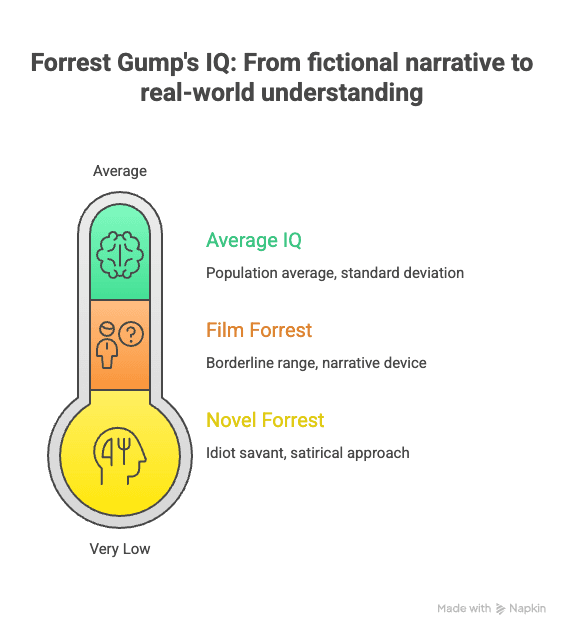
In the 1994 film, a school administrator informs Forrest's mother that his IQ is 75. At the time, this placed him just below the state's enrollment threshold of 80 for standard public schools. This specific number was chosen to establish the core tension of the story: a man officially labeled with cognitive limitations who goes on to lead an extraordinary life. In the original novel, the characterization is slightly different; Groom explicitly describes Forrest as an idiot savant with an IQ of 70, taking a much more satirical and less sentimental approach to his mental capacity.

What does an IQ of 75 actually mean?

On the standard scale used by clinical intelligence tests, the population average is 100, with a standard deviation of 15 points. A score of 75 falls approximately one and two-thirds standard deviations below the mean, placing it roughly at the fifth percentile. This means about ninety-five percent of the population would score higher.

Most professional assessments classify a 75 in the borderline or very low range. Crucially, it sits just above the traditional threshold for intellectual disability, which is generally defined as a score below 70 combined with severe deficits in daily functioning. Statistically, a person with a 75 IQ would likely face meaningful challenges in academic settings—particularly with abstract reasoning and complex problem-solving—but would generally remain highly capable of independent living, holding a job, and participating fully in ordinary social life.


Does Forrest Gump's portrayal reflect how intelligence actually works?

In some respects, the film is surprisingly accurate, while in others, it misses the mark entirely. It correctly demonstrates that IQ does not determine your destiny. The research literature consistently shows that cognitive ability is just one predictor of success among many. Factors like conscientiousness, social support, opportunity, and intense practice shape our lives in ways that raw intellect alone cannot capture. While Forrest's extraordinary specific achievements are highly implausible, the broad message that a single number does not dictate a person's trajectory is scientifically sound.

Where the portrayal misleads is in its romanticization of cognitive limits. The narrative never seriously grapples with how a person scoring a 75 processes complex information or navigates ambiguous social and political events. Instead, the film uses his simplicity as a stand-in for purity, conflating a low IQ with high moral character—a concept that intelligence research does not support. There is no measurable relationship between cognitive ability and human virtue.


What is the difference between IQ and adaptive functioning?

This distinction is vital for understanding both the movie and how clinical psychology actually operates. IQ measures general cognitive ability, including reasoning, learning speed, and abstract thought. Adaptive functioning, on the other hand, refers to the practical skills required to navigate daily independent life, such as managing money, communicating effectively, and fulfilling age-appropriate responsibilities.

A clinical diagnosis of intellectual disability requires significant deficits in both areas. If a person scores below a 70 on an IQ test but successfully manages their finances and maintains steady employment, they typically would not meet the diagnostic criteria. Both dimensions are necessary to understand what a low score actually implies about a person's daily reality.


Why do people search for fictional characters' IQ scores?

We naturally look for concrete reference points to understand abstract statistics. By attaching a specific number to a beloved character, an otherwise clinical percentile becomes memorable and emotionally resonant. Forrest Gump serves as a highly accessible illustration of the borderline cognitive range.

The danger here is that a fictional portrayal can warp our intuition about real people. Forrest is a deeply sympathetic character whose limitations are offset by extraordinary luck, physical talents, and a fiercely protective support network. Real individuals with scores in the seventies live incredibly varied lives shaped by a multitude of factors, and no single Hollywood character can accurately represent that diversity.


How is IQ measured in practice?

Determining a genuine IQ requires a professionally developed test administered under controlled conditions. While Forrest Gump's score is merely a storytelling tool, it highlights why real IQ figures require a legitimate source to carry any weight. Clinician-administered exams like the Wechsler Adult Intelligence Scale remain the traditional gold standard.

For those seeking clinical-grade accuracy outside a doctor's office, the Reasoning and Intelligence Online Test (RIOT) provides a modern alternative. Developed by Dr. Russell Warne and normed on a representative United States sample, it is the first digital assessment built to meet the uncompromising standards of the American Educational Research Association, the American Psychological Association, and the National Council on Measurement in Education. By measuring specific domains like Fluid Reasoning, Spatial Ability, and Processing Speed, the RIOT delivers the empirically grounded measurement that fictional portrayals can never truly substitute.

Watch “Intro to Intelligence Tests: What Is an IQ Test, and Why Do We Use Them?” with Dr. Warne on the Riot IQ YouTube channel to understand how IQ scores are defined and interpreted in real testing.
Author
Dr. Russell T. WarneChief Scientist

Contact