May 4, 2026·History & Origins Of IQ TestingTop 10 Facts About IQ Tests Everyone Should Know
Are IQ scores genetic? What do they really measure? Discover 10 science-backed facts about IQ tests and intelligence. Read the full guide to learn more!
Dr. Russell T. WarneChief Scientist
IQ tests have existed for over 120 years, and in that time they have generated enormous amounts of research, debate, and — frankly — misinformation. Most people have heard of IQ, but far fewer understand what IQ tests actually measure, how they work, or what the scores mean for real life. These 10 facts are drawn from decades of peer-reviewed research. Some will confirm what many people already suspect. Others may surprise even those who consider themselves well-informed on the topic.
Fact #1: IQ and intelligence are not the same thing
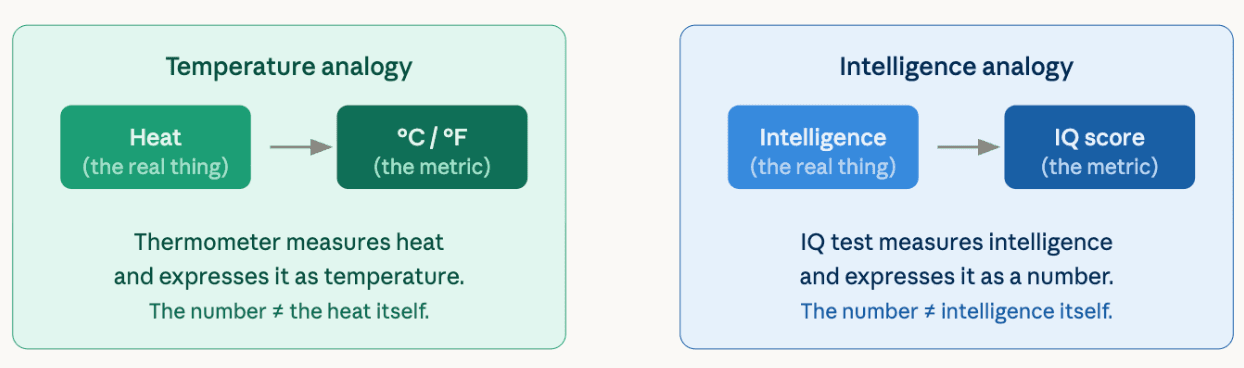
This distinction matters more than most people realize. Intelligence is the underlying mental ability — the capacity to reason, solve novel problems, comprehend complex ideas, and learn quickly. IQ is the number produced by a standardized test designed to measure that ability. The relationship between the two is exactly like the relationship between temperature and a thermometer reading: the instrument doesn't create what it measures, it quantifies it.
According to a 1997 consensus statement signed by over 50 leading intelligence researchers, intelligence is "a very general mental capability that, among other things, involves the ability to reason, plan, solve problems, think abstractly, comprehend complex ideas, learn quickly and learn from experience." IQ is the metric used to express that ability numerically. This distinction has practical consequences. Raising an IQ score through practice and test familiarity is possible — researchers call those gains "hollow" because the number changes without the underlying cognitive ability necessarily following. That is not the same as becoming more intelligent.
Fact #2: IQ scores follow a normal distribution with an average of 100
The scoring system used by modern IQ tests is built around the normal distribution — informally known as the bell curve. The average is set at 100, and each standard deviation spans 15 points. Roughly 68% of people score between 85 and 115. About 95% score between 70 and 130. Only around 2.3% of the population scores above 130, and another 2.3% falls below 70.
This scoring method is called a "deviation IQ," introduced by David Wechsler to replace the older quotient formula. The older formula — dividing mental age by chronological age — worked reasonably well for children but broke down for adults. A 40-year-old and a 25-year-old cannot be compared on a scale that assumes cognitive ability keeps developing with age. The deviation IQ solved that by comparing each person to others in their own age group.
One implication that often gets missed: IQ scores are relative, not absolute. A score of 100 doesn't carry meaning in isolation. It means the person performed at the median for their age group — nothing more, nothing less.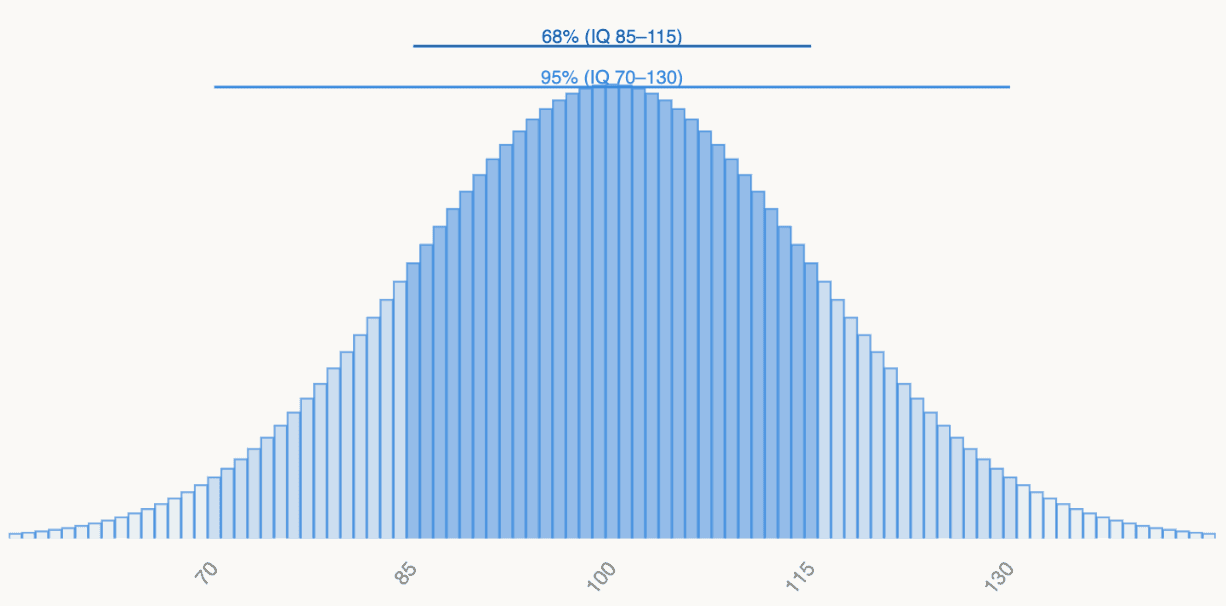
Fact #3: IQ is one of the most well-researched variables in all of social science
Few psychological measures have been studied as thoroughly as IQ. Every year, hundreds — sometimes thousands — of peer-reviewed studies report IQ-related findings. According to a landmark consensus statement by over 50 intelligence researchers, IQ scores correlate with a remarkable range of outcomes: school performance, job performance, income, health, and longevity, among others. Meta-analyses have established that the correlation between IQ and academic performance runs as high as .56 (on a scale from 0 to 1), between IQ and occupational status around .43, and between IQ and income around .23. These are not trivial associations. Even a correlation of .23 with income, applied across millions of individuals over a lifetime, has significant practical consequences. This breadth of replication across decades and countries is part of why serious intelligence researchers defend the construct so vigorously. IQ is not a perfect measure of the full range of human ability, but as a single number predicting outcomes across many domains, it has no rival.
Fact #4: IQ predicts job performance — especially in complex roles
One of the most practically important findings in intelligence research is that IQ predicts workplace performance, with the relationship varying by job complexity. For cognitively demanding roles — physicians, lawyers, engineers, researchers — the correlation between IQ and job performance is substantially higher than for routine tasks. Research by Schmidt and Hunter found validity coefficients ranging from approximately .30 for low-complexity jobs to over .50 for high-complexity professions. Complex roles require learning large amounts of information quickly, solving novel problems, and making judgment calls under uncertainty — precisely the capabilities IQ tests measure. Equally important is IQ's prediction of training success: how quickly a new employee reaches competency. Employers and the military both use cognitive testing for exactly this reason. The U.S. military’s Armed Services Vocational Aptitude Battery (ASVAB), which functions as an intelligence test, is the largest single employment testing program in the United States.
After early childhood — a period during which scores are less settled — IQ tends to remain relatively consistent throughout life. Test-retest reliability studies consistently show high coefficients for adult populations, typically in the range of .85 to .95. Someone who scores in the above-average range at 25 is very likely to score similarly at 45.
This stability is part of what makes IQ scientifically useful. A measure that fluctuated dramatically from year to year would have limited predictive value for outcomes that unfold over decades. The exceptions are at either end of the lifespan. Before about age 10, scores can shift more substantially as cognitive development continues. In late adulthood, processing speed and fluid reasoning decline measurably, while crystallized knowledge and verbal abilities hold up much longer — often well into the 80s. Additionally, elderly people can experience IQ score declines if they succumb to dementia.
Fact #6: Higher IQ is associated with better health and longer life
This finding surprises many people, but it is one of the most robustly replicated in the field of cognitive epidemiology. A landmark Scottish study followed individuals who took an IQ test at age 11. Researchers found that a 15-point IQ advantage was associated with a 21% greater likelihood of surviving to age 76. A 2025 meta-analysis of 49 studies covering over 2.9 million people confirmed the pattern: a 15-point IQ disadvantage in early life was associated with a 22% higher risk of later physical and mental illness. Several pathways explain this relationship. Higher IQ correlates with better health literacy — the ability to understand medical instructions, recognize symptoms, and adhere to treatments. It also predicts healthier behaviors: lower smoking rates, better diet, and more consistent exercise. There is additional evidence that some of the intelligence–longevity relationship is genetic, meaning that the same underlying biological factors that support higher cognitive ability also support physical health. This does not mean high IQ confers immunity from illness, but on average it functions as a meaningful protective factor.
Fact #7: The Flynn Effect shows IQ scores rose throughout the 20th century — but intelligence didn't
James Flynn documented one of the most surprising patterns in intelligence research: average IQ scores climbed steadily throughout the 20th century across many countries, averaging roughly 3 points per decade. Over several generations, that adds up to an enormous shift, which created an immediate paradox. If scores had risen because of genuine intelligence gains, the logical implication would be that people from a century ago would score near the intellectual disability range by today's norms. That clearly does not match the historical record of what those generations accomplished in science, literature, engineering, or governance. The explanation is more nuanced. IQ scores measure a mixture of general intelligence (g) and narrower cognitive abilities that are more susceptible to environmental influence. The Flynn effect operates primarily on those non-g components. Changes in formal education, greater familiarity with abstract thinking and test-taking, and shifts in school curricula all appear to have contributed to higher scores without necessarily raising underlying g. One practical consequence: IQ scores from different historical periods cannot be directly compared. A person who scored 100 in 1950 and a person who scores 100 today are both at the average for their respective generations — but those generations were tested under meaningfully different conditions.
Fact #8: Heritability of IQ is substantial — and increases with age
Both genes and environment shape IQ, but behavioral genetics research has produced fairly consistent estimates of how much each contributes. In non-neglectful environments in wealthy countries, the heritability of IQ tends to fall between .50 and .75 in adults — meaning roughly half of the variation in IQ scores across people can be attributed to genetic differences. One consistently surprising finding is that heritability increases with age. In young children, shared environmental factors (the home, family resources) play a relatively large role. As people grow up, choose their own environments, and self-select into experiences that match their predispositions, the genetic contribution becomes more dominant. By adulthood, heritability estimates are often in the .50 to .75 range.
Despite the high heritability of IQ in adults, the environment still matters. Adoption into a more resourced home raises IQ by about 3 points compared to what would otherwise be expected. An additional year of schooling raises IQ by about 1 point. These are real effects, but they cannot override large genetic differences or produce unlimited gains.
Fact #9: There is no single task that appears on all IQ tests — and that is by design
Some IQ tests rely heavily on verbal reasoning. Others use abstract visual puzzles, working memory tasks, spatial problems, or reaction time measures. Yet all of these, when administered to a general population, produce scores that correlate substantially with one another. Charles Spearman explained why with the principle he called "the indifference of the indicator": as long as a task requires genuine thinking and judgment, it will measure intelligence to some degree. Modern research has confirmed this repeatedly. This diversity of formats is an advantage, not a flaw. It allows test creators to choose tasks best suited for particular populations or assessment goals without sacrificing comparability. Most well-designed IQ tests today are "test batteries" — collections of multiple subtests covering different cognitive domains — which reduces the risk that any single format will dominate the score and distort the full picture of a person's cognitive profile.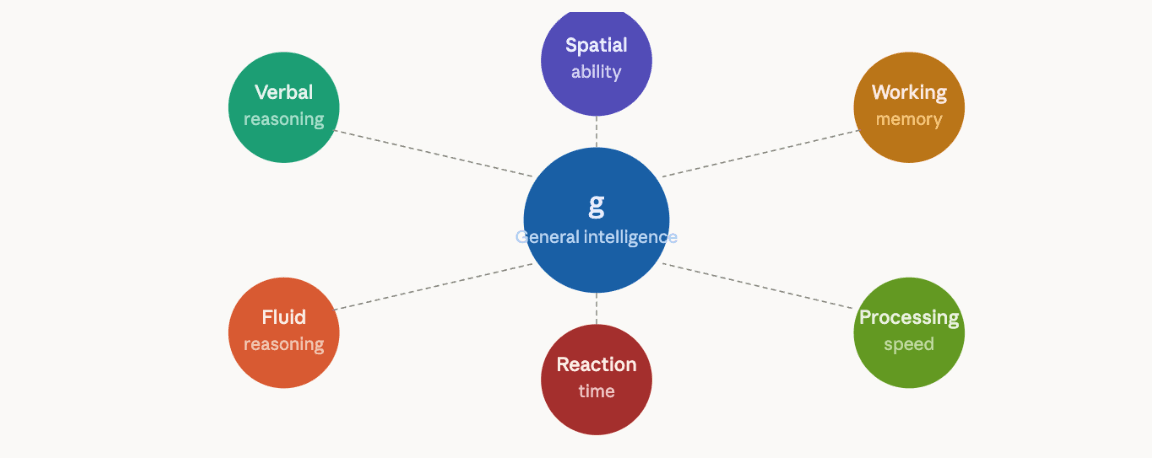
Fact #10: Most online IQ tests are not professionally made — and the difference matters
The internet is full of IQ tests. Most are not what they appear to be. Creating a legitimate psychological test requires years of specialized training in psychometrics (the science of psychological testing), a representative norm sample, rigorous item development and pilot testing, and compliance with professional standards set by the American Educational Research Association, the American Psychological Association, and the National Council on Measurement in Education. Very few online tests meet any of these requirements.
The consequences are not merely technical. A test without a properly constructed norm sample cannot accurately tell someone whether their score is above or below average — it has no valid basis for comparison. A test built without bias screening may systematically disadvantage certain groups. And a test created anonymously provides no avenue for accountability. The most reliable indicator of a legitimate test is a named, credentialed creator willing to stake a professional reputation on the quality of the instrument. Legitimate creators publish technical documentation, submit their work to peer review, and make their methodology available for scrutiny.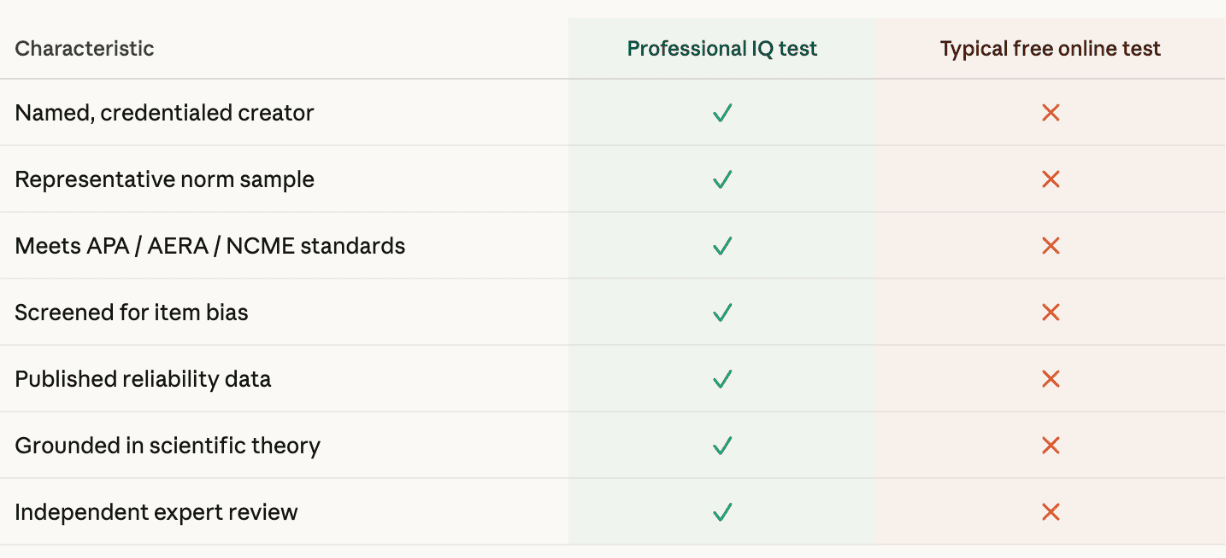
Where to go from here
These 10 facts represent the core of what the research literature has established about IQ tests and intelligence. They are not the complete picture; the field has far more nuance than any single article can cover. But they provide a foundation for thinking clearly about what IQ measures, why it matters, and what the scores actually mean.
For those interested in taking a professionally developed IQ test online, the Reasoning and Intelligence Online Test (RIOT) is the first online IQ test built to meet all relevant professional standards. I created the RIOT after more than 15 years of intelligence research, using the same rigorous development process that traditional in-person tests undergo — including expert review, pilot testing, and the first properly constructed U.S.-based online norm sample. It is the standard that other online tests are measured against.
References
Gottfredson, L. S. (1997). Mainstream science on intelligence. Intelligence, 24(1), 13–23. https://doi.org/10.1016/S0160-2896(97)90011-8 Gottfredson, L. S. (1997). Why g matters. Intelligence, 24(1), 79–132. https://doi.org/10.1016/S0160-2896(97)90014-3 Schmidt, F. L., & Hunter, J. E. (2004). General mental ability in the world of work. Journal of Personality and Social Psychology, 86(1), 162–173. https://doi.org/10.1037/0022-3514.86.1.162 Chabris, C. F. (2007). Cognitive and neurobiological mechanisms of the law of general intelligence. https://doi.org/10.1016/S0160-2896(03)00062-X Flynn, J. R. (1984). The mean IQ of Americans: Massive gains 1932 to 1978. Psychological Bulletin, 95(1), 29–51. https://doi.org/10.1037/0033-2909.95.1.29 Flynn, J. R. (1987). Massive IQ gains in 14 nations. Psychological Bulletin, 101(2), 171–191. https://doi.org/10.1037/h0090408 Haworth, C. M. A., et al. (2010). Heritability of general cognitive ability increases linearly from childhood to young adulthood. Molecular Psychiatry, 15, 1112–1120. https://doi.org/10.1038/mp.2009.55 Ritchie, S. J., & Tucker-Drob, E. M. (2018). How much does education improve intelligence? Psychological Science, 29(8), 1358–1369. https://doi.org/10.1177/0956797618774253 van Leeuwen, M., van den Berg, S. M., & Boomsma, D. I. (2008). A twin–family study of general IQ. Learning and Individual Differences, 18(1), 76–88. https://doi.org/10.1016/j.lindif.2007.04.006 Turkheimer, E., et al. (2003). Socioeconomic status modifies heritability of IQ in young children. Psychological Science, 14(6), 623–628. https://doi.org/10.1046/j.0956-7976.2003.psci_1475.x Whalley, L. J., & Deary, I. J. (2001). Childhood IQ and survival up to age 76. BMJ, 322(7280), 819. https://doi.org/10.1136/bmj.322.7280.819 Gottfredson, L. S., & Deary, I. J. (2004). Intelligence predicts health and longevity, but why? Current Directions in Psychological Science, 13(1), 1–4. https://doi.org/10.1111/j.0963-7214.2004.01301001.x Sanchez-Izquierdo, M., et al. (2023). Intelligence and life expectancy in late adulthood: A meta-analysis. Intelligence, 97, 101723. https://doi.org/10.1016/j.intell.2023.101723 Patalay, P., et al. (2025). Multilevel multiverse meta-analysis: Lower IQ as a risk factor for physical and mental illness. Communications Psychology, 3, 64. https://doi.org/10.1038/s44271-025-00245-2 Arden, R., et al. (2016). The association between intelligence and lifespan is mostly genetic. International Journal of Epidemiology, 45(1), 178–185. https://doi.org/10.1093/ije/dyv112 Strenze, T. (2007). Intelligence and socioeconomic success: A meta-analytic review. Intelligence, 35(5), 401–426. https://doi.org/10.1016/j.intell.2006.09.004 Warne, R. T. (2021). In the Know: Debunking 35 Myths About Human Intelligence. Cambridge University Press. https://doi.org/10.1017/9781108593298 American Educational Research Association, APA, & NCME. (2014). Standards for Educational and Psychological Testing. https://www.testingstandards.net/ Deary, I. J., et al. (2007). Intelligence and educational achievement. Intelligence, 35(1), 13–21. https://doi.org/10.1016/j.intell.2006.02.001
Schmidt, F. L., & Hunter, J. (1998). The validity and utility of selection methods in personnel psychology. Psychological Bulletin, 124(2), 262–274.https://doi.org/10.1037/0033-2909.124.2.262 Take our professional IQ test
Want to know your IQ? Try the first ever professional online IQ test.
AuthorDr. Russell T. WarneChief Scientist