Nov 24, 2025·History & Origins Of IQ TestingWhen Was IQ Testing Invented?
When was the IQ test invented? In 1905, Alfred Binet & Théodore Simon created the first successful IQ test in France. Discover when IQ testing began!
Dr. Russell T. WarneChief Scientist

IQ testing was invented in 1905 by French psychologist Alfred Binet and his colleague Theodore Simon. They created the first successful intelligence test in Paris to help identify children who needed additional educational support. This test became the foundation for all modern intelligence testing.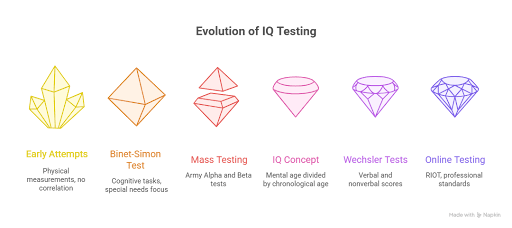
The Failed Attempts Before Binet
Sir Francis Galton (1822-1911) made the most notable early attempt to measure intelligence. In the 1880s, this English scientist set up a laboratory in London where he measured head circumference, reaction time, visual acuity, grip strength, and other basic physiological variables. He theorized these physical measurements would correlate with social class, which he viewed as a reflection of intelligence.
After years of data collection, Galton found that none of these variables were related to social class. With modern knowledge, we now know that some variables he measured do relate to intelligence (like reaction time), but his statistical methods weren't sophisticated enough to detect these relationships.
Binet and Simon's Breakthrough
Alfred Binet took a completely different approach. Rather than measuring physical traits and basic behaviors, he focused on complex tasks, specifically things that actually required thinking, reasoning, and problem-solving.
At the turn of the 20th century, France was debating how to educate children with special needs. Should they be placed in psychiatric facilities or given special classes within regular schools? Binet and Simon created their test as part of their advocacy for keeping these children in educational settings. Their 1905 test consisted of 30 tasks arranged by difficulty, measuring abilities like attention, memory, and comprehension. Unlike Galton's physical measurements, performance on Binet and Simon’s test was related to real-world outcomes (in this case, performance in school). Improved versions followed in 1908 and 1911. Binet died in 1911 at age 54. Binet's test was quickly translated into multiple languages and adapted worldwide. In the United States, Stanford University professor Lewis Terman saw enormous potential. In 1916, he published an expanded version called the Stanford-Binet Intelligence Test, covering a wider range of abilities and ages. It became wildly popular and a modern version remains in use today.
From Individual to Mass Testing
Until World War I, all intelligence tests were administered individually, one administrator testing one person at a time. This changed when the United States entered the war in 1917.
The U.S. Army needed to process millions of recruits and identify potential leaders. Individual testing was impractical at this scale. A committee of psychologists led by Robert Yerkes created the Army Alpha (for literate soldiers) and Army Beta (for men with limited literacy), which were the first tests administered to large groups simultaneously.
Over 2 million tests were given before the war ended. The tests proved successful, correlating with military rank, training success, and pre-war education and occupational prestige. Although they had minimal impact on the war's outcome, they demonstrated that mass testing was feasible. This opened the door for widespread testing in schools and employment settings.
The Origin of the Term "IQ"
Binet never calculated an "IQ" from his tests. The concept came from German psychologist Wilhelm Stern in 1912. Stern proposed dividing a child's "mental age" by their chronological age, then multiplying by 100.
If an 8-year-old performed like an average 10-year-old, their IQ would be (10 ÷ 8) × 100 = 125. An IQ of 100 was always average. Scores above 100 meant above-average performance; scores below 100 indicated below-average performance.
This formula worked for children but broke down for adults. After all, a 40-year-old isn't noticeably smarter than a 35-year-old the way a 10-year-old is smarter than a 5-year-old. Modern tests abandoned this quotient formula in favor of deviation IQs, though the term "IQ" persisted.
Mid-Century Innovations
David Wechsler created his series of tests starting in 1939, introducing innovations like separate verbal and nonverbal scores. His tests, which include the WAIS (for adults), WISC (for children), and WPPSI (for preschoolers), remain the most popular individually administered tests today.
The late 20th century brought computerized testing, making administration easier and scoring more precise.
The Rise of Online IQ Testing
The 21st century introduced online testing, though most online IQ tests are created by amateurs without proper psychometric training. In 2025, the Reasoning and Intelligence Online Test (RIOT) changed this landscape as the first online test designed to meet professional standards established by the American Educational Research Association, American Psychological Association, and National Council on Measurement in Education. Created by Dr. Russell T. Warne, who has over 15 years of experience in intelligence research, the RIOT underwent the same rigorous development process as traditional in-person tests, including expert review and a representative US-based norm sample.
From Galton's failed physical measurements to Binet's breakthrough to modern online testing, one insight remains constant: intelligence can be measured through tasks requiring reasoning and problem-solving. The methods have become far more refined, the theoretical understanding much deeper, and the applications much broader, but Binet and Simon's 1905 innovation set everything in motion. To learn more about the timeline of IQ test development, read A Comprehensive History of IQ Tests. Take our professional IQ test
Want to know your IQ? Try the first ever professional online IQ test.
AuthorDr. Russell T. WarneChief Scientist
