🇺🇸The official website of Riot IQ
My Dashboard
  • Home
  • Test Manual
  • Administer IQ Tests
  • Articles
  • Podcast

Table of Contents

  • Developing Test Items
  • Field Testing and Statistical Review
  • Building the Norm Sample
  • Validating the Instrument
  • Upholding Professional Standards
  • The RIOT as an Example
Nov 30, 2025·History & Origins Of IQ Testing

How Are IQ Tests Created

How are IQ tests made? From theory to norming: discover the rigorous science behind designing real IQ tests like WAIS, Stanford-Binet, and professional online RIOT.

Dr. Russell T. WarneChief Scientist
Share
How Are IQ Tests Created
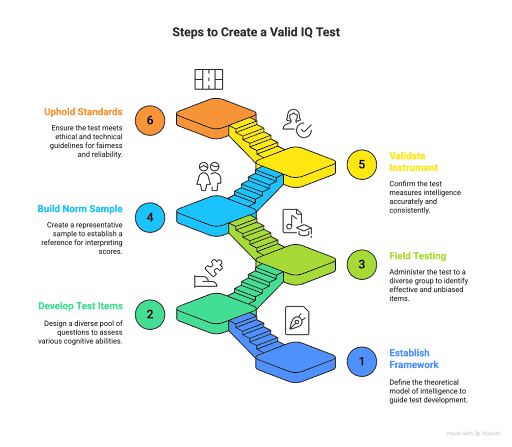
Creating an IQ test begins with defining what the test will measure. Psychologists start with a theoretical model of intelligence, most often the Cattell–Horn–Carroll framework, which identifies key domains of intelligence. These include reasoning, memory, knowledge, and processing speed. This foundation determines which abilities will be assessed and ensures that the instrument reflects accepted scientific understanding rather than intuition.

Developing Test Items

Once the framework is set, psychologists design a large pool of potential questions, or items, to represent each ability. These items may involve patterns, vocabulary, analogies, or numerical reasoning. 

The goal is to sample thinking skills broadly while keeping language and content clear and culturally accessible. Because some preliminary items will not perform as intended, developers create far more than they plan to keep for the final version. That makes it easy to drop an item that doesn’t function as intended.


Field Testing and Statistical Review

The initial item pool is administered to diverse participants who reflect the population for which the test is intended. Psychologists then analyze the results statistically to identify items that accurately distinguish among levels of ability. 

Statistical analysis reveals which questions are too easy, too difficult, or biased toward certain groups. Only items that measure reasoning well and without bias are retained, establishing the foundation for test accuracy.


Building the Norm Sample

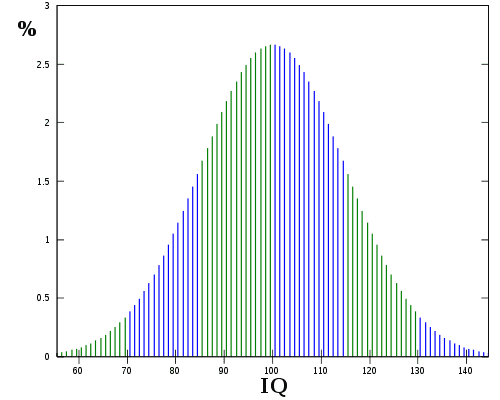
After the best items are selected, the final version of the test is assembled, and the complete test is given to a large, representative sample of people. These data form the norms used to interpret individual scores. IQ is a comparative measure: an individual’s performance is evaluated relative to others of the same age. The average score is set at 100, with a standard deviation of 15, creating a consistent frame of reference across age groups and populations.


Validating the Instrument

Validation confirms that the test measures intelligence rather than unrelated traits (or -- even worse -- measures nothing at all). Psychologists examine correlations between IQ scores and external criteria such as academic achievement or job performance to verify predictive accuracy. They can also examine how well test scores correlate with scores on established IQ tests. Reliability studies confirm that scores remain stable over different conditions, such as repeated administrations. Together, these analyses demonstrate that the instrument measures cognitive ability consistently and meaningfully.


Upholding Professional Standards

Take our professional IQ test

Want to know your IQ? Try the first ever professional online IQ test.

Try our IQ test
Author
Dr. Russell T. WarneChief Scientist

Contact

Table of Contents

  • Developing Test Items
  • Field Testing and Statistical Review
  • Building the Norm Sample
  • Validating the Instrument
  • Upholding Professional Standards
  • The RIOT as an Example
Article Categories
All ArticlesUnderstanding IQ ScoresTaking an IQ TestRIOT-Specific InformationGeneral IQ & IntelligenceAdvanced Topics & ResearchIQ Scores & InterpretationMensa & High-IQ SocietiesOnline IQ Tests IQ Test Basics & FundamentalsAverage IQ & DemographicsFamous People & IQHistory & Origins Of IQ TestingAccuracy, Reliability & CriticismSpecial Population & Related ConditionsImproving IQ / PreparationSpecific IQ Tests & FormatsIQ Testing for HR & RecruitmentSkills Assessment
Related Articles
The Evolution of IQ Testing: A Historical PerspectiveIQ Tests: Understanding the ControversiesThe Role of IQ Tests in Education and Career AssessmentTop 10 Facts About IQ Tests Everyone Should KnowThe Past and Future of IQ Tests: 120 Years of Measuring Human IntelligenceHow Old Are IQ Tests?How is IQ Measured or Calculated?Why Were IQ Tests CreatedDo Schools Test For IQ?How Are IQ Tests CreatedWhen Was IQ Testing Invented?How Do IQ Tests Work?Who Invented the IQ Test?
Take our IQ tests

Basic IQ Test

5 subtests + 5 cognitive abilities

Take the IQ test

Features

  • ~13 Minutes
  • IQ score
  • Cognitive abilities breakdown
  • ±5.6 IQ margin of error

5/15 Subtests

Learn more
Vocabulary
Matrix Reasoning
SToVeS
Visual Reversal
Symbol Search
Most comprehensive

Full IQ Test

15 subtests + all cognitive abilities

Take the IQ test

Features

  • ~52 Minutes
  • IQ score
  • Cognitive abilities breakdown
  • ±3.7 IQ margin of error

15/15 Subtests

Learn more
Vocabulary, Information, Analogies
Matrix Reasoning, Visual Puzzles, Figure Weights
Object Rotation, SToVeS, Spatial Orientation
Computation Span, Exposure Memory, Visual Reversal
Symbol Search, Abstract Matching
Simple Reaction Time, Choice Reaction Time
Compare all tests

Measure your
intelligence online.

Google

Assessments

  • All IQ Tests
  • Basic IQ Test
  • Full IQ Test
  • Custom IQ Test
  • Free IQ Test

Our Socials

  • X
  • YouTube
  • Facebook
  • LinkedIn

Other IQ Tests

  • WAIS-V
  • SB-5
  • Raven's 2
  • RIAS-2
  • CogAT 9
  • WISC-V

Community

  • Join Subreddit
  • Join Discord

Other Pages

  • Test Manual
  • Administer IQ Tests
  • About Us
  • Articles
  • Data
  • FAQ

Research

  • What do polygenic scores really predict?
  • Working speed and ability on the RIOT

Intelligence Journals & Organizations

  • Human Intelligence Research & Education (HIRE) Foundation
  • International Society for Intelligence Research (ISIR)
  • Intelligence & Cognitive Abilities Journal (ICA)
  • Intelligence Journal
  • Mensa Foundation

Contact

  • Email
  • Support

News & Press

  • International Society for Intelligence Research
  • American Thinker
  • Mensa Foundation (1/2)
  • Mensa Northern New Jersey
  • The University of Western Australia
  • Prolific
  • Quillette
  • Brainz

Our Articles

  • Gmatclub (1/2)
  • ApolloTechnical
  • LessWrong
  • Psychreg
  • Study in Switzerland
  • SuccessConsciousness
  • Creative Organizational Design (1/2)
  • ABNewsWire
  • Vanderbilt University

Our Articles

  • The Globe and Mail
  • Barchart
  • Journal
  • Mensa Foundation (2/2)
  • Psychologs
  • Creative Organizational Design (2/2)
  • AZBigMedia
  • Thoughts on Life and Love
  • Anxiety and Depression Association of America

Our Articles

  • Before It's News
  • Siglo XXI
  • TechBullion
  • Medium
  • Gmatclub (2/2)
  • MSN
  • National Review
  • Minding the Campus
  • Launching Next

Our Articles

  • Comparing Cronbach’s Alpha and McDonald’s Omega Reliability
  • Breaking the Intelligence & IQ Taboo
  • What is the Flynn Effect?
  • A Comprehensive History of IQ Tests
  • The 15 Subtests of the RIOT

Our Articles

  • How to Take an IQ Test
  • How to Calculate IQ
  • What is the RIOT IQ Test?
  • The Pro-Human Aspects of Intelligence Research
  • What is an IQ Test? A Beginner's Guide.

Our Articles

  • 5 Best IQ Tests in 2025
  • Cognitive Profiles on the RIOT IQ Test Results
  • 6 Cognitive Abilities of the RIOT
  • Are There Any Professional and Real Online IQ Tests?

Our Articles

  • Resources to Learn About IQ and Intelligence
  • Studying IQ Matters
  • The Search for Albert Einstein's IQ
  • Do Non-g Gains from the Flynn Effect Matter?

Riot IQ © 2026

  • Terms of Service
  • Privacy Policy
  • BAA Agreement
  • Test Administrator Terms
  • Terms of Service
  • •Privacy Policy
  • •BAA Agreement
  • •Test Administrator Terms
All professional test development follows ethical and technical requirements set by the American Educational Research Association (AERA), the American Psychological Association (APA), and the National Council on Measurement in Education (NCME). These guidelines mandate documentation of the development process, evidence of reliability and validity, and verification that the test functions fairly across demographic groups. Any item showing systematic disadvantage for irrelevant reasons must be revised or removed before publication.


The RIOT as an Example

The Reasoning and Intelligence Online Test (RIOT), developed by Dr. Russell T. Warne, illustrates how these principles apply in contemporary testing. It was built around a clear theory of intelligence, refined through multiple stages of pilot testing and analysis, and standardized on a U.S. norm sample representative of the general population. Created in accordance with AERA, APA, and NCME standards, the RIOT demonstrates that online assessment can achieve the same scientific rigor as traditional in-person tests when constructed through proper psychometric methods.

Watch “What Is an IQ Test?” on the Riot IQ YouTube channel to see how intelligence tests are designed, structured, and validated before they’re used.