Dec 4, 2025·IQ Scores & Interpretation
Are Online IQ Tests Valid?
Are online IQ tests valid? Most are NOT—amateur quizzes with fake scores and no science. Only a handful, like the professional RIOT, are truly valid and meet real psychological standards. Discover which ones actually work.
The short answer: it depends entirely on which online test you're talking about. Some online IQ tests are valid, professionally-developed assessments. Others are unreliable as they are created by amateurs.
The problem is that both types call themselves "IQ tests," making it nearly impossible for the average person to distinguish legitimate assessments from meaningless quizzes. Understanding what makes an online test valid or invalid requires looking at how psychological tests are actually developed and evaluated.
What "Valid" Actually Means
In psychology, validity has a specific technical meaning. “Validity” refers to whether the test measures what its creators claim it measures and whether scores can be used for their intended purposes. Validity isn't a yes-or-no property; it's a matter of degree, and it applies to test score uses and interpretations, not to tests themselves.
For an online IQ test, validity means: Does it actually measure intelligence? Do the scores mean what the test claims they mean? Can the results be used for the purposes the test advertises?
These questions can only be answered through research and evidence, not marketing claims.
The Valid Online Test
There's nothing inherently invalid about administering an IQ test online. The medium of administration doesn't determine quality. A well-designed online test can be just as valid as a paper-and-pencil test or an in-person assessment.
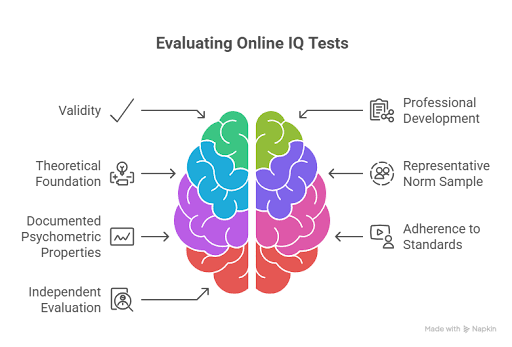
Generally, several characteristics make achieving high validity in psychological tests more likely:
Professional development. They're created by psychologists or psychometricians with expertise in test construction. The creator's identity and credentials are clearly disclosed.
Theoretical foundation. They're based on established theories of intelligence, such as the Cattell-Horn-Carroll model that guides most modern intelligence testing.
Representative norm sample. Scores are compared to a norm sample that actually represents the population. This means the norm sample was recruited systematically, not self-selected from people who happened to take the test.
Documented psychometric properties. Reliability and validity evidence exists, typically in technical manuals or published research. The test experienced pilot testing, item analysis, and revision before release.
Adherence to standards. Development followed guidelines from professional organizations. The Standards for Educational and Psychological Testing outline expectations that legitimate test creators follow.
Independent evaluation. Outside experts have reviewed the test, and it has been used in peer-reviewed research.
The Invalid Online Test
The vast majority of online IQ tests are created by people with no training in psychological assessment. They have no representative norm sample, no reliability data, no validity evidence, and no accountability. These tests produce numbers that look authoritative but are scientifically meaningless.
Common problems with amateur online tests:
Terrible norm samples. Most don't have a representative norm sample. Examinees’ scores get compared to the scores from other people who took the same online test. This is a self-selected group that doesn't represent any meaningful population.
No quality control. Items aren't piloted or statistically analyzed before inclusion. There's no screening for bias. Questions might be ambiguous, have multiple correct answers, or be unsolvable.
Arbitrary scoring. The conversion from raw scores to IQ is often arbitrary and unclear. Many illegitimate tests do not provide any justification for why answering a given number of questions correctly results in a given IQ score.
Inflated scores. Many online tests deliberately inflate scores to make test takers feel good and share results on social media. An average person might score "140" and believe they're gifted when they're actually getting above-average results on an easy test.
No accountability. Creators are often anonymous or use pseudonyms. When the test produces nonsense, no one can be held responsible.
Why Most Online Tests Fail
Creating a valid psychological test is expensive and time-consuming. It requires expertise, pilot testing with hundreds of participants, statistical analysis, norm sample recruitment, and ongoing research. This process takes a lot of time and costs significant money.
Most online "IQ tests" are created by individuals with no budget, no training, and no understanding of what makes a test valid. They're programming projects or blog content, not scientific instruments.
Creating a few puzzles that seem to require intelligence is not the same as building a test with documented measurement properties. It's like the difference between a homemade thermometer and one used in a laboratory—one might give you a rough idea of temperature, but only the calibrated instrument provides meaningful data.
The Culture-Fair Test Myth
Some online tests claim to be "culture-fair" or "culture-free" because they use abstract patterns instead of verbal content. These claims are misleading.
Research shows that nonverbal tests still contain cultural content. Familiarity with geometric shapes, comfort with multiple-choice formats, and experience with test-taking all vary across cultures. These tests don't eliminate group differences, and they can function poorly in populations with limited exposure to formal testing.
More importantly, "culture-fair" doesn't mean "valid." A test can be equally unfair to everyone and still be useless.
When Validity Matters
For some purposes, test validity is critical:
• Legal proceedings
• Disability determination
• Clinical diagnosis
• Custody evaluations
For these purposes, a test administered by a licensed professional either in person or via a video call. No online test—even a valid one—satisfies these requirements. The stakes are too high to rely on self-administered assessment.
For personal curiosity and for low- or medium-stakes decisions (such as when an IQ test is one source of data out of many considered for a hiring decision), a professionally-developed, validated online IQ test can be sufficient. But before investing time and potentially money on a test, it is important to ensure that it will produce accurate information. Invalid tests waste examinees’ time and potentially mislead them about your strengths and weaknesses.
How to Identify Valid Online Tests
Before taking an online IQ test, investigate:
Who created it? Search for the creator's name and credentials. Legitimate test creators have advanced degrees in psychology or related fields and are proud to attach their names to their work. Anonymous tests should be avoided.
Is there a norm sample? Look for information about how scores are calculated and what comparison group is used. If this information isn't clearly provided, that's a red flag.
Has it been independently evaluated? Search for the test name in Google Scholar. If it appears in peer-reviewed research, that's evidence of legitimacy.
What do the reviews say? Look for reviews from psychologists or testing experts, not just user testimonials.
Does it cost money? This is not a perfect indicator, but professional test development is expensive. Be suspicious of comprehensive "professional" tests that are completely free. Either they are not actually professional, or the company is monetizing your data in other ways.
A Professional Online Option
The Reasoning and Intelligence Online Test (RIOT) is the first online IQ test that meets professional standards for psychological assessment. Created by Dr. Russell Warne, who has over 15 years of experience in intelligence research, it underwent the same rigorous development process as traditional in-person tests: expert review, the first ever representative online norm sample of Americans, and adherence to testing standards from the American Educational Research Association, American Psychological Association, and the National Council on Measurement in Education.
The RIOT demonstrates that valid online IQ testing is possible when developers follow scientific standards and invest in proper test construction.
Article Categories
All ArticlesUnderstanding IQ ScoressTaking an IQ TestRIOT-Specific InformationGeneral IQ & IntelligenceAdvanced Topics & ResearchIQ Scores & InterpretationMensa & High-IQ SocietiesOnline IQ Tests IQ Test Basics & FundamentalsAverage IQ & DemographicsFamous People & IQHistory & Origins Of IQ TestingAccuracy, Reliability & CriticismSpecial Population & Related ConditionsImproving IQ / PreparationSpecific IQ Tests & Formats
Related Articles
Take our IQ testsCompare all tests
Basic IQ Test
5 subtests + 5 cognitive abilities
Features
- ~13 Minutes
- IQ score
- Cognitive abilities breakdown
- ±5.6 IQ margin of error
5/15 Subtests
Learn moreVocabulary
Matrix Reasoning
SToVeS
Visual Reversal
Symbol Search
Full IQ Test
15 subtests + all cognitive abilities
Features
- ~52 Minutes
- IQ score
- Cognitive abilities breakdown
- ±3.7 IQ margin of error
15/15 Subtests
Learn moreVocabulary, Information, Analogies
Matrix Reasoning, Visual Puzzles, Figure Weights
Object Rotation, SToVeS, Spatial Orientation
Computation Span, Exposure Memory, Visual Reversal
Symbol Search, Abstract Matching
Simple Reaction Time, Choice Reaction Time

Community
Intelligence Journals & Organizations
News & Press
Our Articles
Our Articles
Our Articles
Our Articles
Our Articles