Jun 9, 2026·IQ Testing for HR & RecruitmentExploring the Link Between IQ and Success
Does a high IQ guarantee wealth, health, or a great career? Discover the proven link between IQ and success. Read the article and try the RIOT test!
Dr. Russell T. WarneChief Scientist
Few topics in psychology spark as much curiosity — or as much confusion — as the relationship between intelligence and success. People want to know whether being smarter translates into a better life. They want to understand what the research actually shows, not what popular culture implies. And they want an honest account of where IQ matters, where it matters less, and where the picture gets complicated.
After more than 15 years studying human intelligence, I can say that this is a topic where the data are genuinely interesting and where the popular narrative often misses important nuances. IQ is a real and meaningful predictor of many important life outcomes — but it is not destiny, and understanding what the research shows requires looking at the evidence carefully and resisting the temptation to oversimplify.
This article surveys what is known about IQ and success across several domains: academic achievement, occupational performance, income, and health and longevity. Along the way, it examines how IQ fits alongside other predictors and what its limits are.
What does "success" mean in this research?
Before exploring the data, it is worth being clear about how researchers define and measure success. In most studies, success is operationalized in terms of outcomes that are measurable and comparatively objective: academic grades, occupational level, income, job performance ratings, and health metrics. These are not the only ways to define a meaningful life, but they are the outcomes that large-scale longitudinal studies can track across years and decades. The research reviewed in this article uses these concrete, measurable definitions.
IQ and academic achievement
The connection between IQ and academic performance is one of the best-established findings in all of educational psychology. A comprehensive meta-analysis by Roth et al. (2015), based on 240 studies, found a mean corrected correlation of ρ = .54 between general intelligence and school grades. That is a strong relationship in the behavioral sciences. For mathematics and science subjects, the correlations were even higher. This finding makes intuitive sense. Learning is, at its core, a cognitive process. Students who can absorb new information more quickly, understand abstract concepts more readily, and apply prior knowledge to new problems are going to perform better on academic assessments. This is not to say that motivation, study habits, and personality traits are irrelevant — they contribute meaningfully. But intelligence is the strongest single predictor of how well students perform academically.
It is also worth noting that the relationship between IQ and academic outcomes is bidirectional to some extent. Schooling itself appears to raise IQ to a modest degree, with one well-regarded meta-analysis estimating roughly 1 to 5 IQ points gained per additional year of education. The relationship between intelligence and learning is not a simple one-way street. The IQ-academic achievement correlation has important implications beyond school performance. Academic achievement is a gateway variable. Educational credentials open access to occupational tracks, professional training programs, and social networks that shape a person's entire career trajectory. This means that even if IQ's direct effect on income and occupational status is moderate, its indirect effects — operating through educational attainment — are substantial.
IQ and occupational attainment
The relationship between intelligence and occupational attainment is robust across decades of research. People with higher IQ scores are, on average, more likely to enter prestigious occupations, advance within their fields, and perform their jobs at a higher level. There are several reasons for this.
First, many high-status occupations have formal gatekeeping mechanisms that are correlated with IQ, including educational requirements, professional licensing examinations, and competitive admissions to graduate and professional schools. Second, cognitively demanding jobs require the ability to learn quickly, adapt to new situations, and handle complex information — all of which are core components of general intelligence. Third, performance on the job itself is predicted by intelligence independent of educational qualifications.
The most influential research on this topic is Frank Schmidt and John Hunter's 1998 meta-analysis, published in the Psychological Bulletin, which synthesized approximately 85 years of research on personnel selection. Their finding was clear: general mental ability is the single best predictor of job performance across virtually all occupations, with an estimated validity coefficient of r = .51. For training performance — how quickly employees learn the knowledge required to do their jobs — the validity was even higher at r = .56. For professional and managerial positions, the validity reached r = .58. It is worth noting that subsequent research has debated the precise magnitude of these estimates, particularly regarding statistical corrections for range restriction. A more recent analysis by Sackett et al. (2022) produced somewhat lower estimates in the range of r = .31 to .42. The exact coefficient remains a subject of ongoing technical discussion, but the fundamental finding — that cognitive ability is the strongest generalizable single predictor of job performance — has not changed. Other selection methods, such as work sample tests and structured interviews, add incremental value when combined with cognitive assessments, but none replaces the predictive power of general intelligence when looking across a broad range of jobs.
IQ and job complexity
One of the most replicable moderators in the IQ-performance literature is job complexity. The relationship between intelligence and performance is stronger for complex jobs than for routine ones. This makes theoretical sense: a job that requires constant problem-solving, adapting to novel situations, and managing large amounts of information draws more heavily on general cognitive ability than one with predictable, well-practiced tasks.
Hunter and Hunter's earlier estimates suggested validity coefficients of .56, .50, and .39 for high, medium, and low complexity jobs, respectively. Updated analyses by Schmidt et al. (2008) using refined statistical corrections raised these to .68, .62, and .50. Even for the least complex occupational category, general intelligence remained a meaningful predictor. The pattern reflects a consistent principle: as job demands on cognitive resources increase, the advantage of higher intelligence grows.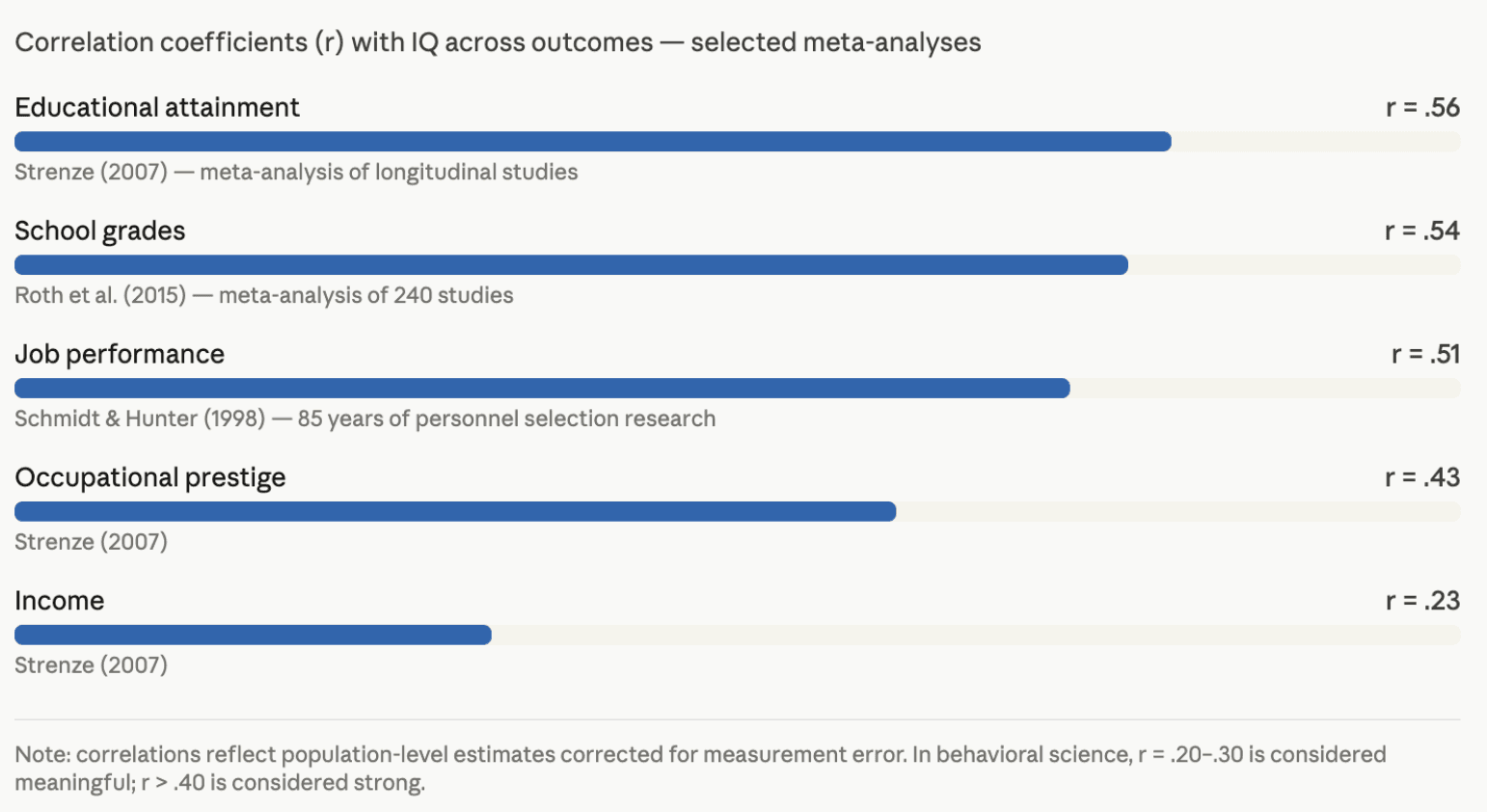
IQ and income
Income is one of the most studied outcomes in the literature on IQ and success. The consistent finding is that IQ and income are positively correlated, but the relationship is not as strong as many people assume, and it is importantly different from the relationship between IQ and job performance.
Jay Zagorsky's (2007) study using the National Longitudinal Survey of Youth (NLSY79) — a nationally representative sample of American baby boomers — found that each one-point increase in IQ was associated with an income increase of approximately $234 to $616 per year after controlling for relevant demographic factors. That is a real and meaningful relationship. Over a career, that adds up. However, the same study found no statistically significant relationship between IQ and net worth, and the correlation between IQ and wealth was notably weaker than the correlation between IQ and income. This pattern reflects an important distinction. IQ predicts earnings reasonably well, partly because it predicts the types of occupations people enter and how well they perform in those occupations. But earnings do not automatically translate into wealth. Wealth accumulation depends heavily on financial behavior — saving rates, investment decisions, spending patterns — and high intelligence is not a reliable predictor of those behaviors.
A broader meta-analysis by Strenze (2007), published in the journal Intelligence, synthesized longitudinal research from multiple countries and found that intelligence predicted educational attainment (r = .56), occupational prestige (r = .43), and income (r = .23). These correlations are meaningful and statistically robust, but they also show that intelligence is a stronger predictor of educational and occupational outcomes than of income per se. Other variables — including parental socioeconomic status, educational attainment, and personality traits — also contribute meaningfully to income.
IQ and health
One of the more surprising findings in intelligence research over the past few decades is how strongly IQ predicts health outcomes. This work has given rise to an entire subfield called cognitive epidemiology, pioneered largely by Ian Deary and colleagues at the University of Edinburgh.
The foundational study used data from the Scottish Mental Survey of 1932, in which nearly all children born in Scotland in 1921 were tested on a cognitive ability measure at age 11. Decades later, researchers traced who was still alive. The findings, published by Whalley and Deary (2001), were striking: a 15-point IQ advantage (one standard deviation) translated into a 21% greater probability of surviving to age 76. A person with an IQ of 115 was 21% more likely to be alive at that age than a person with an IQ of 100. This finding has since been replicated in more than 20 longitudinal studies across multiple countries, including Australia, Denmark, Sweden, the United States, and several Scottish cohorts. The association between higher IQ in childhood or young adulthood and lower mortality risk is now one of the most consistent findings in cognitive epidemiology. The relationship extends beyond mortality to specific diseases. Lower IQ is associated with higher rates of cardiovascular disease, certain cancers, and other chronic conditions. A study using the NLSY79 dataset found that higher intelligence in youth predicted better physical health at age 50, including lower rates of cardiovascular conditions, with odds ratios for specific conditions ranging from 0.59 for stroke to 0.80 for high blood pressure per standard deviation advantage in IQ. Why does this relationship exist? Several mechanisms have been proposed. One is that intelligence helps people navigate complex health information, adhere to treatment regimens, and make better decisions about diet, exercise, and lifestyle. Another is the "system integrity" hypothesis, which holds that brains and bodies are not independent systems, and that the same underlying biological factors that support efficient cognitive function may also support physical health. Both mechanisms likely play a role. Social class partially mediates the relationship — higher IQ predicts better socioeconomic outcomes, which in turn support better health — but the IQ-health association persists even after controlling for socioeconomic variables.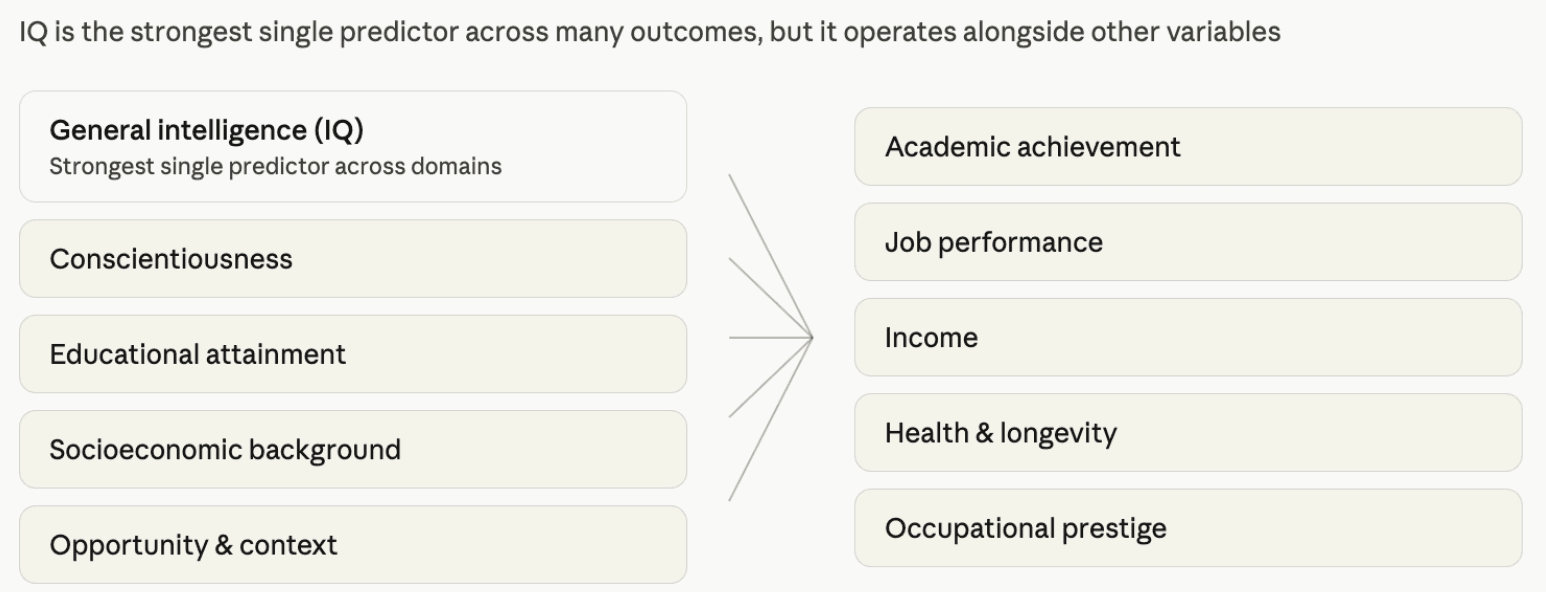
IQ as a predictor: a probabilistic, not deterministic, relationship
One of the most important things to understand about IQ and success is that the relationship is probabilistic, not deterministic. IQ does not guarantee any outcome. High intelligence is a tailwind — it increases the probability of favorable outcomes and decreases the probability of negative ones — but it is one factor among many.
The correlations reviewed in this article leave substantial variance unexplained. An IQ-job performance correlation of r = .51 means that IQ accounts for roughly 26% of the variance in job performance. The remaining 74% is explained by other factors: conscientiousness, job-specific knowledge, interpersonal skills, organizational fit, opportunity, and many others. Similarly, the correlation between IQ and income accounts for only about 5% of income variance — meaning that the vast majority of what determines individual income is not captured by IQ alone.
Non-cognitive characteristics — work ethic, reliability, the ability to form relationships, and the capacity to persist through setbacks — matter substantially and can compensate for lower cognitive ability, at least up to a point. Research suggests that in employment contexts, these characteristics can compensate for roughly 7 to 10 IQ points depending on the job. There is a limit to compensation, though. Some occupational tracks have genuine cognitive floors below which performance becomes unreliable, and no amount of persistence will substitute for the cognitive prerequisites of a given field.
What the data do not show
It is worth addressing some common overgeneralizations about IQ and success, because the popular narrative often goes further than the evidence supports.
First, IQ does not predict wealth accumulation to any meaningful degree, as discussed in the income section above. Wealth is determined far more by financial behavior, inheritance, and life circumstances than by raw cognitive ability. Notably, highly intelligent individuals are not immune to financial distress.
Second, higher IQ is not associated with greater happiness or life satisfaction in any consistent way. The research on this is mixed, and whatever effects exist are small. Happiness is shaped primarily by factors that are largely orthogonal to cognitive ability: social relationships, physical health, meaningful work, and a sense of purpose.
Third, IQ does not protect against all negative outcomes. Some conditions, including high-functioning autism and certain eating disorders, appear to be somewhat more common in higher-IQ populations — a reminder that intelligence is not a simple index of wellbeing.
Putting the evidence together
The accumulated evidence across education, occupational research, economics, and epidemiology points in a consistent direction: IQ is the strongest single generalizable predictor of performance and attainment across a wide range of important life domains. The relationship is strongest for academic achievement and cognitively demanding job performance. It is moderate for occupational prestige and income. It is real but more complex for health. And it is weak or absent for wealth and subjective wellbeing.
Understanding IQ in this way — as a meaningful but bounded predictor, strongest for cognitively intensive outcomes — avoids both the error of dismissing intelligence as irrelevant (a position at odds with the data) and the error of treating it as fate. It is an accurate view, and a practically useful one.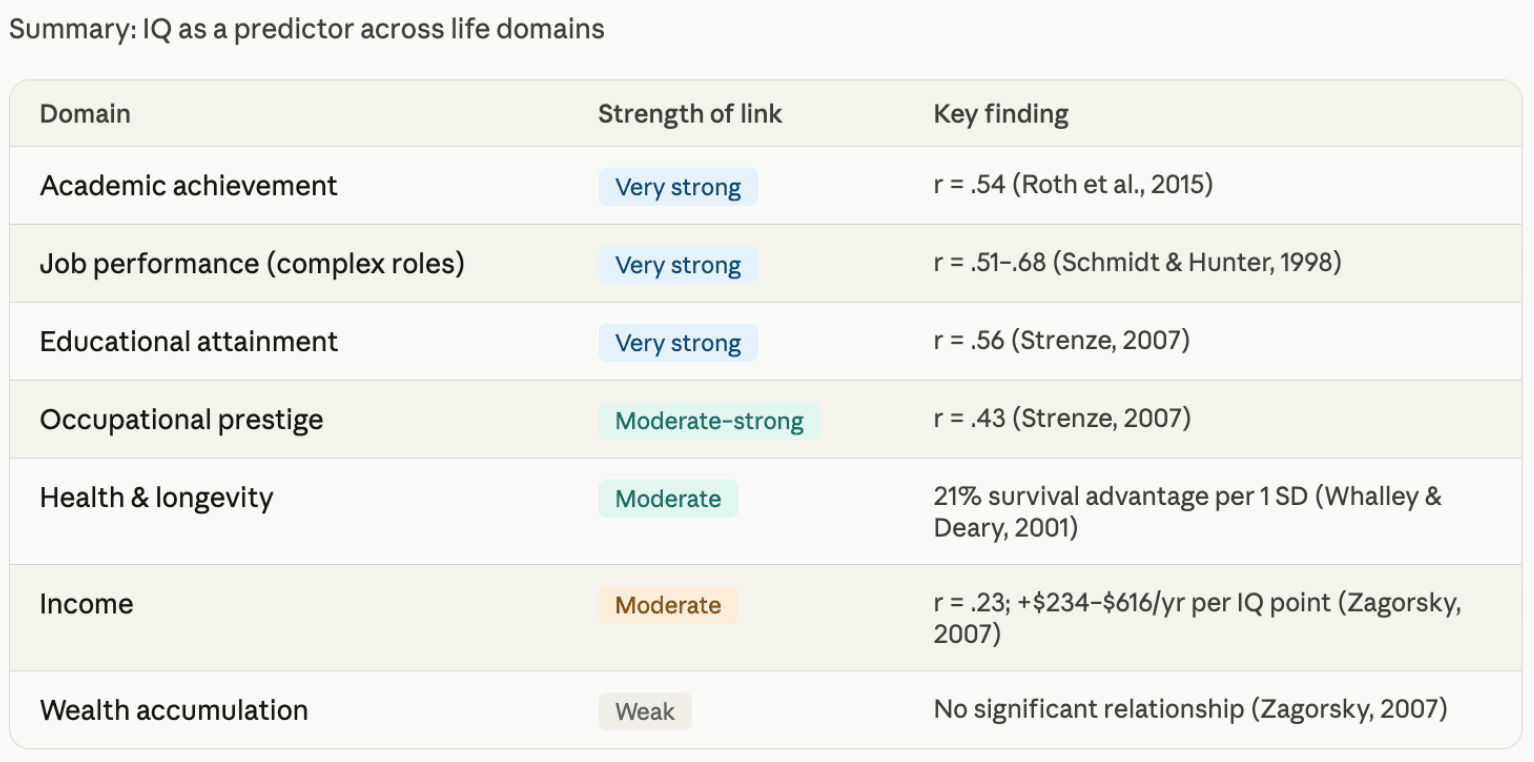
Take the First Ever Professional Online IQ Test
Understanding the link between intelligence and success starts with actually knowing where one stands. That requires a reliable measure — not one of the informal quizzes that populate the internet, but a test developed to professional standards.
The Reasoning and Intelligence Online Test (RIOT) is the first online IQ test designed to meet the technical and ethical standards established by the American Educational Research Association, the American Psychological Association, and the National Council on Measurement in Education. It was developed using the same rigorous process as traditional IQ tests administered by psychologists in clinical and research settings: expert review panels, extensive item piloting, and a representative U.S. norm sample — the first of its kind for an online IQ test. The RIOT was created after more than 15 years of my own research in intelligence and psychological measurement, and it measures a broad range of cognitive abilities in line with the Cattell-Horn-Carroll theory of intelligence. For anyone interested in an accurate, professionally grounded assessment of their cognitive abilities, the RIOT provides exactly what most online tests cannot: a score that means something.
References
Roth, B., Becker, N., Romeyke, S., Schäfer, S., Domnick, F., & Spinath, F. M. (2015). Intelligence and school grades: A meta-analysis. Intelligence, 53, 118–137. https://doi.org/10.1016/j.intell.2015.01.001 Schmidt, F. L., & Hunter, J. E. (1998). The validity and utility of selection methods in personnel psychology: Practical and theoretical implications of 85 years of research findings. Psychological Bulletin, 124(2), 262–274. https://doi.org/10.1037/0033-2909.124.2.262 Strenze, T. (2007). Intelligence and socioeconomic success: A meta-analytic review of longitudinal research. Intelligence, 35(5), 401–426. https://doi.org/10.1016/j.intell.2006.09.004 Zagorsky, J. L. (2007). Do you have to be smart to be rich? The impact of IQ on wealth, income and financial distress. Intelligence, 35(5), 489–501. https://doi.org/10.1016/j.intell.2007.02.003 Whalley, L. J., & Deary, I. J. (2001). Longitudinal cohort study of childhood IQ and survival up to age 76. British Medical Journal, 322, 819–823. https://doi.org/10.1136/bmj.322.7290.819 Gottfredson, L. S., & Deary, I. J. (2004). Intelligence predicts health and longevity, but why? Current Directions in Psychological Science, 13(1), 1–4. https://doi.org/10.1111/j.0963-7214.2004.01301001.x Deary, I. J., Batty, G. D., & Gale, C. R. (2021). Intelligence, health and death. Nature Human Behaviour, 5, 416–430. https://doi.org/10.1038/s41562-021-01078-9 Wraw, C., Deary, I. J., Gale, C. R., & Der, G. (2015). Intelligence in youth and health at age 50. Intelligence, 53, 23–32. https://doi.org/10.1016/j.intell.2015.08.001 Hunter, J. E., & Hunter, R. F. (1984). Validity and utility of alternative predictors of job performance. Psychological Bulletin, 96(1), 72–98. https://doi.org/10.1037/0033-2909.96.1.72 Sackett, P. R., Zhang, C., Berry, C. M., & Lievens, F. (2022). Revisiting meta-analytic estimates of validity in personnel selection: Addressing systematic overcorrection for restriction of range. Journal of Applied Psychology, 107(11), 2040–2068.
Schmidt, F. L., & Hunter, J. E. (2004). General mental ability in the world of work: Occupational attainment and job performance. Journal of Personality and Social Psychology, 86(1), 162–173. https://doi.org/10.1037/0022-3514.86.1.162 Gottfredson, L. S. (1997). Why g matters: The complexity of everyday life. Intelligence, 24(1), 79–132. https://doi.org/10.1016/S0160-2896(97)90014-3 Neisser, U., Boodoo, G., Bouchard, T. J., Jr., Boykin, A. W., Brody, N., Ceci, S. J., … Urbina, S. (1996). Intelligence: Knowns and unknowns. American Psychologist, 51(2), 77–101. https://doi.org/10.1037/0003-066X.51.2.77 Ritchie, S. J., & Tucker-Drob, E. M. (2018). How much does education improve intelligence? A meta-analysis. Psychological Science, 29(8), 1358–1369. https://doi.org/10.1177/0956797618774253 Carroll, J. B. (1993). Human cognitive abilities: A survey of factor-analytic studies. Cambridge University Press. https://doi.org/10.1017/CBO9780511571312 Lubinski, D. (2004). Introduction to the special section on cognitive abilities: 100 years after Spearman's (1904) 'General intelligence,' objectively determined and measured. Journal of Personality and Social Psychology, 86(1), 96–111. https://doi.org/10.1037/0022-3514.86.1.96 Hauser, R. M. (2010). Causes and consequences of cognitive functioning across the life course. Educational Researcher, 39(2), 95–109. https://pmc.ncbi.nlm.nih.gov/articles/PMC3289095/ Salgado, J. F., Moscoso, S., & Berges, A. (2013). Conscientiousness, its facets, and the prediction of job performance ratings: Evidence against the narrow measures. International Journal of Selection and Assessment, 21(1), 74–84.
Warne, R. T. (2020). In the know: Debunking 35 myths about human intelligence. Cambridge University Press. https://doi.org/10.1017/9781108593298 Herrnstein, R. J., & Murray, C. (1994). The Bell Curve: Intelligence and class structure in American life. Free Press.
Take our professional IQ test
Want to know your IQ? Try the first ever professional online IQ test.
AuthorDr. Russell T. WarneChief Scientist
