Jun 9, 2026·IQ Testing for HR & RecruitmentHow IQ Tests Are Used in Professional Settings
Discover how schools, employers, and courts use cognitive assessments for high-stakes decisions. Read the full article and try the RIOT IQ test today!
Dr. Russell T. WarneChief Scientist
IQ tests were not designed for curiosity. They were built to answer specific questions in specific situations where cognitive ability matters — and where an accurate, defensible measurement of that ability has real consequences. A psychologist deciding whether a child qualifies for special education services, a military branch determining which recruits can handle advanced training, or a court weighing whether an inmate can face execution all need more than a rough impression of a person's intelligence. They need a rigorous, standardized measure that can be scrutinized, interpreted, and defended. Understanding where and how IQ tests are used in professional settings helps clarify why the field of psychometrics exists at all. Test quality is not an abstract concern. It has direct implications for the decisions that hinge on IQ data — and for the people those decisions affect.
IQ Testing in Educational Settings
Schools are by far the most common institutional users of IQ tests. In the United States, federal law under the Individuals with Disabilities Education Act (IDEA) mandates that children suspected of having a disability receive a comprehensive evaluation that includes cognitive assessment. This legal framework makes IQ testing a routine part of how schools identify children who qualify for special education services, gifted programs, and related interventions.
The most common educational use of IQ tests is in diagnosing specific learning disabilities. A learning disability is not simply low academic achievement — it is a meaningful gap between a child's cognitive ability and their academic performance that cannot be explained by other factors such as inadequate instruction or sensory impairment. For decades, the standard approach was the Ability-Achievement Discrepancy (AAD) model: if a student's IQ was significantly higher than their score on an academic achievement test, that discrepancy provided evidence of a learning disability. When IDEA was reauthorized, additional identification methods were added, including models that examine specific cognitive processing weaknesses — such as working memory or processing speed deficits — rather than relying on a global IQ-achievement gap alone. IQ tests are also used to identify students with intellectual disability (ID). The standard diagnostic criteria require three things: significantly below-average intellectual functioning, typically indicated by an IQ score two or more standard deviations below the mean (roughly 70 or below); significant limitations in adaptive behavior across conceptual, social, and practical domains; and onset before age 18. A child with an IQ of 65 who functions well independently in daily life would not meet the criteria. Conversely, a child whose adaptive functioning is severely limited but whose IQ falls just above the cutoff may still qualify, depending on the full assessment and clinical judgment involved.
 At the other end of the ability spectrum, schools use IQ tests to identify gifted students for accelerated and enrichment programs. Cutoffs vary by state and district, but a score of approximately 130 — roughly the 98th percentile — is commonly used as a qualifying threshold. States differ substantially in how they define giftedness, and some allow multiple pathways to qualification, but IQ remains one of the most widely used criteria.
IQ Testing in Employment Settings
The largest single employer using cognitive ability testing in the United States is not a corporation — it is the military. The Armed Services Vocational Aptitude Battery (ASVAB) is administered to virtually all military recruits. Although the ASVAB is not labeled an IQ test, its Armed Forces Qualification Test (AFQT) composite functions as one. It measures verbal and quantitative reasoning and produces scores that correlate strongly with established measures of general intelligence. The military uses it because cognitive ability predicts training success and job performance across virtually all occupational specialties — and the validity of ASVAB scores for predicting job-specific performance remains stable even as soldiers gain experience over time. Outside the military, civilian employers use cognitive ability tests less frequently, but the practice is well established in certain industries and roles. Financial services, technology, consulting, and any field requiring rapid learning and complex problem-solving tend to rely more heavily on cognitive screening than industries where job tasks are routine and rule-based.
The reason employers use these tests is straightforward. Meta-analyses spanning decades of research consistently show that general cognitive ability is one of the strongest individual predictors of job performance across occupational categories. A meta-analytic validity coefficient of approximately 0.51 for medium-complexity jobs has been widely cited, though recent methodological work by Sackett and colleagues has argued that some older meta-analyses overcorrected for range restriction, placing the true operational validity somewhat lower. The debate over the exact magnitude of the relationship does not change the practical conclusion: cognitive ability tests consistently predict job performance at levels that justify their use in selection decisions.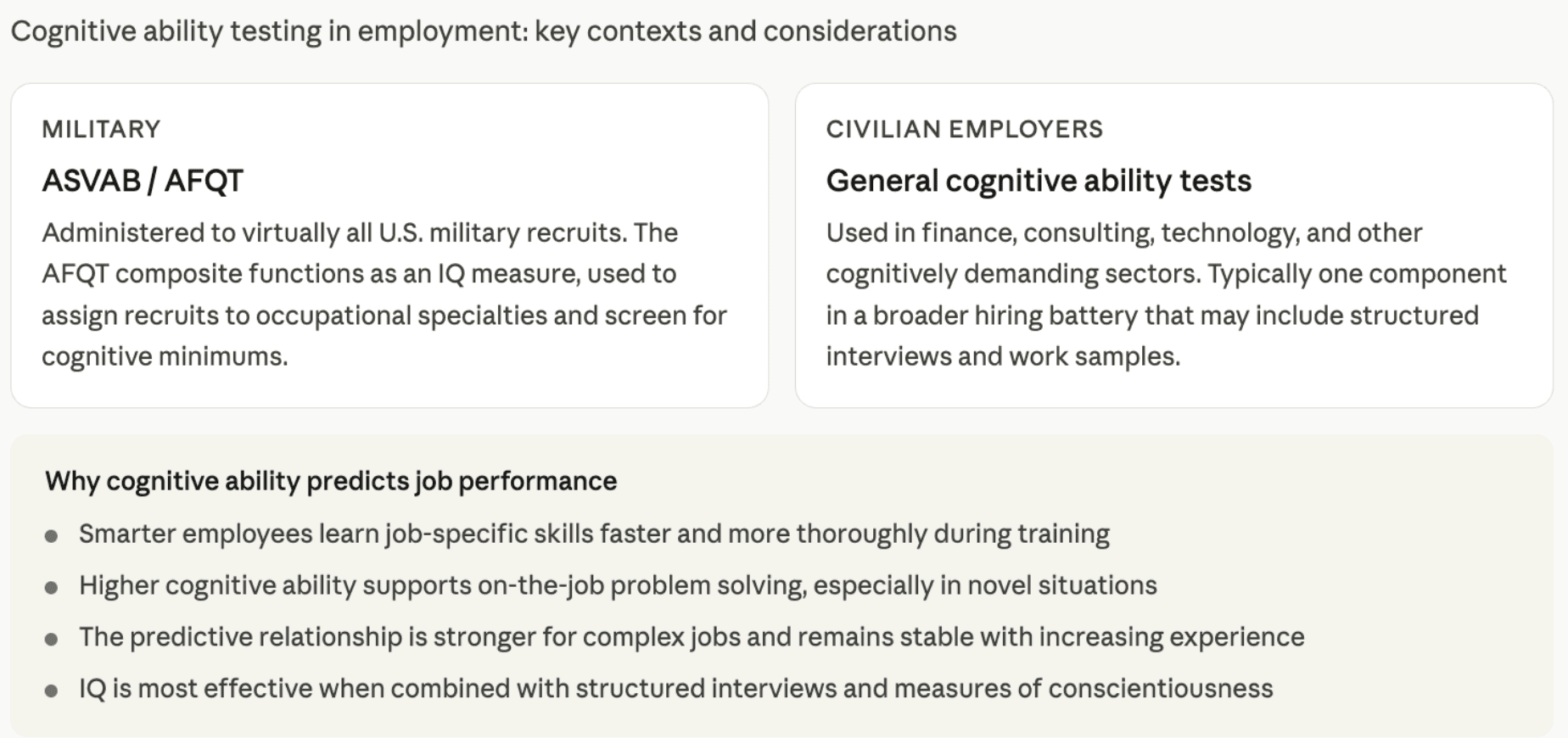 The predictive validity of cognitive ability is stronger for more complex jobs and weaker for simpler ones — though even at lower job complexity levels, the relationship remains positive and practically meaningful. The validity is also not uniform across all performance criteria. General cognitive ability predicts training performance and task performance particularly well. Other criteria, such as organizational citizenship behavior or adaptability, may be better captured by personality measures or structured interviews. Cognitive ability is one component of a complete employee picture, not the entire picture.
IQ Testing in Clinical Settings
Mental health professionals use IQ tests for a range of clinical purposes that extend well beyond determining whether a number is high or low. A psychologist conducting a comprehensive psychological evaluation will often include cognitive testing as one component of a broader battery, alongside personality measures, behavioral rating scales, and structured clinical interviews. The goal is to understand the full profile of a person's functioning — not their intellectual ability in isolation.
In clinical practice, IQ data serves several distinct functions. First, it contributes to diagnostic decisions. Many psychiatric and neurodevelopmental diagnoses either require cognitive data or are informed by it. An autism spectrum disorder evaluation typically includes cognitive testing to establish the person's functional level and identify specific strengths and weaknesses. Attention-Deficit/Hyperactivity Disorder evaluations often incorporate IQ data to identify discrepancies between intellectual potential and academic or occupational performance. Dementia evaluations use serial cognitive assessments to track changes over time.
Second, cognitive testing provides information that directly affects treatment planning. Research has shown that the effectiveness of certain therapies can vary by a client's IQ level. Some therapeutic approaches require a minimum level of abstract reasoning and verbal comprehension to be effective. Knowing where a client falls cognitively helps clinicians adapt their approach — or choose a different modality entirely. Third, IQ data helps clinicians understand why a person is struggling in ways that are not immediately obvious from symptoms alone. A patient presenting with what looks like depression may have a specific cognitive processing weakness that makes certain everyday tasks disproportionately effortful — a distinction with different treatment implications than depression without a cognitive component.
Some practitioners also administer professionally developed tests such as the Reasoning and Intelligence Online Test (RIOT) to gain insight into a client's cognitive profile. Because the RIOT produces both a global IQ and subscores for discrete cognitive abilities, it can provide clinically meaningful data that goes beyond a single summary score.
IQ Testing in Forensic Settings
Forensic psychology sits at the intersection of mental health practice and the legal system, and IQ testing plays a consequential role across several contexts. Courts, correctional institutions, and parole boards all rely on psychological assessment data — including cognitive measures — to make decisions that can profoundly affect individuals' lives.
Competency to stand trial is one of the most common forensic uses of IQ testing. For a defendant to be tried, they must be able to understand the charges against them, appreciate the proceedings, and assist in their own defense. When a defendant's cognitive functioning is in question, psychologists are often appointed to conduct evaluations that include intelligence testing. A defendant with a significant intellectual disability may be found incompetent to stand trial and referred to a mental health facility for treatment rather than criminal prosecution.
Sentencing and mitigation evaluations are another major context. In capital cases, cognitive data can be directly relevant to determining appropriate punishment. The legal backdrop here is significant. In Atkins v. Virginia (2002), the U.S. Supreme Court ruled 6–3 that executing individuals with intellectual disability constitutes cruel and unusual punishment under the Eighth Amendment. For the first time, IQ scores became legally dispositive in capital cases — meaning a test result could determine whether a person lived or died.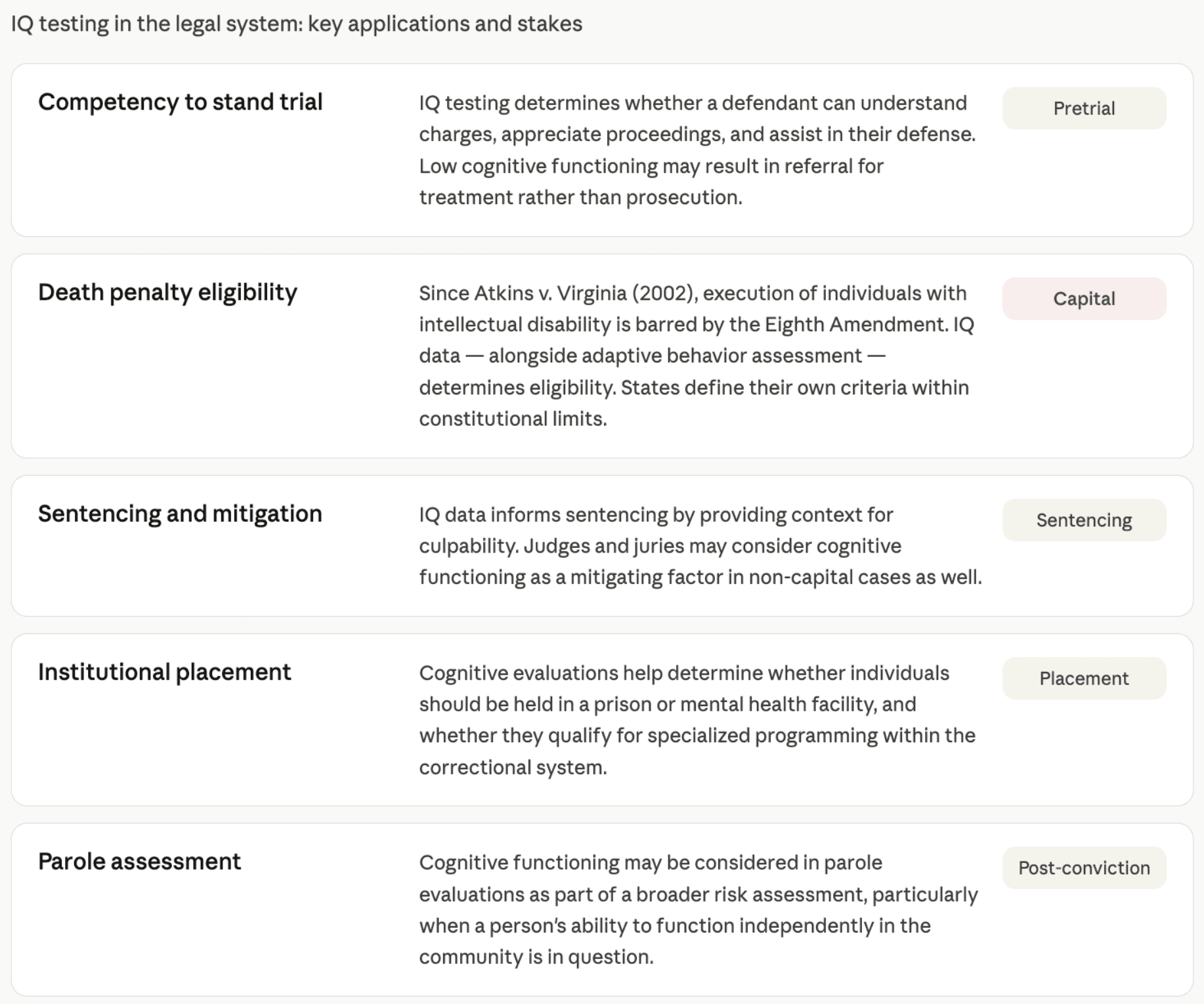 The Atkins ruling left the definition of intellectual disability to individual states, which created immediate inconsistencies. Some states adopted rigid numerical cutoffs — an IQ of 70 or below — with no allowance for the measurement error inherent in any psychological test. Since no IQ test produces a perfectly precise score, a person with a true IQ of 68 might score 72 on a given administration and be deemed eligible for execution under such a standard. The Supreme Court addressed this in Hall v. Florida (2014), ruling that states must account for the standard error of measurement rather than treating a single score as an absolute threshold. Moore v. Texas (2017) further reinforced that courts must apply current clinical standards — not lay stereotypes — when determining intellectual disability.
 The most recent development in this area is Hamm v. Smith, heard by the Supreme Court in December 2025. The case raised the question of how courts should weigh multiple IQ scores when a defendant has been tested several times and the scores cluster just above the 70 cutoff. Its ruling will affect how that data is interpreted across hundreds of capital cases for years to come.
What the Atkins line of cases makes clear is a principle that runs through all professional uses of IQ testing: a score is data, not a verdict. Forensic psychologists are expected to situate IQ scores within a comprehensive evaluation that includes adaptive behavior history, developmental records, and clinical observation. The number matters — but it does not resolve the question by itself.
IQ Testing in Research Settings
Research using IQ data has documented relationships between cognitive ability and health outcomes, longevity, economic security, criminal behavior, educational attainment, and occupational prestige. This body of work — spanning hundreds of studies published every year — has given psychologists a more thorough empirical understanding of intelligence than exists for almost any other individual human trait. Research also drives test improvement. Findings from validation studies, norm comparisons, and differential item functioning analyses are used to revise and update tests over time. The Flynn effect — the documented rise in average IQ scores over the 20th century — was discovered through large-scale IQ data and generated important insights into how environment shapes cognitive performance. The tests in use today are measurably better than those used 30 years ago, in part because research has systematically identified their weaknesses.
Why Professional Standards Matter in Every Setting
The decisions tied to IQ data in professional settings are serious: which children receive support services, which candidates are hired, which patients receive which treatments, and in capital cases, whether someone is executed. These stakes are why the Standards for Educational and Psychological Testing, published jointly by the American Educational Research Association, American Psychological Association, and National Council on Measurement in Education, establish what a professionally developed test must demonstrate before it is used in consequential decisions. A test that lacks a representative norm sample, documented reliability, or validity evidence for its intended use should not be administered in these settings — regardless of how it is marketed.Good practice also requires matching the level of interpretation to the level of the decision. A global IQ is highly relevant to questions about overall adaptive functioning in a forensic evaluation. In a clinical evaluation for a learning disorder, specific subtest scores often matter more than the global number, because cognitive profiles can reveal processing weaknesses that the overall score obscures. Overreaching in either direction — treating a single number as a complete answer, or dismissing score data altogether — produces worse outcomes than careful, calibrated interpretation.
Professional Online IQ Testing
For individuals outside institutional settings who want professionally developed cognitive assessment, the Reasoning and Intelligence Online Test (RIOT) was built to the same standards that govern tests used in schools, clinics, and courts. It is the first online IQ test to meet the technical and ethical guidelines established by the APA, AERA, and NCME — the same organizations whose standards are referenced throughout this article. The RIOT was developed by Dr. Russell Warne after more than 15 years of intelligence research, reviewed by a panel of experts from cognitive, educational, and developmental psychology, and normed on a representative U.S. sample rather than a self-selected pool of internet users. It produces a global IQ alongside subscores for Verbal Reasoning, Fluid Reasoning, Spatial Ability, Working Memory, Processing Speed, and Reaction Time — the same multi-ability approach that CHC theory-based clinical and educational tests use. The difference is accessibility: meaningful cognitive data, available outside of a formal institutional evaluation.
Sources
Warne, R. T. (2025). Technical manual for the Reasoning and Intelligence Online Test, version 1.0. Riot IQ.
American Educational Research Association, American Psychological Association, & National Council on Measurement in Education. (2014). Standards for Educational and Psychological Testing. AERA.
Take our professional IQ test
Want to know your IQ? Try the first ever professional online IQ test.
AuthorDr. Russell T. WarneChief Scientist
