Jun 5, 2026·IQ Testing for HR & RecruitmentWhy Are IQ Tests Important for Career Development?
Does cognitive ability predict your earning potential and job performance? Learn why IQ matters for your career. Read the article and try the RIOT test!
Dr. Russell T. WarneChief Scientist
Most people associate IQ tests with school. What fewer people realize is that cognitive ability is one of the strongest predictors of career outcomes that psychologists have ever measured. Across industries and job types and decades of research, general intelligence shows influences who gets hired, who gets promoted, who earns more, and who performs well under pressure. This article explores what the research actually says about IQ and career development.
What does research say about IQ and job performance?
The foundational study on this question is Frank Schmidt and John Hunter's 1998 meta-analysis, which synthesized 85 years of research on personnel selection. It remains one of the most cited papers in industrial-organizational psychology. Their conclusion was unambiguous: general mental ability is the single best predictor of job performance and training success across virtually all occupations. Schmidt and Hunter found that general cognitive ability predicted job performance moderately strongly at r = .51. This is a strong finding in behavioral science, where correlations of .20 to .30 are often considered meaningful.
That finding's breadth is what makes it particularly important. The relationship held across job complexity levels, though it was stronger for more cognitively demanding work. Even for relatively routine jobs, general intelligence predicted performance at a meaningful level. This finding has been shown to hold, even when an employer is strongly motivated to help workers with below-average IQs succeed. A 2004 update by Schmidt and Hunter confirmed these findings and added nuance: the combination of general mental ability and a structured interview predicted job performance better than almost any other combination of selection tools. Integrity tests, conscientiousness measures, and work samples each added incrementally, but IQ still holds unique predictive power that other variables do not have.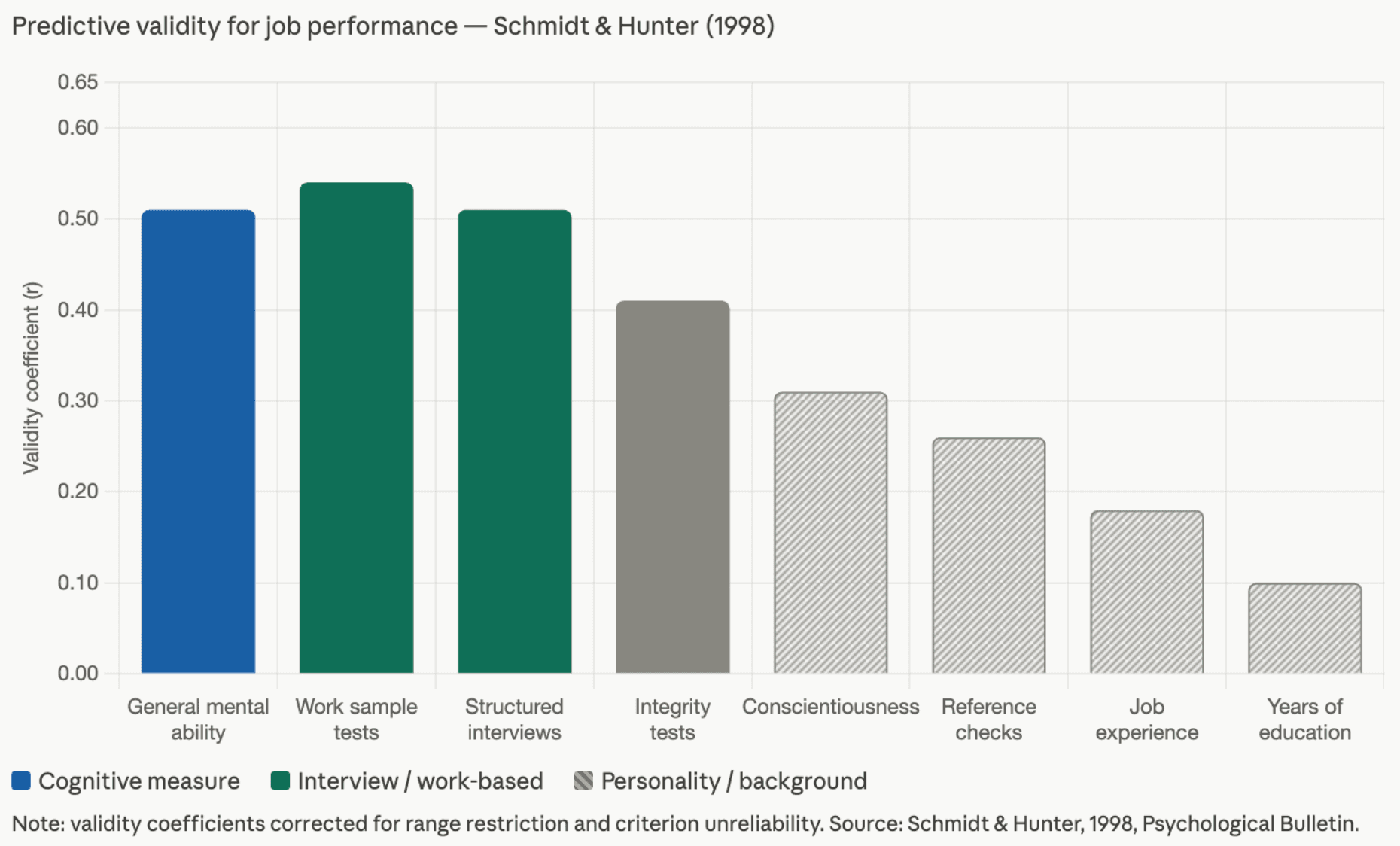 One point worth noting: work sample tests have a slightly higher raw validity coefficient than general mental ability in some analyses. But work sample tests are job-specific, expensive to administer at scale, and unavailable for hiring in entry-level positions. General intelligence tests are fast, inexpensive, and applicable across virtually every role, a combination of validity and practicality that explains their continued use.
How does IQ relate to earnings and occupational status?
The relationship between cognitive ability and income is one of the most consistent findings in labor economics. Cawley, Heckman, and Vytlacil (2001) showed that AFQT scores (which function as IQ proxies) predicted adult wages substantially, even after controlling for education. The wage premium associated with cognitive ability persisted across decades and was not explained away by schooling alone. The mechanism is not mysterious. Higher-paying jobs tend to have higher cognitive demands. They require faster learning, more complex problem-solving, and greater adaptability. Gottfredson (1997) summarized this clearly: the correlation between IQ and occupational prestige is approximately r = .65, making it one of the most powerful predictors of occupational attainment in the social sciences.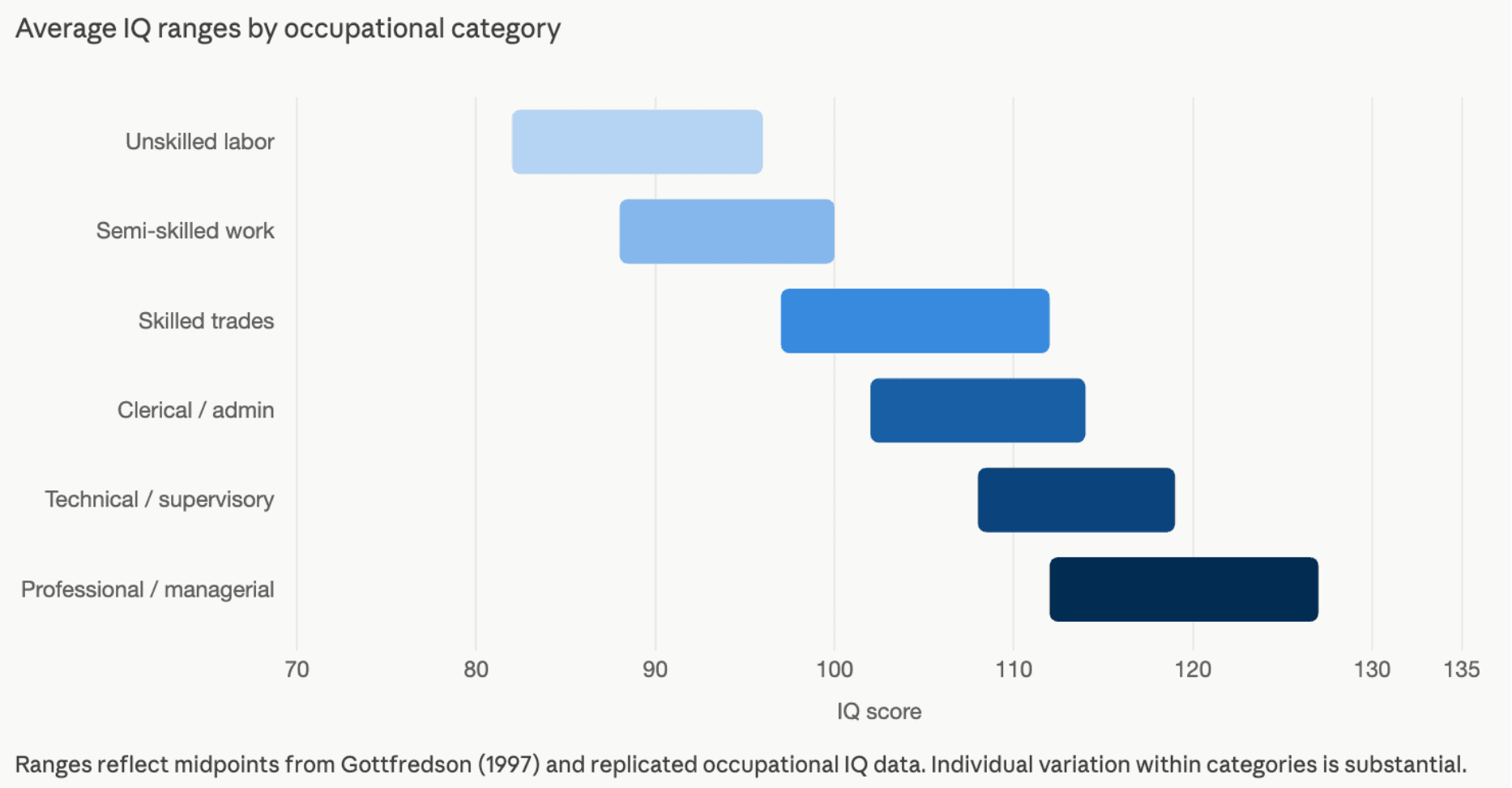 Some of this relationship is causal in both directions: cognitively able people tend to enter higher-paying careers, and those careers compound skill and experience over time. Part of it also reflects minimum thresholds. Many jobs have implicit IQ floors because their training demands require abstract reasoning and rapid learning that cannot be compensated for by motivation alone.
Is IQ relevant beyond entry-level hiring?
A reasonable objection to using IQ data in career contexts is that it might predict early success but become less relevant as workers develop domain expertise. The evidence does not support this view. Judge, Klinger, and Simon (2010) found that cognitive ability predicted career success across the full career span. Workers with higher cognitive ability showed steeper early learning curves and also demonstrated greater adaptability to new responsibilities and technological change over time. The Schmidt, Oh, and Shaffer (2016) meta-analysis reinforced this. In complex jobs (those involving novel problem-solving, ambiguous information, or frequent change) cognitive ability showed stronger predictive validity over time, not weaker. High-IQ workers tend to extract more learning from experience. They notice patterns faster, build richer mental models, and adapt to new demands more efficiently. For organizations, selecting for cognitive ability is therefore not just a short-term strategy for reducing training costs. It is an investment in long-run adaptability.
How does IQ affect learning speed and training outcomes?
One of the most consistent findings in personnel psychology is that cognitive ability predicts how quickly someone acquires new skills, which matters enormously in fast-moving industries and for organizations with expensive training programs.
Ree and Earles (1991) analyzed training outcomes across hundreds of Air Force specialties and found that general cognitive ability predicted training performance at r = .76 after correcting for statistical artifacts. That is an unusually high validity for any psychological predictor, and it held across technical specialties ranging from electronics and navigation to administration. The reason IQ predicts learning so strongly is that cognitive ability is essentially the capacity to process and integrate new information, form accurate mental models, and apply abstract principles to novel situations — which is precisely what training requires. A worker with higher cognitive ability will grasp new material faster, require fewer repetitions, and transfer learning more readily to new contexts.
Cognitive ability does not just raise the performance ceiling a worker eventually reaches. It also reduces the time needed to get there. A new hire who reaches full proficiency in three months costs considerably less than one who takes six. That efficiency compounds across an organization's entire workforce.
Does IQ predict leadership and management effectiveness?
Judge, Colbert, and Ilies (2004) conducted a meta-analysis specifically on IQ and leadership and found a corrected validity of r = .33, a moderate effect that is meaningful, but not overwhelming. The relationship between leader IQ and group performance tends to be stronger when leaders can actually apply their cognitive ability, such as complex, high-stakes situations where analytical thinking is required for good decision making. It is weaker when other structural factors constrain what any individual leader can accomplish.
What does IQ predict across different job types?
The predictive power of cognitive ability varies by job complexity. Simpler, routine jobs show weaker relationships with IQ; complex jobs show higher validity. If a job follows a fixed script and requires little judgment, cognitive ability matters less. If the job requires constant problem-solving and adaptation (as most professional careers do) cognitive ability matters considerably more.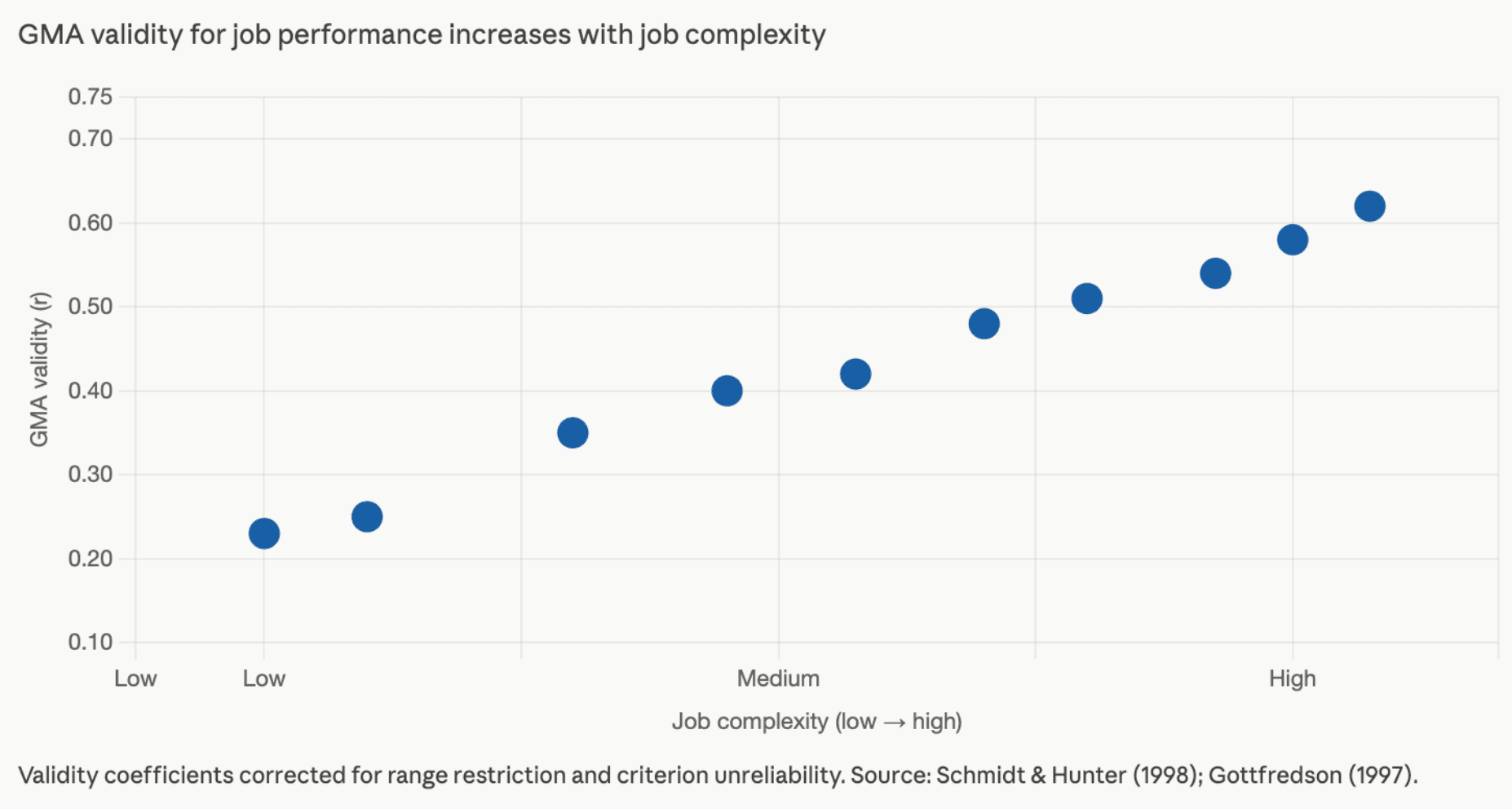 The U.S. military — the largest employer to use cognitive testing — recognized this gradient decades ago. The Armed Services Vocational Aptitude Battery uses minimum score thresholds that vary by military occupational specialty. Recruits who score above the 93rd percentile qualify for essentially any role. Recruits below the 10th percentile are barred by law from enlisting, a policy reflecting practical experience, not an arbitrary preference.
 Civilian employers have largely arrived at the same conclusion through workforce analytics: high-IQ hires require less supervision, commit fewer costly errors, and keep pace with changing technology more readily.
Does IQ matter for entrepreneurship and career adaptability?
The popular narrative of the successful dropout creates a misleading impression about cognitive ability's role in business success.
The data tell a different story. Gottfredson (1997) showed that IQ predicted both self-employment rates and business income among entrepreneurs. Starting and running a business is cognitively demanding: strategic planning, financial analysis, rapid learning across domains, identifying market patterns. Entrepreneurs with higher cognitive ability tend to build more durable businesses and achieve higher revenue growth.
What is sometimes true is that certain forms of execution (e.g., building a team, maintaining customer relationships, persisting through early failure) draw on non-cognitive traits that IQ does not guarantee. Conscientiousness and resilience contribute independently to entrepreneurial success. But there is no evidence that high IQ is a liability for entrepreneurship, and the data consistently show it is an asset.
Career adaptability follows a similar pattern. Workers with higher cognitive ability adapt more readily to technological displacement, complete retraining programs more successfully, and recover from job loss faster. In an era of rapid occupational change driven by automation, this form of cognitive flexibility has become more economically valuable, not less.
What are the limits of IQ as a career predictor?
IQ is not the only career-relevant variable. Several important qualifications apply.
First, motivation matters. A highly intelligent worker who exerts minimal effort will generally be outperformed by a less cognitively gifted but highly conscientious one. Second, domain expertise accumulates separately from IQ. A professional with twenty years of deep specialization has built a knowledge base that a cognitively able generalist cannot quickly replicate. IQ predicts how fast expertise is acquired and how flexibly it is applied, but experience confers real advantages, particularly in specialized fields.
Third, interpersonal skill matters for many roles. Sales, management, counseling, teaching, and client-facing positions all require the ability to build rapport and communicate persuasively. These abilities contribute to performance independently of cognitive ability and are not well captured by standard IQ tests.
The proper conclusion is not that IQ is unimportant, but that it is one powerful predictor among several. The Schmidt and Hunter meta-analysis showed that IQ is one of the best single predictors of job performance, but the best combination of predictors includes IQ alongside a structured interview, work samples, or integrity tests. Using IQ as one input in a multi-faceted assessment is both scientifically defensible and practically useful.
What does this mean for individuals thinking about their own career development?
Understanding the relationship between cognitive ability and career outcomes has practical implications that extend well beyond hiring decisions.
For individuals, an accurate picture of one's cognitive strengths enables better career planning. Someone with strong verbal reasoning but weaker spatial ability might find certain engineering roles frustrating, while excelling in writing-intensive professions. Someone with high processing speed and working memory might thrive in data-intensive roles that others find draining. A professional cognitive assessment does not just provide an IQ number. Rather, it provides a profile of abilities that can meaningfully inform these decisions.
This is not a deterministic argument. IQ is a predictor, not a destiny. Higher cognitive ability increases the likelihood of favorable outcomes; it does not guarantee them, and lower IQ does not preclude them. Hard work, domain expertise, interpersonal skill, and persistence all shift the probabilities. High IQ is a tailwind in life, not a guarantee of success. But knowing one's cognitive profile enables more realistic goal-setting, better identification of leverageable strengths, and greater self-awareness about areas where additional preparation or compensation strategies are warranted.
What should a professionally developed cognitive assessment include?
Given the value of cognitive assessment for career contexts, the quality of the instrument matters considerably. Not all IQ tests are equivalent, and in the online space in particular, the gap between professional and amateur tests is substantial.
Professionally developed assessments follow a rigorous process. They are created by credentialed experts, grounded in established scientific theory, normed on a representative sample of the intended population, screened for bias, and independently evaluated. They produce documented evidence of reliability and validity, and their authors are transparent about both the test's strengths and its limitations.
A test that meets these criteria can be used with confidence. One that does not, regardless of how polished its interface or how impressive its marketing, is providing data of unknown quality. In career contexts, where decisions are real and stakes are meaningful, that distinction matters.
Taking the first ever professional online IQ test
The Reasoning and Intelligence Online Test (RIOT) is the first online IQ test that meets professional standards for psychological assessment. It was developed by a professional intelligence researcher with over 15 years of experience in intelligence research, and it underwent the same rigorous development process as traditional individually administered IQ tests used by psychologists. What distinguishes the RIOT from the many online tests available is straightforward: expert development, the first ever representative U.S.-based norm sample for an online IQ test, expert review by a panel of cognitive, educational, and developmental psychologists, and adherence to the standards for educational and psychological testing established by the American Psychological Association, American Educational Research Association, and National Council on Measurement in Education.
The RIOT reports an overall IQ score alongside index scores for Verbal Reasoning, Fluid Reasoning, Spatial Ability, Working Memory, Processing Speed, and Reaction Time. This is the kind of granular cognitive profile that research has consistently linked to differential performance across career types.
References
Schmidt, F. L., & Hunter, J. E. (1998). The validity and utility of selection methods in personnel psychology. Psychological Bulletin, 124(2), 262–274. https://doi.org/10.1037/0033-2909.124.2.262
Schmidt, F. L., & Hunter, J. (2004). General mental ability in the world of work. Journal of Personality and Social Psychology, 86(1), 162–173. https://doi.org/10.1037/0022-3514.86.1.162
Gottfredson, L. S. (1997). Why g matters: The complexity of everyday life. Intelligence, 24(1), 79–132. https://doi.org/10.1016/S0160-2896(97)90014-3
Cawley, J., Heckman, J., & Vytlacil, E. (2001). Three observations on wages and measured cognitive ability. Labour Economics, 8(4), 419–442. https://doi.org/10.1257/000282802320191570
Ree, M. J., & Earles, J. A. (1991). Predicting training success: Not much more than g. Personnel Psychology, 44(2), 321–332. https://doi.org/10.1111/j.1744-6570.1991.tb00961.x
Judge, T. A., Colbert, A. E., & Ilies, R. (2004). Intelligence and leadership: A quantitative review. Journal of Applied Psychology, 89(3), 542–552. https://doi.org/10.1037/0021-9010.89.3.542
Judge, T. A., Klinger, R. L., & Simon, L. S. (2010). Time is on my side: Time, general mental ability, human capital, and extrinsic career success. Journal of Applied Psychology, 95(1), 92–107. https://doi.org/10.1037/a0017594
Schmidt, F. L., Oh, I. S., & Shaffer, J. A. (2016). The validity and utility of selection methods in personnel psychology. Fox School of Business Research Paper. https://doi.org/10.1177/0149206316668519
Ones, D. S., Dilchert, S., Viswesvaran, C., & Judge, T. A. (2007). In support of personality assessment in organizational settings. Personnel Psychology, 60(4), 995–1027. https://doi.org/10.1111/j.1744-6570.2007.00083.x
Duckworth, A. L., Quinn, P. D., Lynam, D. R., Loeber, R., & Stouthamer-Loeber, M. (2011). Role of test motivation in intelligence testing. Intelligence, 39(5), 315–324. https://doi.org/10.1016/j.intell.2011.07.001
Salgado, J. F., Anderson, N., Moscoso, S., Bertua, C., de Fruyt, F., & Rolland, J. P. (2003). A meta-analytic study of general mental ability validity for different occupations in the European Community. Journal of Applied Psychology, 88(6), 1068–1081. https://doi.org/10.1037/0021-9010.88.6.1068
Bertua, C., Anderson, N., & Salgado, J. F. (2005). The predictive validity of cognitive ability tests. Journal of Occupational and Organizational Psychology, 78(3), 387–409. https://doi.org/10.1348/096317905X26994
Kuncel, N. R., Hezlett, S. A., & Ones, D. S. (2004). Academic performance, career potential, creativity, and job performance. Journal of Personality and Social Psychology, 86(1), 148–161. https://doi.org/10.1037/0022-3514.86.1.148
Ng, T. W. H., Eby, L. T., Sorensen, K. L., & Feldman, D. C. (2005). Predictors of objective and subjective career success. Personnel Psychology, 58(2), 367–408. https://doi.org/10.1111/j.1744-6570.2005.00515.x
Warne, R. T. (2021). In the Know: Debunking 35 Myths about Human Intelligence. Cambridge University Press. https://doi.org/10.1017/9781108593298
Gottfredson, L. S. (2003). Dissecting practical intelligence theory: Its claims and evidence. Intelligence, 31(4), 343–397. https://doi.org/10.1016/S0160-2896(02)00085-5
Hunter, J. E., & Hunter, R. F. (1984). Validity and utility of alternative predictors of job performance. Psychological Bulletin, 96(1), 72–98. https://doi.org/10.1037/0033-2909.96.1.72
Strenze, T. (2007). Intelligence and socioeconomic success: A meta-analytic review. Intelligence, 35(5), 401–426. https://doi.org/10.1016/j.intell.2006.09.004
Take our professional IQ test
Want to know your IQ? Try the first ever professional online IQ test.
AuthorDr. Russell T. WarneChief Scientist
