Jul 31, 2026·IQ Testing for HR & RecruitmentHow to Pass the General Aptitude Test Battery (GATB)
Preparing for the General Aptitude Test Battery? Master the 9 aptitudes, beat the strict time limits, and ace your exam. Read the guide and try the RIOT test!
Dr. Russell T. WarneChief Scientist

The General Aptitude Test Battery is one of the most historically significant vocational assessments in the United States and Canada — and one of the least well-understood by the candidates who take it. Taking an IQ test and understanding your cognitive profile in advance is one of the best preparation strategies available, because the GATB's cognitive subtests map directly onto the same domains that professional IQ batteries measure. This article explains exactly what the GATB is, how it's structured, what it's measuring, and what actually moves your score.
What the GATB Is and Where It's Used
The GATB was developed by the U.S. Employment Service (USES), a division of the Department of Labor, beginning in the 1930s and formally implemented from 1942 onward. It is a standardized multiple aptitude test designed to assess nine specific aptitudes predictive of occupational performance and vocational suitability, administered through 12 subtests — some paper-and-pencil and others apparatus-based — covering cognitive, perceptual, and psychomotor abilities. In the United States, the GATB has largely been replaced by the O*NET Ability Profiler for vocational counseling purposes — the U.S. Department of Labor replaced the GATB with the ONET Ability Profiler, to be used with its new ONET occupational classification system. However, the GATB remains in active use in Canada — particularly for federal public service roles and law enforcement positions — and elements of the GATB's aptitude framework continue to inform occupational assessment across multiple countries. The test takes approximately 2 to 2.5 hours to complete and does not require a professional administrator. Scores are reported as standard scores with a mean of 100 for each of the nine aptitudes, allowing comparison against the working-age population.
The Nine Aptitudes and Twelve Subtests
Understanding exactly what the GATB measures is the starting point for preparing effectively. The GATB measures nine distinct aptitudes using twelve separate subtests, organized into three composites. The Cognitive Composite (G, V, N)
General Learning Ability (G) — measured by combining Vocabulary, Arithmetic Reasoning, and Three-Dimensional Space — is the closest the GATB comes to measuring general intelligence. It is the most heavily weighted composite for most occupations and the one most directly analogous to what a cognitive IQ battery measures.
Verbal Aptitude (V) is measured by the Vocabulary subtest, which presents synonym-antonym pairs and asks candidates to identify which two words are most similar or opposite in meaning. This is a direct measure of crystallized verbal intelligence — the same construct that the Vocabulary subtest on the WAIS measures.
Numerical Aptitude (N) is measured by the Computation subtest — rapid arithmetic operations on whole numbers, fractions, and decimals — and the Arithmetic Reasoning subtest — word problems requiring the translation of narrative scenarios into mathematical operations. Both are timed, and the Computation subtest in particular is extremely speed-dependent.
The Perceptual Composite (S, P, Q)
Spatial Aptitude (S) is measured by the Three-Dimensional Space subtest, which presents a flat folded pattern and asks candidates to identify which three-dimensional shape it would produce. This is a direct measure of spatial visualization — the same Gv construct covered in the spatial reasoning articles in this series.
Form Perception (P) is measured by Tool Matching and Form Matching, which require candidates to identify identical or most similar shapes from sets of similar-looking figures under time pressure. These are essentially perceptual speed tasks.
Clerical Perception (Q) is measured by Name Comparison, which requires candidates to rapidly compare pairs of names or numbers and identify whether they are identical or different. This is a pure clerical speed and accuracy task.
The Psychomotor Composite (K, F, M)
Motor Coordination (K) is measured by Mark Making — placing pencil marks within small boxes as rapidly as possible. Finger Dexterity (F) is measured by the Assemble and Disassemble pegboard tasks, which require candidates to rapidly assemble or disassemble rivets and washers. Manual Dexterity (M) is measured by Place and Turn, which require moving pegs from one location to another on a pegboard as quickly as possible.
How Scores Are Used for Occupational Matching
The GATB's scoring produces nine individual aptitude scores that are then combined into Occupational Aptitude Patterns (OAPs) — specific score profiles required for entry into different occupational families. A clerical role might require a high Q and adequate N, while an engineering technician role might require a high S and G. Understanding which aptitudes matter most for your target occupation tells you where to concentrate your preparation energy.
Different provincial and federal agencies in Canada set their own benchmark cutoffs based on the complexity of the role. Broadly, the 60th percentile qualifies for entry-level vocational and trades roles, the 75th percentile for most standard occupational entries, and the 90th percentile is the target for competitive professional and law enforcement positions. Aiming for the minimum passing score is a weaker strategy than aiming for the top tier, because in competitive hiring situations, managers typically use GATB raw scores as a tiebreaker between otherwise equal candidates.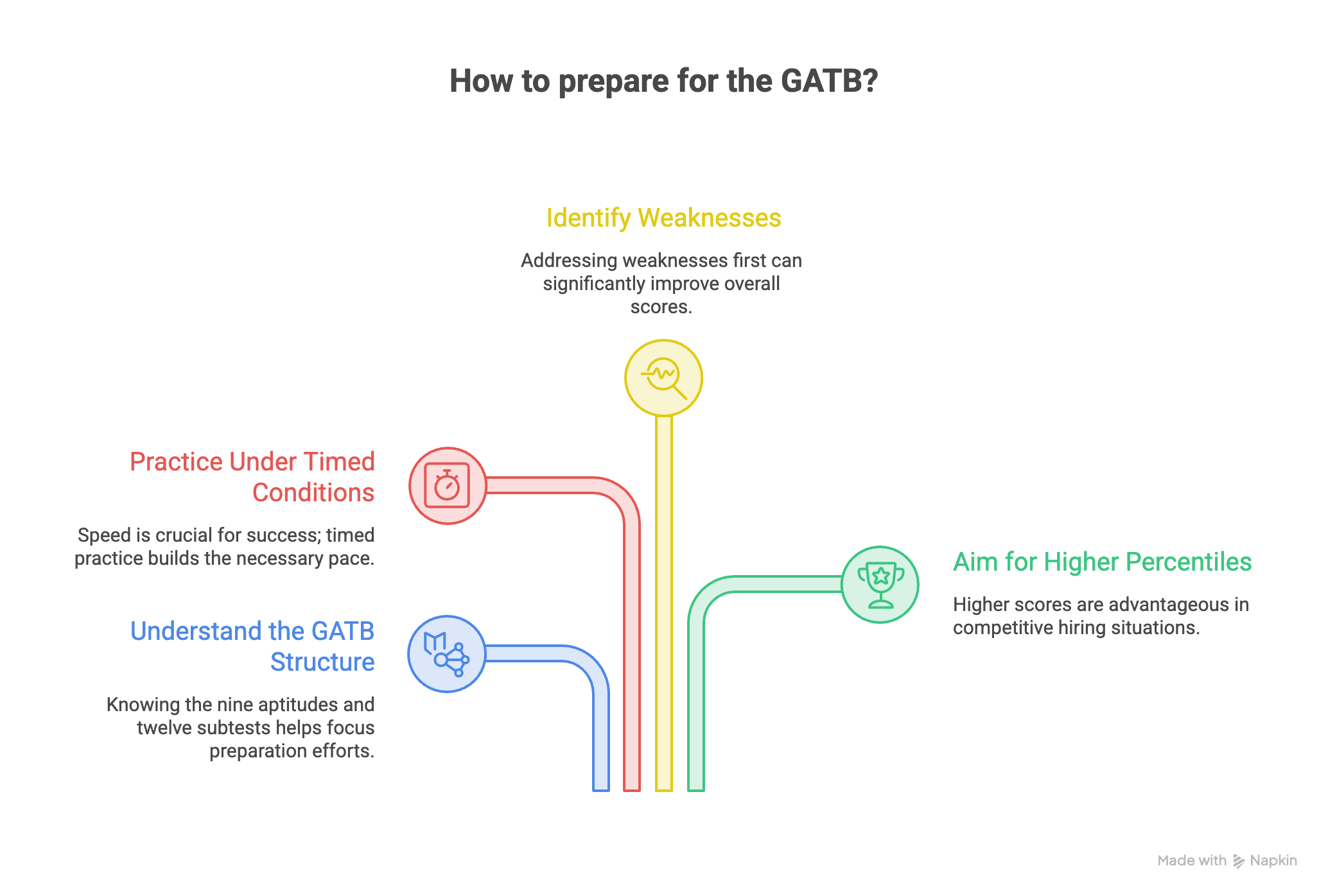
What Actually Drives Performance on Each Section
Verbal Aptitude (Vocabulary Subtest)
The Vocabulary subtest rewards breadth of word knowledge — the same crystallized ability that IQ vocabulary subtests measure. The most reliable way to improve this is systematic vocabulary training with targeted exercises that expand your vocabulary and enhance comprehension skills. GRE-level word lists are appropriate for this purpose. Read widely from diverse sources — broadsheet newspapers, quality nonfiction, and academic writing all expose you to the range of vocabulary the test draws on. Numerical Aptitude (Computation and Arithmetic Reasoning)
The Computation subtest is a pure speed test — you have roughly 45 seconds per item, and accuracy under time pressure is the bottleneck. The arithmetic involved is secondary school level: addition, subtraction, multiplication, division, fractions, decimals, and percentages. The challenge is doing it fast and without errors. Practice mental arithmetic until basic calculations are reflexive. For Arithmetic Reasoning, the challenge is rapid translation of word problems into equations — practice identifying the key variables in a problem description and writing the equation before calculating. Spatial Aptitude (Three-Dimensional Space Subtest)
This is consistently the hardest subtest for candidates without prior exposure to spatial tasks, and the one where preparation makes the most difference. Most candidates who fail the GATB do so because they hit a wall in the Spatial Relations section — the area where winging it simply doesn't work. The task requires mentally folding a flat pattern into a three-dimensional object and selecting which of four answer options it produces. This is a trained skill. Ace spatial relations questions, including folding and rotating exercises, through detailed step-by-step practice using net folding exercises specifically. Paper folding practice — physically fold paper cutouts and compare the results to mental predictions — is one of the most effective preparation methods because it provides immediate feedback on spatial predictions. Form Perception and Clerical Perception
These are perceptual speed tasks where accuracy is the primary variable and speed is built through practice. For Name Comparison, practice with timed comparison drills — pairs of similar-looking names, numbers, and codes, compared for differences under time pressure. The most common errors are missing single-character differences in otherwise similar strings. Slowing down by one second per item and checking each character position systematically dramatically reduces errors without costing enough time to significantly impact total score.
The Psychomotor Subtests
The pegboard tasks are the most unusual component for candidates coming from academic backgrounds. Physical practice with pegboards or similar fine motor tasks in the weeks before the test improves performance meaningfully because these tasks respond to repetition. Tasks that involve sorting small objects, handling coins rapidly, or assembling small components all exercise the same finger dexterity systems the pegboard tasks assess. If you have access to a pegboard practice kit, use it. If not, activities requiring rapid, precise manipulation of small objects are reasonable substitutes.
The Timing Reality: Speed Is the Core Constraint
The most important tactical insight about the GATB is that most candidates fail not because they can't solve the problems, but because they can't solve them fast enough. Almost every subtest is highly speeded. This has two implications. First, preparation must happen under timed conditions from the beginning — not in the last week. Every practice session for the cognitive and perceptual subtests should be strictly timed. Practicing without a clock builds comfort with the content but trains you to work at the wrong pace. The psychological experience of a time limit is itself a variable that needs to be habituated.
Second, spending too long on any single item is always the wrong decision. Focus on quality practice with deliberate attention to error analysis, concept mastery, and progressive skill development — but in a timed testing context, a 90-second perfect answer is worth the same as a 20-second correct answer and costs you four additional attempted items. Guessing and moving forward is almost always the better strategy once you have exceeded 30–45 seconds on any item.
A Preparation Timeline
Four to six weeks out: Take a full diagnostic practice test under real time conditions. Identify your weakest aptitudes — typically spatial and one of the numerical subtests for most candidates — and begin concentrated work on those areas. Vocabulary building should start immediately if verbal is a weakness; word knowledge accumulates slowly and benefits from the longest preparation window.
Two to three weeks out: Add daily timed practice for your target subtests. For spatial, this means daily net-folding and rotation exercises. For numerical, this means daily computation drills and arithmetic reasoning word problems. For clerical, this means daily comparison drills.
One week out: Add full timed practice tests. Simulate the complete 2.5-hour administration at least once, including the psychomotor sections if you have access to practice materials for those. Review your error patterns — not just which questions you got wrong, but why. Errors from misreading the question, errors from concept gaps, and errors from time pressure require different corrective approaches.
Final days: Light review only. Rest, sleep adequately, and eat before the test. The cognitive performance research I've covered elsewhere in this series is directly applicable: sleep deprivation and low blood glucose suppress processing speed and working memory — exactly the capacities the GATB's timed subtests most directly tax.
The Takeaway
The GATB is a multi-domain aptitude battery that rewards systematic preparation across three distinct skill areas: cognitive (verbal, numerical, and general reasoning), perceptual (spatial, form, and clerical), and psychomotor (motor coordination, finger dexterity, and manual dexterity). The cognitive subtests measure the same constructs as professional IQ batteries — verbal intelligence, numerical reasoning, and spatial visualization — and respond to the same preparation approaches that work for those instruments.
The defining challenge of the GATB is not difficulty but speed. Every timed subtest requires you to work significantly faster than untimed preparation would train. Starting timed practice early, identifying your weakest aptitudes first, and understanding which score thresholds your target occupation requires are the three decisions that most determine how your preparation translates into your final score.
If you want to understand your underlying cognitive profile across the verbal, numerical, and spatial domains before beginning your GATB preparation — and identify which aptitudes are already strong and which need the most work — the RIOT gives you a domain-level baseline that makes your preparation considerably more targeted than generic practice alone.
References
EBSCO Research Starters. General Aptitude Test Battery (GATB) — structure, history, and 12-subtest format. https://www.ebsco.com/research-starters/health-and-medicine/general-aptitude-test-battery-gatb iResearchNet / Counseling Psychology. General Aptitude Test Battery — nine aptitude scores, composite validity, and career assessment use. https://psychology.iresearchnet.com/counseling-psychology/career-assessment/general-aptitude-test-battery/ Grokipedia. General Aptitude Test Battery — development history, nine aptitudes, OAP framework. https://grokipedia.com/page/General_Aptitude_Test_Battery CareerShodh / Dr. Balaji Niwlikar. (2024). General Aptitude Test Battery (GATB) and Its 9 Important Sub-Tests. https://www.careershodh.com/general-aptitude-test-battery-gatb/ Practice Test Geeks. (2026). GATB Aptitude Test — 7 Tips to Know for Success. https://practicetestgeeks.com/gatb-aptitude-test-7-tips-to-know-for-success Complete Test Preparation Inc. (2026). General Aptitude Test Battery GATB Practice Questions — Canadian benchmarks and 90th percentile strategy. https://test-preparation.ca/general-aptitude-test-battery-gatb-practice-questions/ Complete Test Preparation Inc. General Aptitude Test Battery GATB Study Guide — vocabulary, spatial relations, and problem-solving coverage. https://test-preparation.ca/product/general-aptitude-test-battery-gatb/ Sage Reference / Encyclopedia of Career Development. General Aptitude Test Battery (GATB) — USES development history, Ability Profiler transition. https://sk.sagepub.com/ency/edvol/download/careerdevelopment/chpt/general-aptitude-test-battery-gatb.pdf
Take our professional IQ test
Want to know your IQ? Try the first ever professional online IQ test.
AuthorDr. Russell T. WarneChief Scientist
