Jul 14, 2026·Famous People & IQWhat Is Erling Haaland's IQ? What the Science Actually Says
Wondering about Erling Haaland's real IQ score? We debunk the fake numbers and explore his elite attentional fitness. Read more and try the RIOT test!
Dr. Russell T. WarneChief Scientist
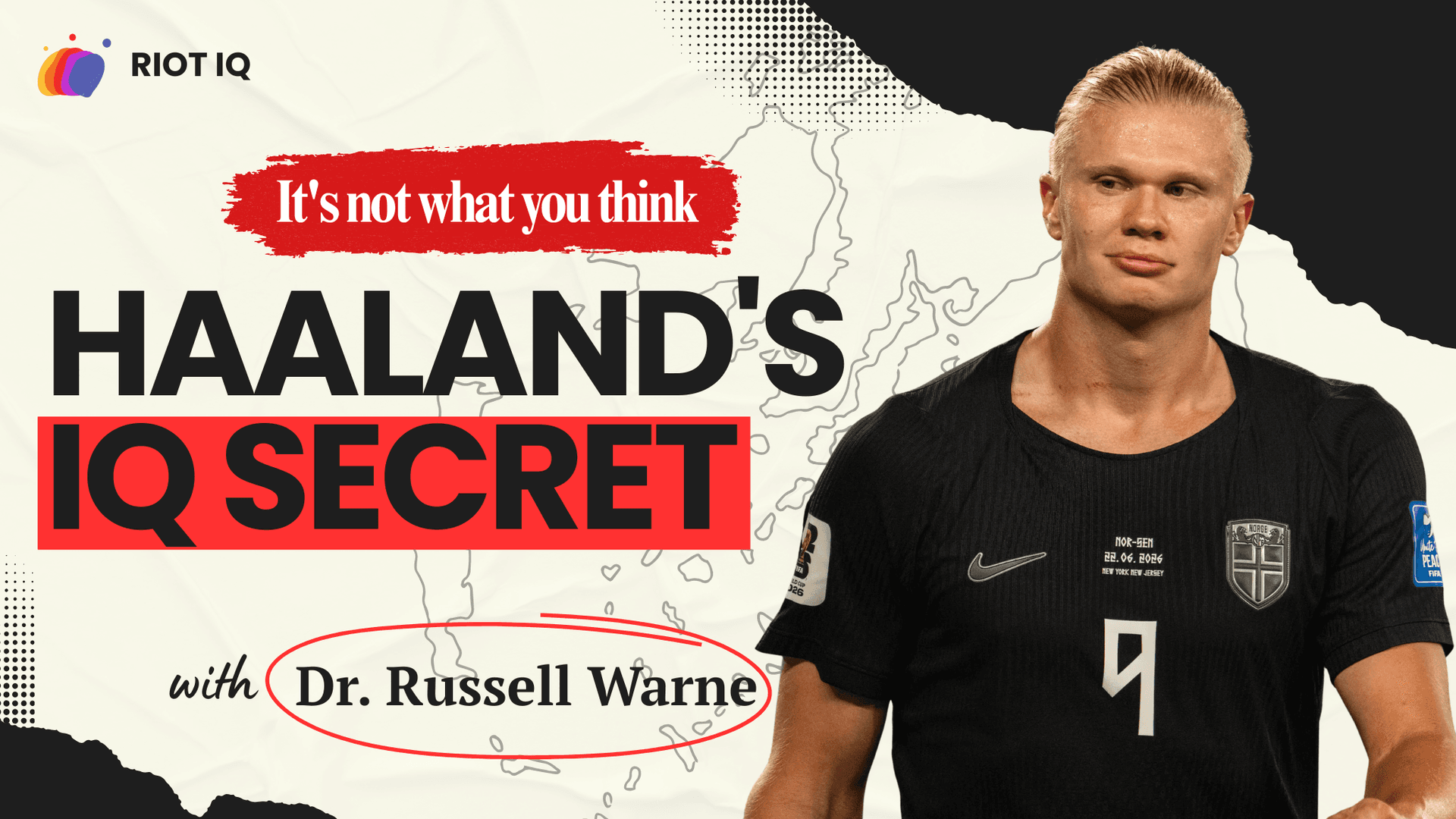
Erling Haaland has just finished the most statistically remarkable debut World Cup by any player in over 50 years. Seven goals in Norway's run to the quarterfinals at the 2026 FIFA World Cup — the most by a player in their debut tournament since Poland's Grzegorz Lato in 1974. He scored more goals in this tournament alone than Messi, Mbappé, and Ronaldo combined in their respective debut World Cups. His 39% conversion rate from 18 shots is the best in a single tournament since Gary Lineker in 1986. Norway exited in the quarterfinals to England — eliminated by a heartbreaking scoreline after Sørloth controversially chose to shoot rather than pass to a wide-open Haaland in a position to double the lead — but nothing about the tournament diminished what Haaland demonstrated. Which brings us back to the question: what does cognitive science actually say about his intelligence?
What We Don't Know: The Online Numbers Are Invented
Let me establish the baseline fact immediately. No verified, publicly documented IQ score exists for Erling Haaland. The figures that appear on celebrity IQ aggregator websites — ranging from 100 to 145 depending on the source — have no psychometric basis. They are estimates derived from behavioral observation, biographical inference, or simple fabrication, not from standardized testing under controlled conditions. A single verified score from a validated instrument has never been publicly linked to him, and treating any specific number as fact misrepresents both Haaland and how IQ measurement works.
What the research can support is an examination of the specific cognitive capacities that Haaland's documented performance implies — which turns out to be considerably more interesting than any single number.
The Cognitive Architecture of What He Actually Does
The popular reading of Haaland is that he is a physical specimen who runs fast, is tall, and scores goals. That reading is wrong, and analytically lazy. The tactical cognition required to consistently find scoring positions in elite soccer is immense. What looks simple in its output — get in the box, receive, score — is extraordinarily complex in its process. Haaland's movement patterns reveal sophisticated spatial processing. He reads defensive lines to time runs at the precise moment that avoids offside while maximizing separation from markers. He identifies which defenders are ball-watching and exploits their lapses with positioning changes that happen two or three seconds before the pass arrives. He selects finishing techniques — power, placement, headers, one-touch finishes — based on rapid assessment of goalkeeper position and defensive coverage. This is multi-variable spatial computation running in real time, under pressure, against opponents who have specifically prepared to prevent it. His World Cup conversion rate of 39% from 18 shots reflects something beyond physical ability. Haaland is averaging a goal every 14 touches in this tournament — the fewest of any player who has scored three or more goals in a single tournament in the last 60 years. That efficiency is not random. It reflects an exceptionally high signal-to-noise ratio in the decisions he makes about when to shoot, from where, and with what technique. Indiscriminate shooting doesn't produce a 39% conversion rate. Extraordinarily precise situational assessment does.
Attentional Fitness and the Elite Striker Profile
The most directly relevant cognitive framework for understanding Haaland comes from sport psychology. At this World Cup, researchers and commentators have consistently grouped Haaland with Mbappé and Kane under the umbrella of attentional fitness — the capacity to maintain multi-source attentional control under pressure, lock into the moment when it matters most, and seamlessly shift between tasks. Strikers like Haaland maintain attentional control under pressure in ways that reliably distinguish elite performers from merely excellent ones. This capacity overlaps with what standard IQ batteries measure through processing speed and working memory subtests — but it also extends into the domain of domain-specific spatial cognition and pressure-response regulation that clinical batteries don't directly assess. A World Cup quarterfinal with Norway's historic run on the line, against England, at 25 years old, is not a context where attentional fitness is easy to maintain. Haaland scored and led his team to within minutes of a semifinal. The cognitive regulation required for that is real and documented.
The 2025 PNAS study I've cited across this series — which used AI to distinguish elite soccer players from the general population with 97% accuracy based on cognitive and personality features — identified heightened planning and memory capacities, enhanced cognitive flexibility, and above-average openness to experience as the consistent features of elite players. Haaland fits every dimension of that profile, and he does so at the extreme end of one of the most elite groups ever studied.
What His Preparation Tells Us
One aspect of Haaland's profile that tends to be underreported but cognitively significant is his approach to preparation. He incorporates meditation and visualization into his preparation routine as tactical cognitive tools — not as superstitious rituals, but as deliberate mechanisms for building pattern recognition for game scenarios and embedding movement sequences into automatic processing. Visualization during meditation helps build the kind of pre-loaded motor programs that allow a striker to execute under pressure without consuming the working memory resources that pressure-induced anxiety would otherwise drain. This is also the same principle that underlies Ronaldo's dark-room experiment: experts automatize the motor execution of complex skills to the point where the physical execution requires minimal conscious cognitive resource, freeing working memory for real-time game reading. Haaland's meditation and visualization practice is a deliberate effort to accelerate that automatization process. The fact that he understands the cognitive basis of his own preparation and systematically optimizes it is itself a meaningful signal about the quality of his metacognitive self-awareness.
His 174 goals in 199 career matches across Manchester City and previous clubs, at an 0.87 goals-per-match rate, reflect consistency that transcends individual opposition quality, form cycles, or tactical context. Consistency at that level requires not just physical quality but cognitive reliability — the ability to produce optimal decision-making output across wildly varying contexts, opponents, and pressure environments. That's a cognitive achievement as much as a physical one.
The Leadership Development Angle
One dimension of Haaland's profile at this World Cup that has been widely noted by those who know him longest is leadership development — and from a cognitive science perspective, this is worth examining on its own terms.
Former Norway striker Jan Åge Fjørtoft, who played with Haaland's father at the 1994 World Cup, described it directly: "He's always been very popular in the different dressing rooms he's been in. The leadership has always been brilliant." The cognitive science of leadership maps onto executive function — the capacity to read interpersonal dynamics, regulate one's own affect in high-stakes environments, and communicate in ways that build collective motivation. These are not the domains that standard IQ tests directly assess, but they are the domains that the 2025 PNAS elite player profile identified as distinctive features of elite footballers, particularly in the personality dimensions of agreeableness, conscientiousness, and openness. Haaland's own framing of his relationship to pressure is cognitively self-aware in an unusual way for a 25-year-old professional athlete: "I like the pressure — I would put a lot of pressure on Erling Haaland if I wasn't Erling Haaland myself." That's third-person self-appraisal under competitive pressure — a form of metacognitive distancing that sport psychologists associate with reduced performance anxiety and more accurate self-monitoring. It's not a throwaway quote. It's a window into how he cognitively processes his own role.
What a Reasonable Estimate Looks Like
Without verified psychometric data, any specific IQ number assigned to Haaland is speculation. What the available evidence does support is a cognitive profile consistent with well-above-average executive function, exceptional domain-specific spatial processing, strong attentional regulation under pressure, and a metacognitive self-awareness that is unusual even among elite athletes.
In terms of the proxy-based estimation approach used by researchers like Simonton for historical figures — inferring cognitive capacity from behavioral and biographical indicators — Haaland's profile suggests someone operating comfortably above the population average on the cognitive dimensions most relevant to his performance. The elite player research places the general cognitive profile of players like Haaland well above the population mean on executive function measures, though not necessarily at the extreme upper end of general fluid intelligence distributions that would correspond to FSIQ scores above 130.
A reasonable behavioral inference — and I want to be clear this is inference, not measurement — would place Haaland in the above-average to high-average range on general intelligence, with a specific profile of exceptional spatial-attentional processing that substantially exceeds what a standard FSIQ composite would capture. His domain-specific cognitive excellence is one of the clearest examples in current sport of the distinction I draw throughout this series between general intelligence as measured by IQ tests and domain-specific cognitive mastery as demonstrated by elite real-world performance.
The Takeaway
Erling Haaland's IQ is unknown. No verified score exists. What is documented — through one of the most statistically exceptional debut World Cup performances in half a century, through analytical frameworks derived from peer-reviewed sport psychology research, and through the observable consistency of his cognitive preparation approach — is a profile of spatial, attentional, and metacognitive capacity that operates at the extreme upper end of what elite sport science has studied. That profile is real, meaningful, and grounded in evidence. A specific number attached to it would be speculation dressed as data.
What the 2026 World Cup confirmed is that Haaland's cognitive game — not just his physical one — is operating at a level that justifies the extraordinary statistics his career has produced. The quarterfinal exit hurts. The cognitive profile that produced seven goals on the world's biggest stage does not diminish with a single lost match.
If you want to understand where your own cognitive profile sits — across the spatial, attentional, and executive function domains that Haaland demonstrates at an elite level — the RIOT gives you a systematic, evidence-based measurement that no celebrity IQ list can provide.
References
Brooklyn Eagle / Scientific American. (2026). How Mbappé, Haaland and Messi use psychology to stay sharp at the World Cup. https://brooklyneagle.com/401863/how-stars-use-their-brains-to-gain-edge-at-the-world-cup/ Sport Personalities. (2026). Erling Haaland: The Record-Breaker — Cognitive Profile and Athletic Personality. https://sportpersonalities.com/articles/the-record-breaker/athlete-personality/erling-haaland-personality/ PubMed Central / PNAS. (2025). Decoding the elite soccer player's psychological profile. https://pmc.ncbi.nlm.nih.gov/articles/PMC11760505/ Frontiers in Psychology / PubMed Central. (2025). A scoping review of empirical research on executive functions and game intelligence in soccer. https://www.ncbi.nlm.nih.gov/pmc/articles/PMC11994698/ FotMob. (2026). Erling Haaland — 2025/2026 Season Statistics. https://www.fotmob.com/players/737066/erling-haaland
Take our professional IQ test
Want to know your IQ? Try the first ever professional online IQ test.
AuthorDr. Russell T. WarneChief Scientist
