Jul 2, 2026·Famous People & IQ

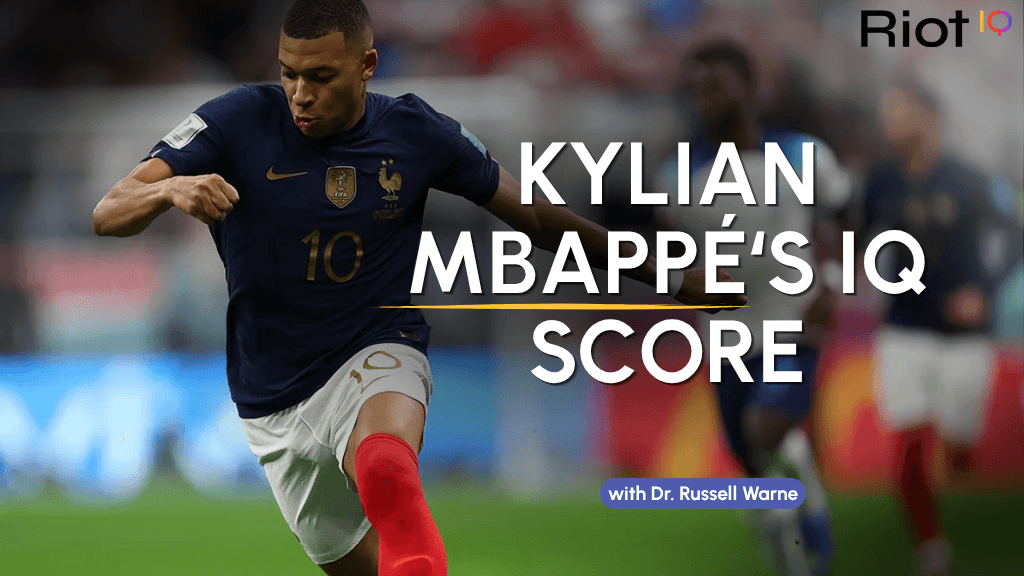
What Is Kylian Mbappé's IQ?

Wondering about Kylian Mbappé's real IQ score? We debunk the fake numbers and explore his elite attentional fitness. Read more and try the RIOT test!

Dr. Russell T. WarneChief Scientist
Share
What Is Kylian Mbappé's IQ?
At 27 years old, Kylian Mbappé is already rewriting the record books at the 2026 FIFA World Cup. He became France's all-time leading international goalscorer with a brace against Senegal in the group stage opener, overtaking Olivier Giroud on 58 goals. He then added more in consecutive matches, surpassing Gerd Müller for third place on the all-time World Cup scoring list and accumulating the most knockout-stage goals in World Cup history. He is the all-time leading scorer in World Cup finals with four goals across two deciders. He is doing this at 27, which is an age at which most elite strikers haven't yet entered their peak.

The question that follows him is the same one that follows Messi and Ronaldo: what does cognitive science actually say about his intelligence? Has he taken an IQ test, and what is his IQ score? I'll give that question the same honest treatment I've given the others, starting with what the evidence doesn't support.


What We Don't Know: The Fabricated Numbers


No verified, publicly documented IQ score exists for Kylian Mbappé. None. Figures circulating online range from 103 to 200 depending on the source, generated by unvalidated online tools or invented wholesale. The variation alone tells you everything: none of these figures come from a standardized clinical battery administered under controlled conditions. They are not data. Treating them as such misrepresents psychometrics and misleads anyone trying to understand what intelligence research actually says about elite athletes.

What the evidence can support is an examination of the specific cognitive capacities that Mbappé's documented performance implies.


Attentional Fitness: The Cognitive Core of His Game


The most precise framework I've seen applied to Mbappé's cognitive profile in the sport psychology literature is what researchers call attentional fitness, or the cognitive efficiency required to maintain focus, manage multiple sources of attention simultaneously, and execute under pressure without freezing. Elite goal scorers are celebrated for their "coolness" and on-the-ball craft, but it is their psychological intelligence that makes them special. One of the first skills to break under pressure is the ability to focus. Strikers like Mbappé maintain attentional control under conditions that reliably degrade performance in less cognitively developed players.

This attentional capacity is distinct from what a standard IQ battery measures but overlaps meaningfully with it. Working memory, or the ability to hold and manipulate multiple pieces of information simultaneously, underpins both the kind of focus that attentional fitness describes and the kind of executive processing that IQ subtests like digit span and letter-number sequencing assess. Mbappé's ability to track defenders, read a pass, adjust his run, and finish cleanly in a fraction of a second reflects working memory deployment at an elite level. What separates him from players with comparable physical gifts is, in large part, cognitive: the ability to process more information faster and act on it more accurately.


The Academic Profile and Multilingual Capacity


One data point about Mbappé that rarely makes it into football discussions is relevant here. As a child attending a private Catholic school in Bondy, he was considered academically gifted. At 15, he began taking Spanish lessons deliberately, not because a club required it, but because he understood that international football would demand it. He is now fluent in French, English, and Spanish, with working knowledge of Italian and Portuguese.

This is not a trivial observation. Mbappé views multilingualism as a deliberate professional tool, and his linguistic ambition doesn't stop at the "Big Three." His multilingual capacity, particularly the disciplined, proactive acquisition of languages outside his native environment, reflects the kind of cognitive flexibility and learning efficiency that the intelligence literature associates with above-average executive function. The cognitive benefits of multilingualism are well-documented: bilingual and multilingual individuals consistently show advantages on executive control tasks, particularly cognitive flexibility and attention switching, which are precisely the capacities that define high-level playmaking.


What the Broader Elite Player Research Predicts


The 2025 PNAS study I've referenced across this series, which used AI to distinguish elite football players from the general population with 97% accuracy based on cognitive and personality features alone, establishes a baseline for what Mbappé's profile almost certainly contains. Elite players demonstrate heightened planning and memory capacities, enhanced cognitive flexibility, and reduced neuroticism. Mbappé, operating at the top of that cohort at an unusually young age, is consistent with that profile by every observable behavioral measure.

The research on tactical creativity is also relevant here. Tactical creativity is a key driver of the cognitive skill set that allows players to see several moves ahead. Modern football stars not only play soccer on a different level, but also think soccer on a different level. Watching Mbappé's movement off the ball, such as the curved runs, the delayed accelerations, the spatial positioning that consistently places him a half-step ahead of defensive lines, is watching multi-variable spatial computation in real time. The fact that he is doing this more effectively at 27 than he did at 19 suggests an executive function base that continues to develop, consistent with the neuroscience literature showing that prefrontal-dependent capacities mature into the late 20s.


What the Number Can't Tell You


The same caveat I applied to Messi and Ronaldo applies here: nothing about Mbappé's football performance allows us to derive a specific IQ number with any confidence. Executive functions correlate with each other but correlate less with general IQ, meaning that someone's working memory, cognitive flexibility, and attentional capacity can be substantially above average even when performance on traditional IQ subtests is not exceptional. A Full Scale IQ score captures some of what Mbappé demonstrates cognitively, but not all of it, and the parts it misses, particularly the domain-specific spatial and attentional processing built through thousands of hours of elite football, are precisely what make his performance distinctive.

What the evidence does support is a cognitive profile consistent with well-above-average executive function, strong attentional regulation, deliberate multilingual investment reflecting high learning efficiency, and the kind of spatial processing that the 2025 elite player research identifies as a distinguishing feature of this cohort.


The Takeaway


Mbappé's IQ score is unknown, and the figures online are not data. What is documented is a cognitive profile that places him at the upper end of the abilities most directly relevant to elite football, attentional fitness, working memory, cognitive flexibility, and spatial anticipation, combined with an off-pitch intellectual profile that is unusually deliberate for a professional athlete his age. At 27, with the 2026 World Cup still unfolding and the all-time scoring record within reach, what Mbappé is demonstrating is the convergence of elite physical and cognitive development at the same moment. The science doesn't reduce that to a number. But it can describe it, and what it describes is exceptional.

If you want to understand where your own cognitive profile sits across the domains that matter for a rigorous measure of intelligence, the RIOT gives you a systematic answer that a leaderboard never will.


References


  1. Fox Sports. (2026). Tracking Every Kylian Mbappé Goal At The 2026 World Cup. https://www.foxsports.com/stories/soccer/2026-world-cup-can-kylian-mbappe-break-all-time-goalscoring-record

  2. Scientific American. (2026). How Mbappé, Haaland and Messi Use Psychology to Stay Sharp at the World Cup. https://www.scientificamerican.com/article/how-mbappe-haaland-and-messi-use-psychology-to-stay-sharp-at-the-world-cup/

  3. Wikipedia. Kylian Mbappé — Biography and Career. https://en.wikipedia.org/wiki/Kylian_Mbapp%C3%A9

  4. Metro League. (2026). Can Kylian Mbappé Speak English? Multilingualism and Professional Foresight. https://www.metroleague.org/can-kylian-mbappe-speak-english/

  5. PubMed Central / PNAS. (2025). Decoding the elite soccer player's psychological profile. https://pmc.ncbi.nlm.nih.gov/articles/PMC11760505/

  6. ESPN. (2026). Kylian Mbappé scores stunner, breaks France goal record in Senegal win. https://www.espn.com/soccer/story/_/id/49084969/kylian-mbappe-breaks-goal-record-france-kick-world-cup-senegal-win

  7. Frontiers in Psychology / PubMed Central. (2025). A scoping review of empirical research on executive functions and game intelligence in soccer. https://www.ncbi.nlm.nih.gov/pmc/articles/PMC11994698/

Take our professional IQ test

Want to know your IQ? Try the first ever professional online IQ test.

Author
Dr. Russell T. WarneChief Scientist

Contact