What was Muhammad Ali's IQ? He really did fail the Army's 1964 qualifying test, then joked about it. Here is what the score meant and what it did not.
Dr. Russell T. WarneChief Scientist
Share
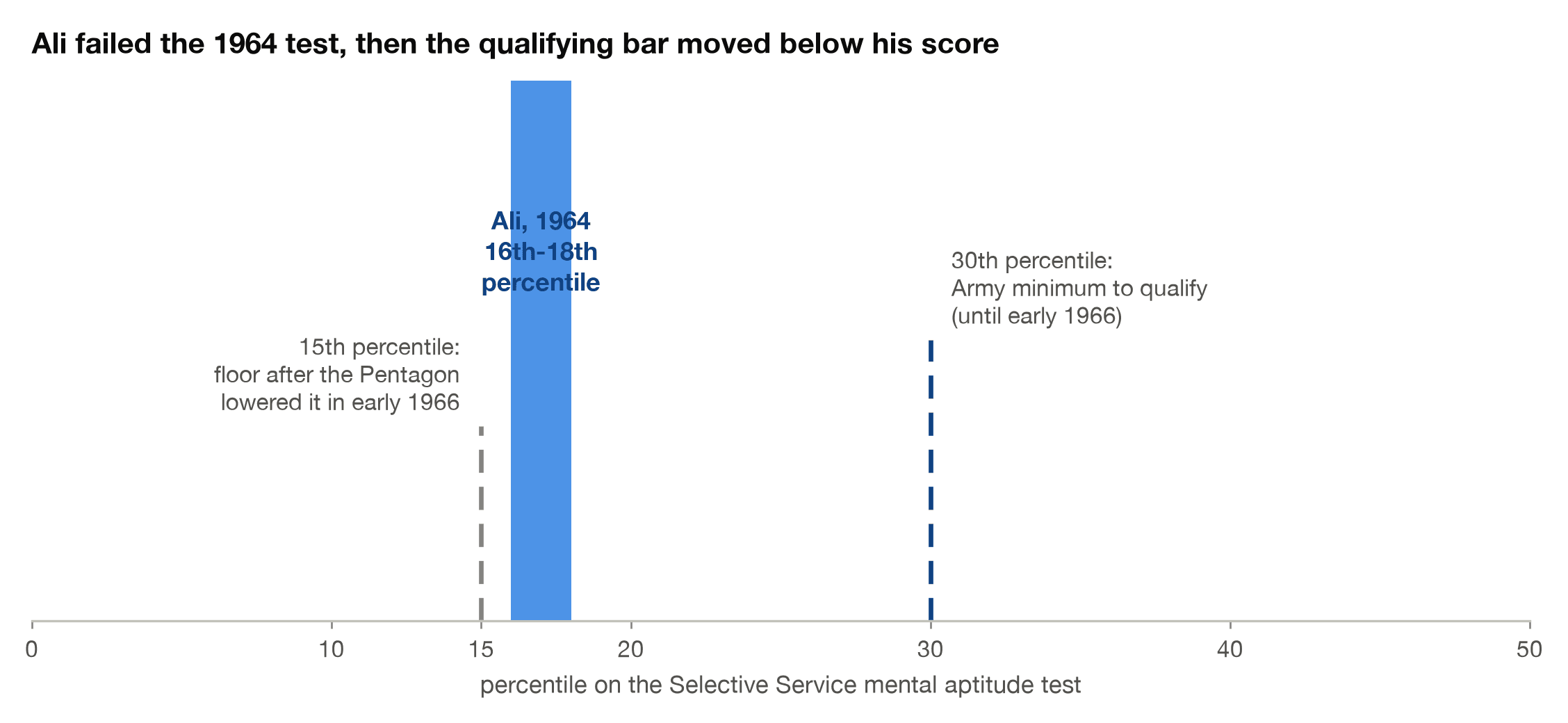
Muhammad Ali is one of the few celebrities whose record contains a real, documented cognitive test result. In 1964, the year he won his first heavyweight championship at age 22, he took the Selective Service's mental aptitude test and failed it, scoring between the 16th and 18th percentile, well below the 30th percentile the Army then required. The result is widely retold as an IQ of 78. His own verdict became one of his most famous lines: "I said I was the greatest, not the smartest." Here is what actually happened, what the numbers say, and what one 1964 screening can and cannot tell you about a mind like Ali's.
What happened in 1964
When Ali (then Cassius Clay) was examined for the draft, the qualifying mental test placed him between the 16th and 18th percentile, meaning that roughly five out of six test-takers scored higher. The Army's floor at the time was the 30th percentile, so he was initially classified as not qualified for induction. The military's qualification tests are genuine, "g-loaded" cognitive tests, meaning they draw heavily on general mental ability, and their scores predict training outcomes. The fail was real, and so was the test.
78 or 83? What the records actually say
The exact IQ number is messier than the legend. Decades of press coverage settled on 78, but historian Anthony O. Edmonds, working from FBI files, records that Ali "scored 83 on an IQ test administered by the Army." There is also a scaling wrinkle: on a modern IQ metric with a mean of 100 and a standard deviation of 15, the 16th percentile corresponds to roughly 85. The percentile facts are solid; the single-number IQ conversions are not, and honest accounts report the range rather than asserting 78.
1966: the Army lowers the bar
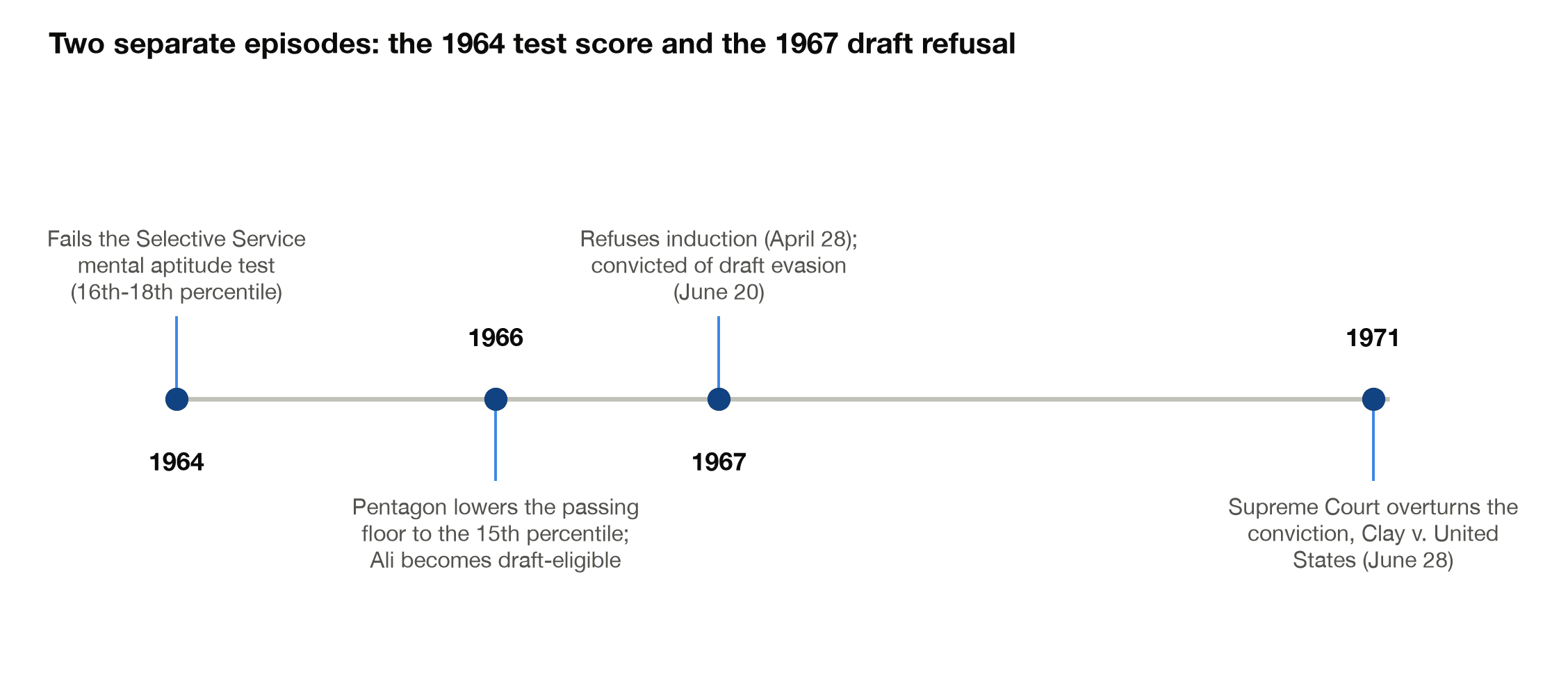
Ali's score never improved on record. What changed was the standard. In early 1966, with the Vietnam War escalating, the Pentagon lowered the mental-qualification floor from the 30th percentile to the 15th, and Ali's 1964-level performance suddenly counted as passing. He was reclassified as draft-eligible without ever retaking anything.
1967: refusal, conviction, and the Supreme Court
The draft refusal that defined Ali's public life was a separate episode from the test, though folklore often mashes the two together. On April 28, 1967, he refused induction into the armed forces on religious conscientious-objector grounds. On June 20, 1967, he was convicted of draft evasion, sentenced to five years in prison, fined $10,000, and banned from boxing for three years. The Supreme Court overturned the conviction in Clay v. United States, decided June 28, 1971. The low score kept him out of the Army; the refusal was a matter of principle after the rules changed.
What a percentile score does and does not tell you
A percentile score locates a person within a distribution of test-takers on one occasion. Well-built cognitive tests are reliable and predictive, and pretending otherwise would be bad psychology; our article on whether IQ tests are valid covers that evidence. But psychologists also distinguish a single group-administered screening from an individually administered assessment, and they read every score against the test-taker's background. Ali had such poor grades in 10th grade that he had to repeat the year, and a weak academic foundation depresses performance on any school-flavored test. A single 1964 group screening of a poorly schooled 22-year-old is a lower-bound snapshot, not a full accounting of a mind.
So was Ali smart?
The observers who knew his work thought the question answered itself. Biographer David Remnick described a hyperverbal performer whose wit ran ahead of everyone in the room, and Ali's ring career was built on strategy, psychology, and improvisation as much as speed. Verbal inventiveness and tactical brilliance are real cognitive work, even when they do not show up on a timed paper-and-pencil screening. The gap between Ali's tested percentile and his obvious quickness is a standing lesson in why context matters when reading any single score on the IQ bell curve.
Frequently asked questions
Did Muhammad Ali really score 78 on an IQ test?
He really did fail the Army's mental aptitude test in 1964, scoring between the 16th and 18th percentile. The exact IQ conversion is disputed: press tradition says 78, FBI files cited by historian Anthony Edmonds record 83, and the 16th percentile maps to roughly 85 on a modern IQ scale.
What did Ali say about his Army test score?
He turned it into one of his most famous lines: "I said I was the greatest, not the smartest." The quip is documented in contemporaneous coverage and retold in major biographies.
Why did Ali become draft-eligible in 1966?
Not because his score improved. In early 1966 the Pentagon lowered the passing floor from the 30th to the 15th percentile, which made his 1964-level score qualifying. He was reclassified as eligible and refused induction in 1967 on religious grounds.
Does Ali's test score mean IQ tests are wrong?
It means one group-administered screening of a man who had repeated 10th grade is a weak basis for judging a mind. Well-built IQ tests are reliable and predictive, but a single score under poor conditions is a snapshot, and Ali's verbal wit and tactical genius show why context matters.
What happened to Ali's draft conviction?
He was convicted of draft evasion on June 20, 1967, sentenced to five years, fined $10,000, and banned from boxing for three years. The Supreme Court overturned the conviction in Clay v. United States in June 1971.
The takeaway
Ali's 1964 result is a genuine data point and a poor summary of the man, which is exactly the tension a good test reader learns to hold. Modern assessment differs from a 1964 induction screening in every particular: individual administration, current norms, and stated confidence intervals around every score. If you want a number produced that way, the Reasoning and Intelligence Online Test reports modern deviation scores with stated precision; you can take the RIOT IQ test here.
References
1. Page, C. (2016, June 8). Ali was a deep thinker whom test scores belied. The Philadelphia Tribune. phillytrib.com
2. History.com Editors. (n.d.). Muhammad Ali refuses Army induction. History.com (A&E). history.com
4. Schmidt, F. L., & Hunter, J. E. (1998). The validity and utility of selection methods in personnel psychology. Psychological Bulletin, 124(2), 262-274. doi.org
5. Flynn, J. R. (1987). Massive IQ gains in 14 nations: What IQ tests really measure. Psychological Bulletin, 101(2), 171-191. doi.org
6. Warne, R. T. (2020). In the know: Debunking 35 myths about human intelligence. Cambridge University Press. doi.org
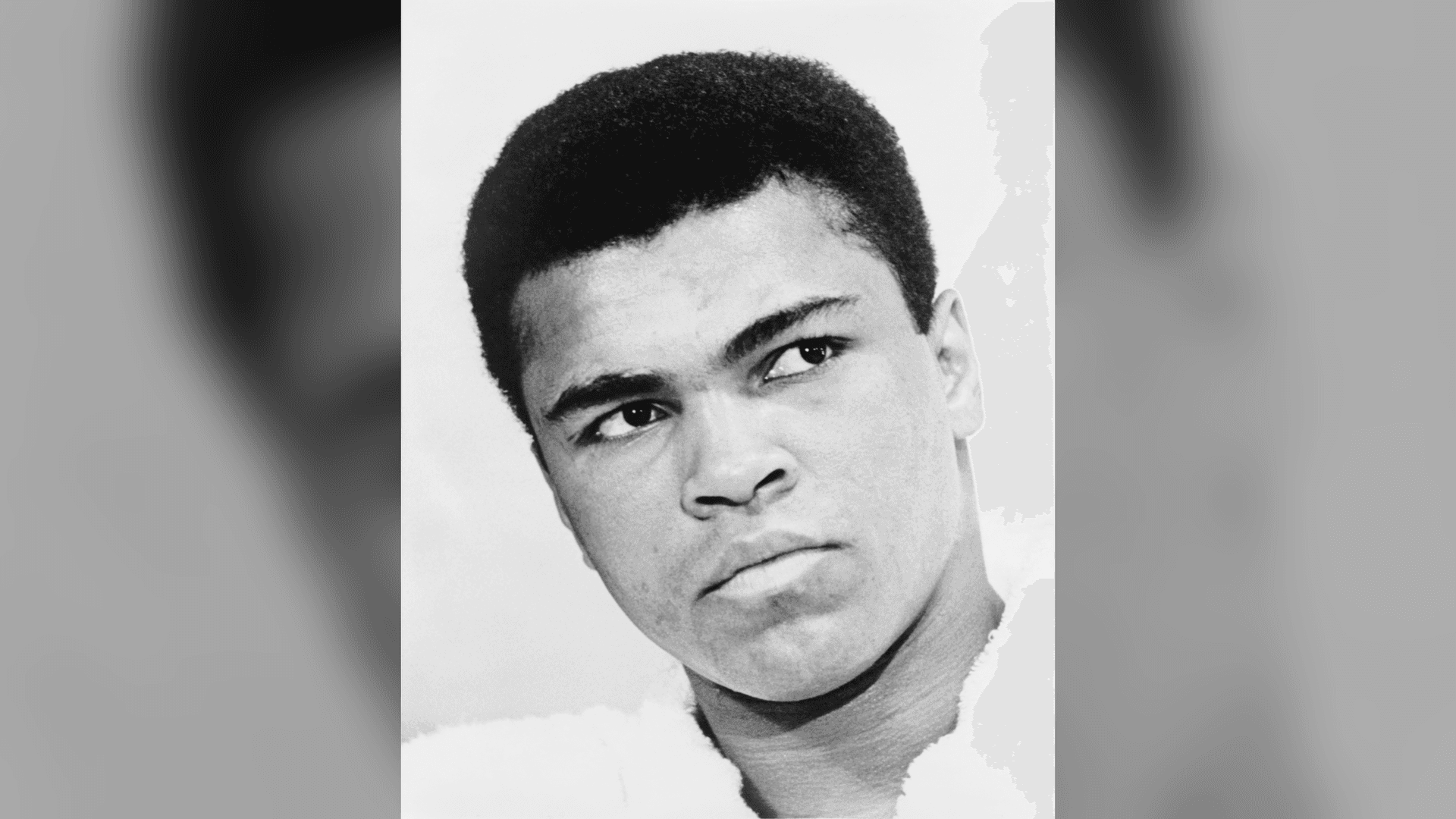
Hero image: Muhammad Ali by Ira Rosenberg, World Journal Tribune, 1967. Public domain, via Library of Congress / Wikimedia Commons.
Take our professional IQ test
Want to know your IQ? Try the first ever professional online IQ test.